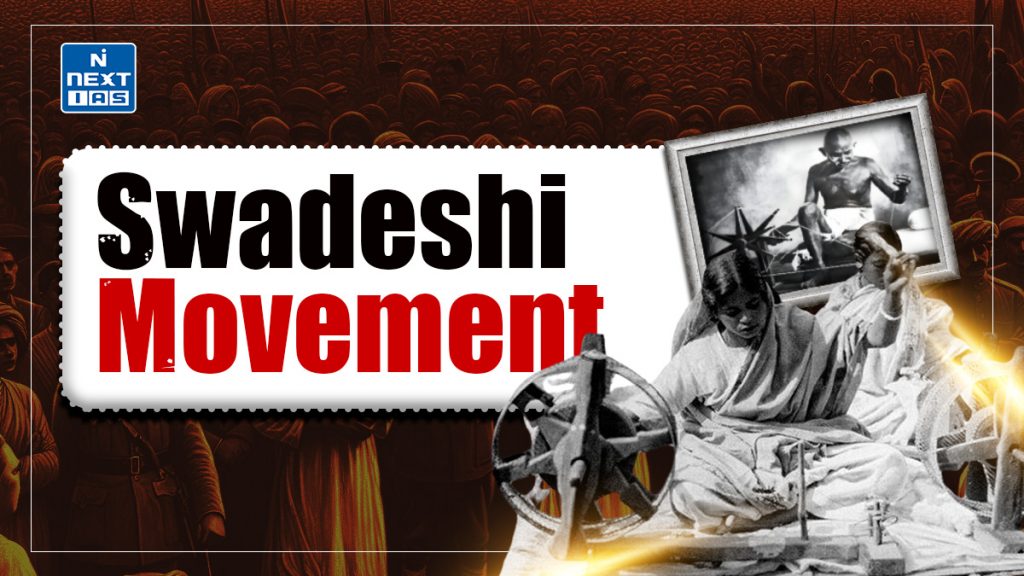
The purpose of the Swadeshi Movement was to attain self-rule in governance and economic independence. It is the first large-scale mass nationalist movement in India. It began in response to the partition of Bengal in 1905, to encourage Indians to boycott British goods and promote indigenous products as a means of economic independence. The key leaders in this movement were Lala Lajpat Rai, Bal Gangadhar Tilak, Vipin Chandra Pal, Arvindo Ghosh and Rabindra Nath Tagore.
The methods of protest in this movement were boycotting foreign goods, schools and courts. The promotion of Swadeshi led to the rise of textile mills, soap factories, and banks (e.g., Tata Steel, Bengal Chemicals). Established a national college, the National Council of Education, and Bengal National College in 1906. It shows the cultural resistance through the adoption of Vande Mataram as a theme song, Raksha Bandhan as a symbol of unity, and the use of traditional melas and festivals, such as Shivaji and Ganapati festivals, to spread the message.
In the impact of this movement, the rise of extremism and the annulment of the partition of Bengal in 1911 by the Britishers, and they were also forced to make constitutional changes in favour of indians.
About Swadeshi Movement
- The Swadeshi Movement began in 1905 as a response to the British partition of Bengal.
- It aimed to promote indigenous products and boycott British goods.
- While “Swadeshi” originally implied indigenisation, the movement grew to encompass broader objectives of self-reliance and national pride, fostering economic independence as a path toward political freedom.
Swadeshi Samaj
- In 1904, Rabindranath Tagore introduced the concept of Swadeshi Samaj as a self-reliant, national collective striving for autonomy without government dependency.
- Tagore’s vision emphasised rural development and modern technology, aiming for an empowered society resistant to Western political and cultural dominance.
Early Activities in Swadeshi Movement
- When the partition took effect on October 16, 1905, the people of Bengal marked it with public mourning and peaceful protests.
- The movement spread across India, with leaders like Bal Gangadhar Tilak (Poona), Lala Lajpat Rai (Punjab), and Chidambaram Pillai (Madras) mobilising their regions.
- The Indian National Congress, led by Gopal Krishna Gokhale, supported the movement and condemned British policies.
Rift Between Moderates and Extremists
- Differences soon surfaced between the Moderates and Extremists. The Moderates wanted to keep the movement within Bengal and use constitutional methods.
- At the same time, Extremists, led by Tilak and Aurobindo Ghosh, advocated for extending it nationwide and using mass protests to achieve Swaraj (self-rule). This tension later led to the Surat Split in 1907, weakening the Swadeshi Movement.
Leadership Shift to Extremists
- With the Moderate approach failing to yield results, the movement’s leadership shifted to the Extremists, who called for passive resistance and a boycott of British institutions.
- Leaders like Aurobindo Ghosh emphasised making the British administration difficult by rejecting all forms of British economic and political engagement.
Forms of Protest
- Boycott of Foreign Goods: People burned foreign-made items, refused foreign clothing in rituals, and promoted local products.
- Emergence of Samitis: Volunteer groups like Swadesh Bandhab Samiti in Barisal organised mass mobilisation efforts, training members in social service, crafts, and Swadeshi education.
- Use of Festivals: Tilak’s Ganapati and Shivaji festivals and folk theatre forms like jatras disseminated nationalist ideas and helped mobilise the masses.
- Atma Shakti and Self-Reliance: The movement promoted Atma Shakti (self-reliance) through social reforms and building national pride. Programs encouraged self-sufficiency in villages.
- Swadeshi and National Education: Educational institutions like Bengal National College and the National Council of Education promoted Indian-led education in local languages.
Swadeshi Enterprises and Cultural Renaissance
- The movement spurred the growth of Swadeshi industries like textiles, soap, and match factories and promoted Indian art and literature.
- Artists like Abanindranath Tagore and Nandlal Bose pioneered Indian art inspired by Mughal and Rajput traditions. Rabindranath Tagore’s song “Amar Sonar Bangla” stirred national pride.
Challenges and Weaknesses in Swadeshi Movement
Despite initial success, the Swadeshi Movement faced several setbacks:
- Government Repression: Leaders faced arrests, deportations, and suppression of media.
- Limited Mass Mobilization: The movement primarily attracted educated, upper-caste Hindus and urban communities, failing to include lower castes and the Muslim population.
- Split in Leadership: The Surat Split weakened the movement and diluted its leadership, causing disunity.
- Economic Limitations: Swadeshi products were often more expensive than British goods, limiting accessibility.
Conclusion
The Swadeshi Movement significantly impacted India’s nationalistic aspirations, fostering a spirit of self-reliance and patriotism. Although it waned by 1908 due to internal divisions and British repression, the movement pioneered mass mobilisation techniques and sowed seeds for future resistance, ultimately laying the groundwork for India’s struggle for independence.
FAQs about Swadeshi Movement
How did the Anti-Partition movement become a Swadeshi Movement?
The anti-partition movement against the partition of Bengal (1905) evolved into the Swadeshi movement as leaders advocated for self-reliance, boycotted foreign goods, and promoted Indigenous industries as a means of protest.
What was the cause of the boycott and Swadeshi Movement?
The immediate cause was the partition of Bengal by Lord Curzon in 1905, which was seen as an attempt to divide Indians on religious lines and weaken national unity.
Who started the Swadeshi Movement?
The Swadeshi movement was initiated by prominent leaders like Bal Gangadhar Tilak, Bipin Chandra Pal, and Lala Lajpat Rai, with solid support from the Indian National Congress.
What is the Swadeshi Movement?
The Swadeshi movement was a nationalist movement that encouraged using indigenous goods and boycotting foreign products to promote self-reliance and resist British economic exploitation.
Which two associations promoted the cause of Swadeshi during the anti-partition movement?
The Indian National Congress and the Swadeshi Samiti played key roles in promoting the Swadeshi cause during the anti-partition movement.