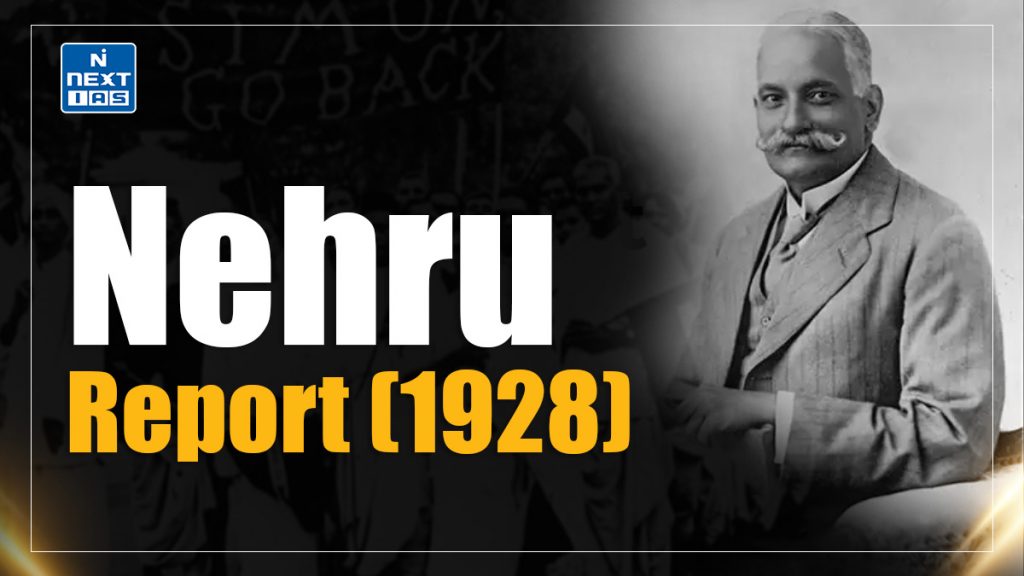
The Nehru Report was actually the 1st attempt to draft a constitution made by Indians in 1928. It was a direct outcome after the provocation by the British Secretary of State, Lord Birkenhead. He initially thought that the differences of ideologies among Congress, Muslim League and the Princely states would make it practically impossible to form a constitution draft.
The All-party Nehru report was chaired by Motilal Nehru. The report mentioned Dominion Status, Joint Electorates, Fundamental Rights and the Formation of Provinces on the linguistic criteria.
The demand for dominion status by Indians was to form a self-governing rule under British Commonwealth rather than demanding complete independence. It rejected separate electorates and advocated for a Joint electorate with reserved seats for minorities in Central and Province level.
The Draft mentioned 19 Fundamental Rights including Universal Adult Suffrage above 21 years and Equality before law.
The Britishers did not accept the report and in retaliation to it, the Congress hoisted the tricolor at Lahore on 31 December 1929 and declared January 26 as Independence Day.
About Nehru Report
- The Nehru Report was a significant development in the Indian freedom struggle that emerged as a response to the British-imposed Simon Commission, which was criticised for excluding Indian representatives.
- With no Indian participation in the Commission, Indian leaders took the initiative to present a unified framework for constitutional reforms that would reflect Indian aspirations.
- This led to the formation of a committee under Motilal Nehru’s chairmanship in 1928, and the subsequent proposal became known as the Nehru Report.
- The report outlined the way forward for India’s constitutional future, considering the Indian populace’s demands for self-governance and political representation.
Historical Background
- In 1919, the British government introduced the Government of India Act, which promised limited reforms in Indian governance.
- However, by 1927, it was clear that the reforms had failed to deliver the desired results for India’s political and economic needs.
- The Simon Commission, set up by the British government to review the implementation of the 1919 reforms, was criticised for not including a single Indian member, sparking widespread protests.
- In this political unrest and dissatisfaction climate, Indian political leaders decided to take matters into their own hands.
- They sought to develop a constitutional proposal that would address Indian aspirations while avoiding further delay from British authorities.
Key Recommendations of Nehru Report 1928
The Nehru Report made important recommendations to reform India’s political structure. These included:
- Dominion Status: The Nehru Report proposed that India should be granted Dominion Status as an immediate form of self-government.
- This was a significant shift from the complete independence that some leaders, including Jawaharlal Nehru and Subhash Chandra Bose, demanded.
- Dominion status meant that India would remain part of the British Empire but have self-governing powers.
- Federation of British India and Indian States: The report called for a federal structure to unite British India and the princely states.
- The Federation would consist of a central government and provincial governments with adequate powers allocated to each.
- Joint Electorates: A key element of the Nehru Report was the proposal for joint electorates with reserved seats for minorities, as opposed to the separate electorates that were in place at the time.
- This was aimed at fostering unity among communities, although it was met with strong opposition from some groups, especially the Muslims.
- Fundamental Rights: The report included provisions for nineteen fundamental rights designed to protect individual freedoms and safeguard the rights of various communities.
- These rights ensured that the Indian government would be based on democratic principles.
- Bicameral Legislature: At the central level of governance, a bicameral legislature comprising a Senate (elected for seven years) and a House of Representatives (elected for five years) was proposed.
- This was intended to create a more balanced representation of the people at the central level of governance.
- Universal Adult Suffrage: Universal adult suffrage was to be the basis for elections to the Provincial Councils and the House of Representatives.
- This meant that all adult citizens, regardless of caste, creed, or gender, would have the right to vote.
- Governor-General’s Role: The Governor-General would be required to act on the advice of the Executive Council, which would be responsible to the Indian Parliament.
- This was a step towards limiting the powers of the British representative in India.
- Formation of Linguistic Provinces: The report recommended the formation of linguistic provinces based on language groups, allowing people to have political representation in regions where they spoke the same language.
- Separation of State and Religion: A significant provision was the complete disassociation of the state from religion, which meant that religion would not influence government policies or the functioning of the state apparatus.
- Protection for Minorities: The Nehru Report also ensured complete protection for the cultural and religious rights of the Muslim minority. It sought to guarantee that their interests would be safeguarded in the new political order.
Public Reactions to the Report
While the Nehru Report represented a significant step toward constitutional reform, it was not accepted unanimously within Indian political circles.
Opposition from the Muslim League
The Muslim League, led by Muhammad Ali Jinnah, opposed the proposal, particularly the joint electorate system. Jinnah and the Muslim League were concerned that this would undermine the political power of Muslims, especially in Muslim-majority provinces.
Radical Nationalists’ Opposition
The radical nationalists, led by Jawaharlal Nehru and Subhash Chandra Bose, opposed the Nehru Report for different reasons.
- They believed that the demand for Dominion Status was insufficient and that India should immediately strive for complete independence from British rule.
- These leaders rejected the idea of Dominion Status, viewing it as a compromise that would not achieve true freedom for India.
The Congress Split
The Congress was also divided on the issue. While the moderate Congress leaders, led by Motilal Nehru, supported the report, the younger, more radical leaders, including Jawaharlal Nehru and Subhash Chandra Bose, were at odds with the proposed constitutional framework.
Delhi Proposals
The Delhi Proposals, agreed upon in December 1927, formed the basis of the Muslim League’s demands and called for separate electorates for Muslims, directly contradicting the joint electorate system proposed in the Nehru Report.
Independence for India League
Jawaharlal Nehru and other radical leaders founded the Independence for India League to oppose the Nehru Report. The League sought complete independence for India and rejected the Dominion Status as a viable option.
Political Impact
- The Nehru Report marked a turning point in India’s constitutional history. Although it did not achieve consensus, it highlighted the growing divide within the Indian freedom struggle between those willing to compromise for partial self-rule and those who sought complete independence.
- It also underscored the emerging political role of the Muslim League and the deepening divisions between Hindus and Muslims in the struggle for Indian self-rule.
- The failure of the Nehru Report to secure widespread approval signalled the limitations of seeking constitutional reforms through negotiations with the British.
- It also led to the further development of radical nationalist movements, which would play a crucial role in the coming years as India moved closer to the Civil Disobedience Movement under Mahatma Gandhi.
Conclusion
The Nehru Report was a significant but divisive document in the Indian independence movement. While it offered a detailed vision for India’s constitutional future, it failed to address the diverse aspirations of all sections of Indian society. The opposition from key groups, including the Muslim League and radical nationalists, made it clear that the path to Indian self-rule would be complex and fraught with challenges. However, the Nehru Report remains an important milestone in India’s journey toward self-governance, as it demonstrated the growing political maturity of Indian leaders and their commitment to framing an inclusive, democratic constitutional structure for the country.
FAQs about Nehru Report 1928
What is Nehru Report?
The Nehru Report, published in 1928, proposed a future constitution of India demanding self-government under dominion status within the British Empire.
Why was the Nehru Report rejected?
The Nehru Report was rejected by the Muslim League as it failed to address their demand for separate electorates and by radical nationalists who wanted complete independence instead of dominion status.
Who prepared the Nehru Report?
The Nehru Report was prepared by a committee led by Motilal Nehru, with contributions from prominent leaders like Tej Bahadur Sapru and Subhash Chandra Bose.