
 80813-00200
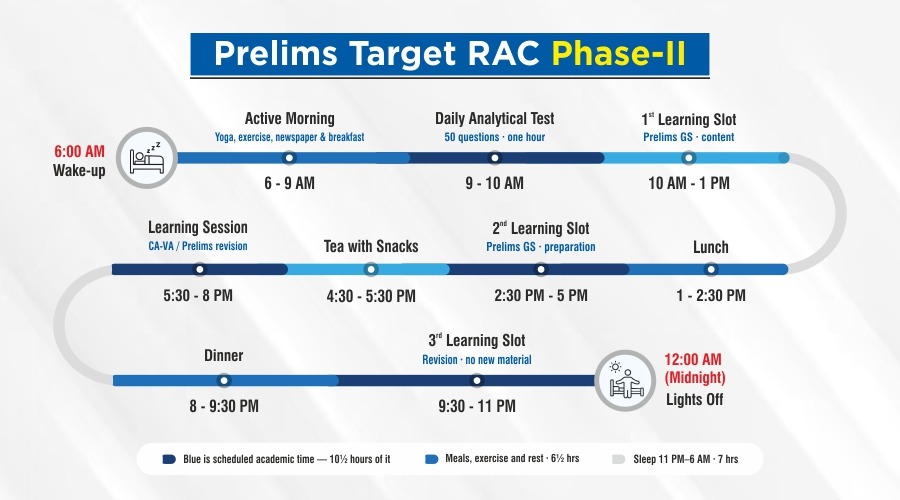


THREE ROOM TYPES. Same Campus, Same Services.
Choose Your Accommodation
Choose the room that fits your budget and how you work. What differs across types is roommates and bathroom sharing — not campus, not services, not academic access.
Note:
- Facility visits are open only to selected candidates. Once selected, you may visit the hostel before confirming your admission to see the layout, rooms, and other facilities first-hand.
- Hostel rent is payable quarterly in advance. A refundable caution deposit of Rs. 15,000 is due with the first instalment and will be refunded within 30 days of vacating the room, after clearance of dues and deduction for any damages.
- Students are not permitted to bring room heater (for safety purposes).
**Electricity charges will be applicable based on actual usage.**
Every room is furnished, air-conditioned, and has 24*7 power backup. Every student, whatever the room type, gets the same dedicated reading hall seat, the same mess access, and the same access to the on-call doctor, the counsellor and the parent portal. The room is where you sleep. The reading hall is where you work.
Dedicated residential wings for girls and boys. Wings are physically separated, each with its own entry and 24×7 attendance. Shared rooms match same-gender roommates only. Room type is chosen at admission on a first-confirmed-first-served basis. Room changes mid-term are considered on request, subject to availability.
Provided in Every Room · Every Type
Note:
- 1. Students should bring their own bed sheet, pillow and pillow cover.
- 2. Not charged separately: Wi-Fi, RO water, linen laundry (up to 60 garments), meals, housekeeping, virtual doctor consultation, counsellor, parent portal, reading hall seat.
Reading Hall & Study Facilities
Your Reading Hall Seat. Yours For The Full Term.
NEXT IAS Gurukul exists for the reading hall, not just for the room. Every student, whatever room type, gets an assigned seat where the serious work happens.
Reading Hall · Specification
- Total Capacity 200 Seats
- Fixed Library SeatYes
- Silent Study Zone Largest
- Shared Wi-Fi At Every seat Yes
- Mentor Consultation Zone Enclosed
- Operating Hours 6 AM – 12 AM (Midnight)
- Discussion Zone Enclosed
- Common Newspapers, Magazines & Periodicals Yes
Note: Personal subscriptions for newspapers & magazines are chargeable.
Assigned at admission. Yours until the term ends. Nobody else uses it.
The default for a South Delhi aspirant is a first-come seat in a shared library, or a bed doubling as a desk in a PG. This is a room built for one job — Three separately enclosed zones share the hall: the largest is dedicated to silent study, alongside separate spaces for discussion and mentor consultation. So when it's time to focus, the silent area stays genuinely silent.
Included Services and Facilities
Every Essential, Taken Care Of
Meals on time. Laundry at your door. Rooms cleaned. Maintenance the same day.
Medical, mental health, and a way for your family to check in.
Wellness & Recreation
The infrastructure a serious residential programme actually needs — and that most coaching hostels don't publish.
Health is what breaks a preparation year, more often than anything academic. The infrastructure to catch that early is on this campus, not on speed dial to somewhere else. A trained first-aid room on campus. A tertiary hospital 15 minutes away. An on-call physician for anything the first-aid room cannot handle.
On-campus first-aid room
Trained staff on every shift.
Monthly satisfaction survey
Scores published quarterly on this page — including the ones we score badly on.
Fitness, Games and Adventure*
Yoga Gym, game rooms for Indoor Games, Monthly Outing Activities and Trekking
*The activities are chargeable & will be included in coming phase.
Security & access. Logged. Not intrusive.
Separate residential wings for men and women, with separate entries and 24×7 attendance.
Every entry and exit is logged at the gate. Guardians can request a monthly log through the parent portal — that is a channel between the campus and the family, not a substitute for the student's own agency. Overnight absence and late entry require a gate pass filed the day before through the app. The front gate closes at 10 PM; the reading hall inside the campus stays open until 12:00 AM (Midnight) as scheduled.
- Perimeter Security 24×7 Personnel
- CCTV — Common Areas Yes
- Residential Wing Access Restricted Access
- Men's & Women's Wings Separate Entries
- CCTV Footage Retained Yes
- Front Gate Cutoff 22:00
- Visitor Register At Gate Yes
- Reading Hall Closes 12:00 AM (Midnight)
Photo Gallery
Pictures and highlights from our program will be uploaded soon.
How to Reach Our Residential Campus?
By Metro
Yellow Line to Saket Metro Station. Gate 1 is a 10-minute walk via IGNOU Road, or a five-minute auto ride from the station.
By Train
Alight at Hazrat Nizamuddin (nearest, ~8 km) or New Delhi Railway (~15 km). Metro Yellow Line to Saket from either, or an app cab (20–40 minutes).
By Air
From IGI Terminal 3, take the Airport Express to New Delhi and transfer to the Yellow Line for Saket. Or an app cab, 30–45 minutes depending on traffic.
Residential Advance Course (RAC)
Scholarship-cum-Admission Test
For CSE 2027
Kartavyam Gurukul by NEXT IAS admits through a transparent selection process. A written examination followed by a structured panel interview.
- Duration 90 Minutes
- Written test 50 marks
- Objective Test 100 Marks
- Selection Test Fee Rs. 100
Note: The RAC Scholarship-cum-admission test registration fee is non-refundable.
*The scholarship is applicable only to the Residential Advance Course Fee (RAC) and does not cover hostel and mess fees.
Who can apply?
No age bar beyond UPSC's own. No attempt bar. No income bar. No disqualification for having applied before.
Only candidates who have completed their graduation can apply. A degree from a recognised university, in hand at the time of application.
Note: Do not apply if you have not yet finished the GS syllabus once, cannot suspend other commitments for the full term, or are still deciding whether to prepare seriously.
Test Syllabus
| Part | Content | Questions | Marks |
|---|---|---|---|
|
Part A
Objective
|
General Studies — Polity, Economy, Environment & Ecology, History, Geography, Science & Technology, Current Affairs | 40 | 80 |
| CSAT — comprehension, reasoning, numeracy, data interpretation | 10 | 20 | |
|
Part B
Subjective
|
Subjective Written: Questions from GS Papers I, II, III & IV | 4 | 50 |
| Total | 150 | ||
Negative marking: one-third of a mark per incorrect objective answer, as in UPSC Prelims. No negative marking in the subjective session.
Important Dates for RAC Scholarship-cum-Admission Test
| Registration Status | Open |
| Selection Test | 22nd November, 2026 |
| Registration Closes | 18th November, 2026 |
| Written Test Results and Interview Shortlisting Announcement | 27th November, 2026 |
| Interviews | 1st - 10th December, 2026 |
| Final Result Announcement | 15th December, 2026 |
Kartavyam Gurukul OnBoarding Timeline
| Kartavyam OnBoarding | From 26th December - 3rdJanuary, 2027 |
| Orientation & Course Starts | 4th January, 2027 |
Duty. Obligation. Responsibility. An action a person
is morally, ethically or socially required to do.
Your Duty
Your success in the Civil Services Examination begins with your own commitment. At Kartavyam, we expect you to study with discipline, consistency and complete devotion throughout the programme. Attend classes sincerely, follow the academic plan, practise answer writing, revise regularly and make every day count.
Our Duty
Our responsibility is to create an environment where your sincere effort has the best opportunity to translate into success. Kartavyam, will provide you with structured academic guidance, personalised mentorship, regular testing and evaluation, dedicated study infrastructure, disciplined residential living and continuous academic support.
Kartavyam, Gurukul by NEXT IAS is a comprehensive residential learning programme created for serious UPSC Civil Services aspirants. It brings learning, mentorship, self-study and disciplined living under one integrated ecosystem, allowing aspirants to remain focused on what matters most, their preparation. From structured academic support and a dedicated reading-hall seat to nutritious meals, laundry services and doctor-on-call assistance, every element of Kartavyam, has been thoughtfully designed to reduce distractions and support a productive preparation journey. Under the personal guidance of B. Singh Sir it is A place to study, A system to stay disciplined, A community committed to one goal, Civil Services.
Kartavyam Gurukul Residential Advance Course
Mains Build (Phase I: 13 Oct 2026 – 31 Jan 2027)
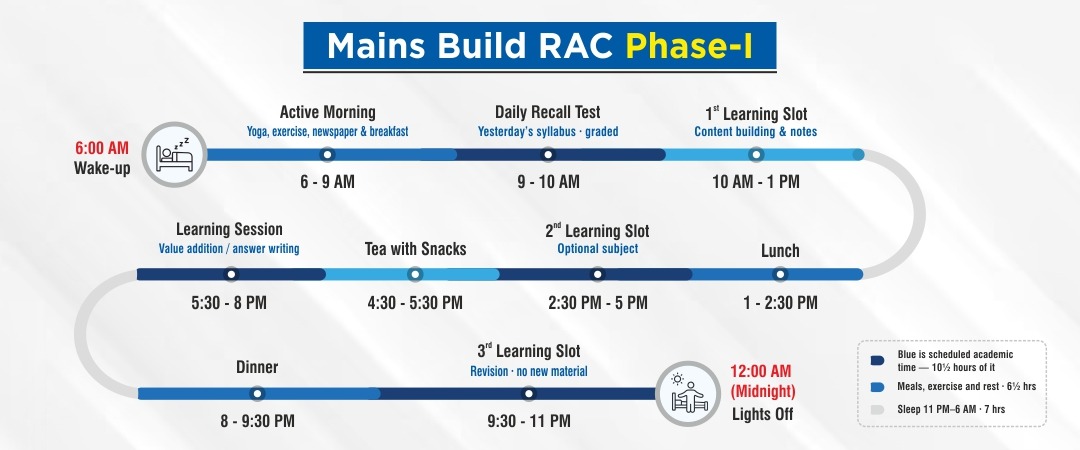
The same day, six times a week, for sixteen weeks — and a paper on the seventh morning. What you cover today, you are tested on at nine tomorrow — which is why the timetable is built the way it is, and why the evening revision slot carries no new material.
A day at Kartavyam Gurukul
Sixteen weeks, built backwards.
Ethics goes first — 250 marks that carry no Prelims weight, finished, evaluated and banked inside three weeks. Then GS-III, GS-II and GS-I, so that the subjects carrying the heaviest Prelims overlap are the ones you finish last, in December and January, three weeks before Phase II opens.
| Week | Content | Sunday Paper |
|---|---|---|
| 01 | GS-IV Ethics, Human Values & Aptitude | Ethics Theory |
| 02 | GS-IV Thinkers, Emotional Intelligence, Public Service Values | Ethics Application |
| 03 | GS-IV Case Studies, Integrity, Probity & Integration | Full GS-IV · 250 |
| 04 | GS-III Economy — Growth, Inflation, Banking, Budget, External Sector | Economy |
| 05 | GS-III Agriculture, Environment & Disaster Management | Agriculture & Environment |
| 06 | GS-III Science & Technology, Internal Security | S&T & Internal Security |
| 07 | GS-III Integration, Current Affairs & Revision | Full GS-III · 250 |
| 08 | GS-II Constitution & Polity | Constitution & Polity |
| 09 | GS-II Governance & Social Justice | Governance & Social Justice |
| 10 | GS-II International Relations | International Relations |
| 11 | GS-II Integration, Current Affairs & Revision | Full GS-II · 250 |
| 12 | GS-I History — Modern, World, Post-Independence | History |
| 13 | GS-I Art & Culture | Art & Culture |
| 14 | GS-I Geography — Physical, Indian, Human, Economic, Mapping | Geography |
| 15 | GS-I Indian Society & Integration | Full GS-I · 250 |
| 16 | The Mains Simulator | 28–30 Jan · 5 papers · 1,250 marks |
The Mains Simulator.
Five papers, three days, UPSC’s own timings.
Forenoon and afternoon sittings, in UPSC’s answer booklets, on three consecutive days. 1,250 marks between the 28th and the 30th of January — then the debrief, and then you go home.
| Date | 9:00 AM – 12:00 PM | 2:30 PM – 5:30 PM |
|---|---|---|
| Day 1 Thu 28 Jan |
Essay 250 marks |
– |
| Day 2 Fri 29 Jan |
GS-I 250 marks |
GS-II 250 marks |
| Day 3 Sat 30 Jan |
GS-III 250 marks |
GS-IV 250 marks |
Weekly Schedule
Six and a half days. The half you get back is Sunday afternoon.
Only one block moves during the week — the 5:30 evening slot alternates between the Value Addition Session and the Answer Writing Workshop, three of each. Everything else is fixed. Sunday afternoon is yours.
Value Addition Sessions
Primarily lecture-driven — concepts, frameworks and syllabus-related knowledge are taught and explained by the faculty.
Answer Writing Workshop
Primarily interactive — two-way discussion around questions, with answer analysis, feedback and value addition to your existing notes.
Assessments Every morning, and every Sunday
The four instruments and the graded-versus-evaluated distinction are set out on the Approach tab. Below is what they actually are in this phase. Both are published in full below — question count, mark split, duration and what comes back. Nobody else in this market publishes their paper structure before you pay.
The Daily Recall Test
5 × 10-markers + 2 × 15-markers. 80 marks. Sixty minutes. Closed book. Drawn from yesterday’s syllabus, written at nine, collected at ten.
The Sunday Full Test
10 × 10-markers + 10 × 15-markers. 250 marks. Three hours. UPSC format, UPSC timing, UPSC answer booklet.
Ask yourself the same things again.
These are the six questions from Chapter 00, in the same order, asked again on the last day of Phase I. That gap is the whole product — and it is why the answers are numbers rather than adjectives.
| THE QUESTION | 12 October | 31 January |
|---|---|---|
| Where your GS notes are | Three places. Maybe four. | One set, in your own hand, built across 288 scheduled hours and revised through four full papers |
| Full-length papers under time | Nought, or one | Twenty — fifteen Sundays plus the five in Simulator week |
| Tests evaluated and reviewed with a mentor | Can’t remember | 96 graded, 15 fully evaluated, 16 mentor reviews — by the same evaluator from October to January |
| Hours you studied yesterday | You don’t know | Ten and a half — and you know, because it was on a timetable you did not have to write |
Note: None of this makes you a different person. It makes you a person who has done the day a hundred and twelve times, and can therefore do it a hundred and thirteenth time in a hall with a UPSC booklet on the desk.
Mains Target in Numbers
Prelims Target (Phase II: 1 Feb - 2 May 2027)
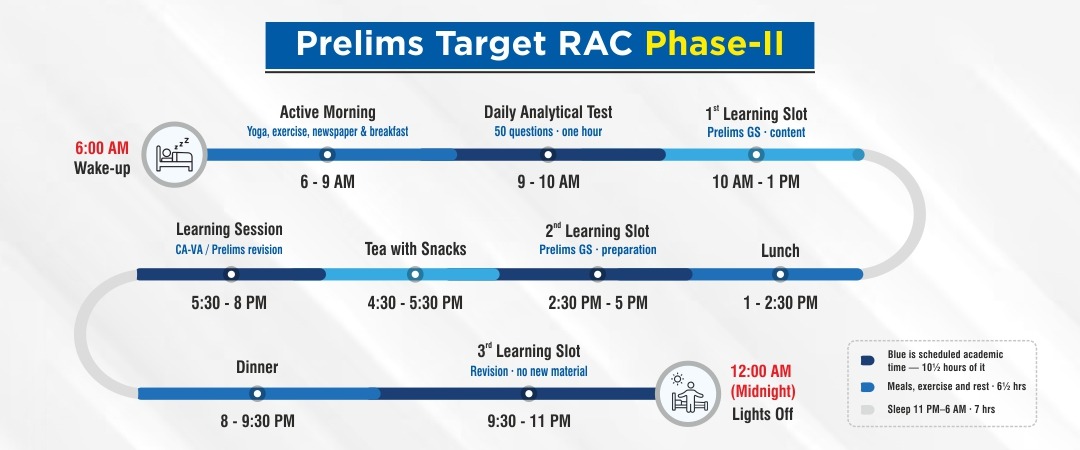
The same day, six times a week, for thirteen weeks — and both papers on the seventh morning. What you cover today, you are tested on at nine tomorrow — fifty questions, negative marking, analysed the same day.
A Day at Kartavyam Gurukul
Weekly Schedule
Six and a half days. The half you get back is Sunday afternoon.
Only one block moves during the week — the 5:30 evening slot alternates between a Current Affairs Value Addition Session and a Prelims Revision Class, three of each. Everything else is fixed. Sunday afternoon is yours.
2:30 – 4:30 PM CSAT Full Test
2:30 – 4:30 PM CSAT Full Test
CA-VA Sessions
Dynamic current affairs through issue-based analysis, reports, schemes, judgments, international developments and exam-oriented value addition.
Prelims Revision Classes
Systematic revision of the static Prelims syllabus through concept reinforcement, PYQs, high-yield themes and focused revision.
Daily Assessments and Weekly Full-Length Tests
The Daily Analytical Test
50 questions. One hour. 9:00 to 10:00 AM. Sectional, inside the block you are studying, with negative marking exactly as UPSC applies it. It will test the themes you covered yesterday.
Analysed the same day, not just scored. Which questions you got wrong matters less than which two options you were choosing between — and that is what the analysis returns.
The Weekly GS Full Test
100 questions. Two hours. Full syllabus, UPSC OMR format, ranked against the cohort. Thirteen full-length attempts before the one that counts
The Weekly CSAT Full Test
Not because you want it, because you need it. 80 questions. Two hours. Comprehension, reasoning, numeracy, data interpretation.
CSAT is qualifying, and it ends more attempts than any other paper in the examination. A candidate who clears GS and misses 66 in CSAT is out, and finds out in June. Thirteen full-length attempts is what makes that impossible.
The Simulators
Three GS Full Tests and three CSAT Full Tests across the final three weeks, at UPSC’s own sittings.
The block that turns thirteen weeks of subject study into a Prelims day you have already had.
Ninety Days, nine blocks, 2,300 themes.
Nine blocks, 86 tests, and a three-week Simulator phase that turns thirteen weeks of subject study into a Prelims day you have already had. Polity and Governance closed in December; History, Art & Culture and Geography in January. You do not meet this syllabus in February — you return to it.
| Block | Subject | Daily 9–10 AM · Sunday |
|---|---|---|
| 01 | 14 days Indian Polity | 12 Analytical · 2 GS + 2 CSAT |
| 02 | 7 days Ancient & Medieval History | 6 Analytical · 1 GS + 1 CSAT |
| 03 | 7 days Modern History | 6 Analytical · 1 GS + 1 CSAT |
| 04 | 14 days Economy + Agriculture | 12 Analytical · 2 GS + 2 CSAT |
| 05 | 7 days Geography | 6 Analytical · 1 GS + 1 CSAT |
| 06 | 7 days Environment | 6 Analytical · 1 GS + 1 CSAT |
| 07 | 7 days Science & Technology | 6 Analytical · 1 GS + 1 CSAT |
| 08 | 7 days Art & Culture + International Organisations + Government Schemes | 6 Analytical · 1 GS + 1 CSAT |
| 09 |
GS & CSAT Simulator Phase 21 days · daily revision & analysis, comprehensive evaluation |
3 GS Full · 3 CSAT Full |
A different six, and they only have numbers for answers.
| THE QUESTION | 1 FEBRUARY | 2 MAY |
|---|---|---|
| Full Prelims papers sat under time | Three or four, mostly at home | Thirteen GS papers — 100 questions, two hours, ranked against the cohort every single Sunday |
| CSAT | “It is qualifying — I will look at it in April” | Thirteen full CSAT papers, 1,040 questions — the paper that ends more attempts than any other, rehearsed thirteen times |
| Questions attempted under time, with negatives | A few hundred, mostly untimed and unmarked | 5,340— 3,000 daily, 1,300 GS, 1,040 CSAT, negative marking applied exactly as UPSC applies it |
| The two options you cannot choose between | Guess, move on, never find out | Analysed the same day, 86 times. Elimination is a trained skill here, not a hope |
| Twelve months of current affairs | Clippings and a folder you have not reopened | 39 CA–VA sessions— sorted into the fifteen or twenty questions it becomes, and tested against them |
| The Prelims syllabus | Read once, in pieces, at different times, some of it in 2025 | Nine blocks, closed and dated, then revised across a 21-day Simulator phase built from your own error log |
Prelims Target in Numbers*
* Figures are for the Phase II term, 1 February to 2 May 2027 — 91 days. They are tentative in nature and may be subject to minor changes wherever and whenever necessary, as deemed appropriate by NEXT IAS management.
Three Phases Of Residential Campus
Kartavyam Gurukul is not a sixteen-week course. It is a residential programme that runs from October to the day before Mains, in three phases with a gate between the second and the third. This tab is the method — the part that is the same in every phase. The schedules, the papers and the day itself are on the two phase tabs.
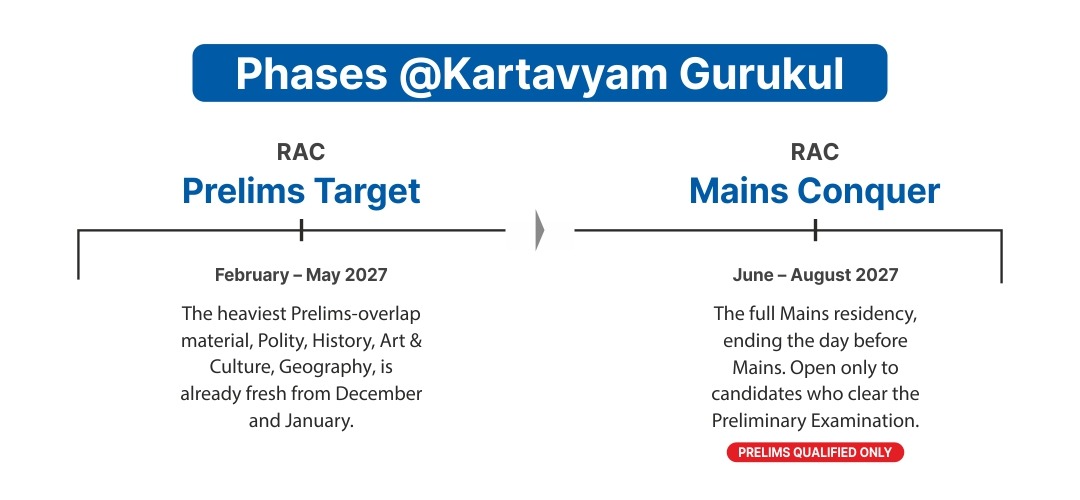
Four kinds of test. The Same Four in Every Phase.
Most programmes treat Prelims and Mains as two different problems. They are the same problem at two speeds — can you produce the right thing from memory before the clock runs out. So the method does not change between them: a test every morning, a full paper every week, a subject closed before the next one opens.
The Daily Test
You never carry a gap for more than a day. What you covered yesterday came back closed-book this morning, so the thing you half-learnt is caught while it is still one topic, not a chapter.
The Sunday Test
Your mistakes stop being new ones. A full paper under the real clock every Sunday, so what you were told to fix last week is what this week's paper checks.
The Subject Test
You find out a subject is weak while there is still term left to fix it. When it ends, the whole of it comes back as one paper, full syllabus, under time.
The Simulator
On the real day, nothing is happening to you for the first time. Consecutive full papers on consecutive days, at the real timings and in the real order, the fatigue, the turnaround, the second paper attempted after the first.
Types of Learning Sessions (Hybrid Mode)
Prelims Learning Phase
CAVA Classes
Dynamic current affairs through issue-based analysis, reports, schemes, judgments, international developments and exam-oriented value addition.
PRC Classes
Systematic revision of the static Prelims syllabus through concept reinforcement, PYQs, high-yield themes and focused revision.
Note: 2-3 classes/week will be provided in online mode.
Mentorship Sessions
Subject Strategy
One-to-one mentoring to finalise subject strategy, resources, notes and a personalised study plan for every student.
Test Review
Detailed discussion of evaluated answer sheets to identify mistakes, refine strategy and improve performance after every assessment.
Kartavyanishtha — the Weekly Boards
Two boards go up on the campus wall and every Monday at nine. They are never merged into one rank — because the candidate who turned up for all of it and the candidate who scored highest this week are doing two different, equally necessary things, and a single number would hide both.
Published Monday, 09:00
The Consistency Board
- 01Ashish Kumar42 / 42
- 02Kanak 42 / 42
- 03Tanishk41 / 42
- 07You39 / 42
- 08Devika Nair39 / 42
The Performance Board
- 01Rohit Menon148 / 250
- 02Ananya Kulkarni144 / 250
- 03Vikram Sethi141 / 250
- 11You126 / 250 ▲9
- 12Priya Joshi125 / 250
Details regarding this phase will be updated soon.
Kartavyam Gurukul (The Hostel) - Fee Structure
Frequently Asked Questions
Who is Kartavyam Gurukul designed for?
The curriculum has been made very rigorous and designed for students who have completed their basic preparation and are looking to strenthen their GS, optional, answer writing and overall exam preparation. Students who have appeared for Civil services mains and interviews and would like to make their next attempt their best attempt will be ideal candidates.
What makes Kartavyam different from a regular UPSC coaching programme?
Kartavyam is more than a classroom coaching programme. It brings together structured academics, residential facilities, daily testing, answer writing, mentoring, self-study and a dedicated study environment under one system. The entire day is designed to ensure maximum productive time and bring down distractions and down time.
What does a typical day at Kartavyam look like?
The day at Kartavyam starts with a 6 AM - 9 AM open slot where students can wake up, engage in some physical activity, read newspaper and have breakfast. The Daily test starts at 9 AM which is mandatory for every student. The first learning slot is from 10 AM - 1 PM which is dedicated for GS prepatration. After lunch, students have another learning slot dedicated to their Optional subject. In the evening, after refreshments, they attend value-addition classes and answer-writing workshops. After dinner, students have another one-and-a-half-hour revision block before the day ends.
How does the daily testing work?
The day at Kartavyam is designed to start with a test. Everyday from 9AM to 10AM you will get a test. Mains phase will have subjective test and Prelims phase will have Objective test.
What mentoring support will students receive?
Students will have dedicated mentors who will support them with note-making, preparation strategy and improving their answer writing. Mentors will also discuss evaluated answers with students, provide personalised feedback and help them identify and work on areas requiring improvement.
What is included in the residential programme?
Apart from a rigorous curriculum Kartavyam will be providing an ideal environment for students. It has accomodation, food, Housekeeping, Space for physical activities, Laundry services and emergency medical support. We have provided everything a student might need so that they can focus on their preparation.
