
 80813-00200


The full form of LBSNAA is Lal Bahadur Shastri National Academy of Administration (लाल बहादुर शास्त्री राष्ट्रीय प्रशासन अकादमी). It is a prestigious training institution for the civil services in Mussoorie, Uttarakhand in India. LBSNAA is a dream of all the aspirant community who think of preparing for UPSC Civil Service Examination.
About Lal Bahadur Shastri National Academy of Administration
- LBSNAA conducts a common Foundation Course (FC) for the newly recruited civil servants to the All India Services, Indian Foreign Service, Group ‘A’ services of the Union and the Royal Bhutan Service.
- The FC is further followed by professional training for the recruits of the IAS and members of the Royal Bhutan Service.
- The Academy also conducts in-service and Mid-Career Training Programmes (MCTPs) for members of the IAS and Induction Training Programme for officers promoted to the IAS from State Civil Services.
- Moreover, seminars and workshops on policy and governance-related issues are held from time to time.
Historical Background
- On April 15, 1958, it was announced that the Government would set up a National Academy of Administration, where training would be given to all the recruits of the Civil Services.
- The Ministry of Home Affairs also decided to amalgamate the IAS Training School, Delhi and the IAS Staff College, Shimla to form a National Academy of Administration to be set up at Charleville Estate in Mussoorie.
- In September, 1959 curtains were drawn on the training in Metcalfe House.
- Union Home Minister Pandit Govind Ballabh Pant was instrumental in effecting this shift to Mussoorie.
- In October 1972, the name of the Academy was changed to ‘Lal Bahadur Shastri Academy of Administration’.
- In July 1973, the word ‘National’ was added to it.
- The Academy is now known as the ‘Lal Bahadur Shastri National Academy of Administration’ (LBSNAA).
Core Values of LBSNAA
-
Integrity
- Be consistent in your thoughts, words and actions which will make you trustworthy.
- Have courage of conviction and always speak the truth to even the most powerful, without fear.
- Never ever tolerate any degree of corruption, be it in cash, kind or intellectual.
-
Respect
- Embrace diversity of caste, religion, colour, gender, age, language, region, ideology and socio-economic status.
- Reach out to all with humility and empathy.
- Be emotionally stable, grow with confidence and without arrogance.
-
Professionalism
- Be judicious and apolitical in your approach, be professional and completely committed to your job with a bias for action and results and continuously pursue improvement and excellence.
-
Collaboration
- Collaborate in thoughts and actions by engaging deeply with all to evolve consensus.
- Encourage others, promote team spirit and be open to learning from others.
- Take initiative and own responsibility.
-
Serve the underprivileged
- Be humane in your approach while dealing with people.
- Be the voice of the underprivileged and be proactive in addressing any injustice against them.
- You can achieve success in this endeavour if you act with integrity, respect, professionalism and collaboration.
Overview of LBSNAA Training
- A number of courses are conducted in LBSNAA every year.
- Amongst these the Foundation Course (FC) is essentially knowledge centred.
- Further, the professional courses are fundamentally skill oriented.
- In-Service Courses are mainly directed towards enhancement of policy formulation capabilities for assuming senior positions in Government.
- The effort of LBSNAA is to help create a bureaucracy that commands respect by performance.
- The academic curriculum is periodically reviewed and updated for its relevance.
- The above task is done in consultations with state governments, feedback of the participants, internal review and recommendations of the Committees set up by the Government.
Training Methodologies
- Conventional classroom teaching methodology is not always effective to make an impact on attitudes and values of trainees. Therefore, diverse pedagogy is used.
- Many courses operate on a modular structure, whereby relevant themes are chosen in a consolidated manner to ensure that all major aspects relating to them are covered.
-
A module consists of some of the following methodologies as mentioned below.
- Lessons by in-house and Guest faculty
- Panel discussion to promote appreciation of divergent opinions and views
- Case studies
- Films
- Group discussion
- Simulation exercise
- Seminars
- Moot Court and Mock Trial
- Order and judgment writing practice
- Practical demonstration
- Problem solving exercises
- Report Writing (Term Paper)
- Group Work
Trekking Activities for Officer Trainees
- Trekking is part of the Foundation Course.
- During the trek, the officer trainees go out into the Himalaya.
- LBSNAA makes all the basic arrangements like transport, boarding, lodging besides helpers and guides who are trained para-military force jawans.
- The teams are provided with lifesaving medicines, sleeping bags, rucksacks, GPS or Compass, VHF handsets etc.
- The District administration also provides the necessary support through block/tehsil level officials.
- The faculty and doctors also visit the teams at various locations to guide and assist the officer trainees during the trekking.
-
Following are the objectives of trekking:
- To foster a spirit of adventure and love for flora and fauna.
- To promote esprit de corps and camaraderie among fellow officer trainees.
- To improve self-esteem, feeling for friends, to know & understand each other better and make for lasting friendships.
Inter Service Meet
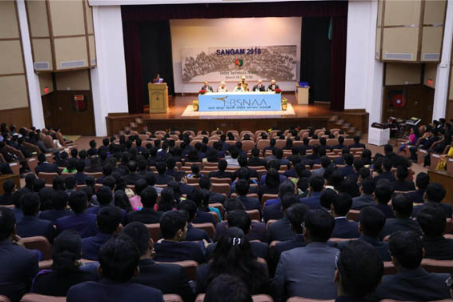
- The Inter-Services Meet, ‘SANGAM’, is an entertaining and stimulating 3-4 day endeavour by the varied civil servants of India.
Bharat Darshan
- Bharat Darshan at the LBSNAA puts the participants of the Foundation Course in India's varied geographical and cultural settings.
- Exposure tours that last for 8 to 10 weeks involve villages, forests, industries, and border areas in different states, hence promoting national integration.
- The participants interact with local governance, tribal bodies, and development initiatives in order to cultivate empathy and administrative know-how that is required for civil servants in the likes of IAS, IPS, and IFoS officers in the future.
Academic Song of LBSNAA
- The Academy Song of LBSNAA is a Bengali Song composed by Shri. Atul Prasad Sen (1871 - 1934), the renowned Bengali composer, lyricist and singer. He was a successful lawyer, philanthropist, social worker, educationist and Literature.
- The song was adopted by LBSNAA during the tenure of Shri. Rajeshwar Prasad, who was the Director of the Academy from May 1973 to April 1977.
- LBSNAA has modified the song by introducing the translation of some lines of this song into Hindi, Tamil and Marathi.
- The song embodies what is expected to be the spirit of Indian Civil Services and is therefore constant inspiration for all the officers.
Conclusion
LBSNAA’s Bharat Darshan and its academic song show the spirit of the civil services training in weaving hands-on learning into the journey, shaping officers equipped for good governance, dedicated to upholding the unity in diversity of India. For UPSC CSE hopefuls, it marks the transformative path from trainee to nation’s guardian..
FAQs
What is Bharat Darshan at LBSNAA?
Bharat Darshan is an immersive 8–10 week program for foundation course trainees. They get a chance to travel through all regions of India to observe local governance, cultures, and challenges in fostering national integration.
What does the LBSNAA academic song stand for?
This song brings into active psychology the ideals of selfless service and public welfare, relative to that area of interest, to arouse and create patriotism and unity among probationers in civil service.
Who participates in Bharat Darshan?
Officers of IAS, IPS, IFoS and other Central services, in fact, join at LBSNAA, Mussoorie during their early stages of training.
Where is LBSNAA located?
LBSNAA is situated in Mussoorie, Uttarakhand, operating as the leading institute for the training of civil services.
