
 80813-00200


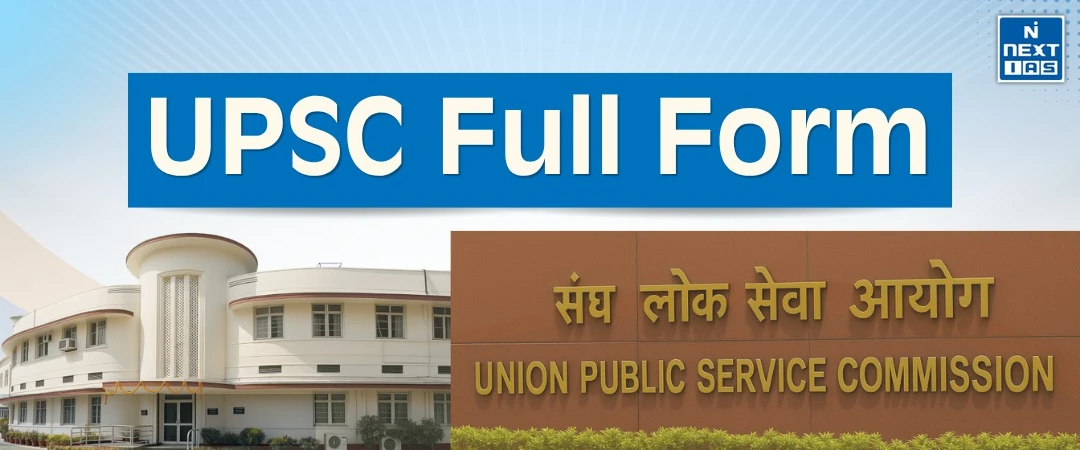
The full form of UPSC is the Union Public Service Commission. It is the central recruitment agency for the top central government services (IAS, IPS, IRS, Defence, Medical, Engineering). The name of UPSC was changed 3 times earlier. In 1926, it was founded as the Public Service Commission based on the Lee Commission report, 1924. The name was reconstituted as Federal Public Service Commission in 1935. Finally on 26 January 1950, the name was officially changed to Union Public Service Commission (UPSC). Celebrating its Centenary year (1926 to 2026), UPSC is among the oldest Institutions in India. It was set up on 1st October 1926. The commission has been the most important body that recruits competent individuals in the country. Sardar Vallabh Bhai Patel had earlier mentioned it as a ‘Steel Frame of India’.
The First Chairperson was Sir Ross Barker in 1926. The First Indian Chairperson was H.K. Kripalani. The First Female Chairperson was Rose Millian Bathew who held office between 1992-96. The First Indian to pass the predecessor ICS exam was Satyendranath Tagore in 1863. Although the Civil Service is the most widely-known exam in India, the ‘UPSC Full Form’ refers to a recruitment process which spans an extensive scope. The organization holds over a dozen important examinations, which include NDA and CDS (Defence), IES (Engineering Services), CMS (Medical Services), IFS (Forestry Services).
UPSC का फुल फॉर्म संघ लोक सेवा आयोग है। यह भारत के संविधान द्वारा स्थापित एक स्वतंत्र संवैधानिक निकाय है, जो केंद्र सरकार की अखिल भारतीय सेवाओं जैसे भारतीय प्रशासनिक सेवा, भारतीय पुलिस सेवा, भारतीय विदेश सेवा आदि और अन्य केंद्रीय सेवाओं में भर्ती के लिए सिविल सेवा परीक्षा सहित कई परीक्षाएँ आयोजित करता है। यूपीएससी का मुख्य कार्य योग्य एवं निष्पक्ष अधिकारियों का चयन करना है, ताकि देश का प्रशासन कुशल और निष्पक्ष बना रहे।
List of 24 Services Under the UPSC Civil Services Examination
There are 24 services in UPSC Civil Service Exam that can be broadly divided into three categories which are as follows:
All India Civil Services
- Indian Administrative Service (IAS)
- Indian Police Service (IPS)
- Indian Forest Service (IFoS)
Group ‘A’ Civil Services
- Indian Foreign Service (IFS)
- Indian Audit and Accounts Service (IAAS)
- Indian Civil Accounts Service (ICAS)
- Indian Corporate Law Service (ICLS)
- Indian Defence Accounts Service (IDAS)
- Indian Defence Estates Service (IDES)
- Indian Information Service (IIS)
- Indian Ordnance Factories Service (IOFS)
- Indian Communication Finance Services (ICFS)
- Indian Postal Service (IPoS)
- Indian Railway Accounts Service (IRAS)
- Indian Railway Personnel Service (IRPS)
- Indian Railway Traffic Service (IRTS)
- Indian Revenue Service (IRS)
- Indian Trade Service (ITS)
- Indian Revenue Service (Customs & Indirect Taxes) (IRS C&IT)
Group ‘B’ Civil Services
- Armed Forces Headquarters Civil Service
- DANICS
- DANIPS
- Pondicherry Civil Service
- Pondicherry Police Service
Salary of an IAS officer
- The monthly salary of an IAS officer starts with Rs. 56,100. With further work experience, they get timely promotions during their tenure.
- The salary upgrades are usually up to Rs. 1,32,000 per month at higher level.
- The Cabinet Secretary, who is regarded as the highest IAS official, earns around Rs. 2,50,000 per month, usually after approximately 37+ years of their service.
About Union Public Service Commission
- UPSC is a Constitutional Body under Article 315-323 in Part XIV of the Constitution of India.
- It discharges its duties, functions and obligations assigned under Article 320.
- It conducts various examinations (CSE, CDS, NDA, EPFO, CAPF etc.) in accordance with the Rules of examination as notified by the Government of India in a just, fair and impartial manner for making a merit based selection and recommendation of candidates for various Group A and Group B services.
About UPSC Exams
Every year UPSC conducts numerous competitive examinations. Approximately, ten exams are being conducted by UPSC which are as follows:
- Civil Services Exam (CSE)
- Indian Forest Service Exam (IFoS)
- Engineering Services Exam (ESE)
- Central Armed Police Forces (Assistant Commandants) Exam (CAPF AC)
- Combined Defence Services Exam (CDS)
- National Defence Academy Exam (NDA)
- Combined Medical Services Exam (CMS)
- Indian Economic Service Exam (IES)
- Combined Geo-Scientist Exam (CGSE)
- Central Industrial Security Force (Assistant Commandants) Exam (CISF AC)
Eligibility Criteria for UPSC CSE
| S.No. | Criterion | Details |
|---|---|---|
| 1 | Nationality |
|
| 2 | Age (as on 1 August of exam year) |
|
| 3 | Educational Qualification |
|
| 4 | Number of Attempts |
|
How to Apply for UPSC CSE?
| S.No. | Step | Action | Details |
|---|---|---|---|
| 1 | Visit Official Website |
|
|
| 2 | One-Time Registration (OTR) |
|
|
| 3 | Log In for Application |
|
|
| 4 | Fill Part-I of Application Form |
|
|
| 5 | Fill Part-II of Application Form |
|
|
| 6 | Pay Application Fee |
|
|
| 7 | Submit & Print |
|
|
Union vs State
- UPSC conducts the exam at the central level while SPSC conducts at state level.
- The maximum age limit for UPSC CSE examination is 32 years (for general category) while the age limit for SPSC is 40 years (for gen. category). However, it varies state to state.
- The number of attempts in UPSC is Six whereas there is no limit on the number of attempts in SPSC.
Role and Functions
Knowing the UPSC full form is not sufficient without understanding its role and functions. Its primary duty is recruitment through the conduct of examinations. However, its role is broader:
-
Conduct of Examinations:
- The primary function of UPSC is to conduct the examinations for Grade A and B posts in the country.
- It conducts numerous examinations every year, with the Civil Services Examination (CSE) being the most prominent for recruiting IAS, IPS, IFS officers.
- Other exams include Engineering Services Exam (ESE), Combined Defence Services Exam (CDS), National Defence Academy Exam (NDA) etc.
-
Direct Recruitment:
- It conducts interviews for selecting candidates for various posts under the Central Government.
-
Advisory Role:
-
The Commission is often consulted on matters related to:
- Methods of recruitment to civil services and posts.
- Principles to be followed in making appointments, promotions, and transfers.
- The suitability of candidates for appointments.
- Disciplinary matters affecting civil servants.
-
The Commission is often consulted on matters related to:
Note: The advisory role of UPSC is not binding on the government to accept. It highlights the role and function to uplift the administrative integrity in the country.
Conclusion
The long preparation journey begins with a single step towards the goal. It is very important to understand the constitutional significance, its historical evolution and its rigorous process of the Union Public Service Commission (UPSC).
FAQs about Union Public Service Commission
What is the full form of UPSC?
The full form of UPSC is the Union Public Service Commission. It is a central constitutional authority that was founded in 1926. Its role is to select civil servants via a competitive examination process.
What is UPSC CSE Full Form?
The full form of UPSC CSE is the Union Public Service Commission Civil Service Examination.
What are the exams conducted by UPSC?
UPSC conducts Civil Services Examination (CSE) for IAS/IPS/IFS, Engineering Services, Combined Defence Services, NDA, CDS, and medical services exams annually.
Where is UPSC headquartered?
UPSC headquarters is located at Dholpur House, Shahjahan Road, New Delhi.
What is the constitutional provision for the UPSC?
The articles from 315 to 323 of the Indian Constitution regulate UPSC in such a manner that it remains autonomous in making appointments, promoting employees, and offering advice on disciplinary matters.
How many attempts for upsc?
For General or EWS candidates, there are 6 attempts up to 32 years. For OBC candidates, there are 9 attempts up to 35 years. For SC/ST candidates, there is no attempt limit up to 37 years. The candidates with PwBD have further relaxations according to regulations.
How to make notes from newspapers for upsc exams?
Read news which are related to syllabus, focus on editorials, government schemes, economy, environment, and international relations. Also, make concise notes using keywords in your language, and relate them to GS papers.
Who appoints the chairman of upsc?
The President of India appoints the Chairman and other members of UPSC according to Article 316 of the Indian Constitution.
What are the main components of the UPSC syllabus?
The major constituents of UPSC syllabus include Prelims (GS + CSAT), Mains (Essay, GS I-IV, optional subjects, language papers), and Interview.
