
 80813-00200


UPSC CSE Booklist for Prelims and Mains 2026
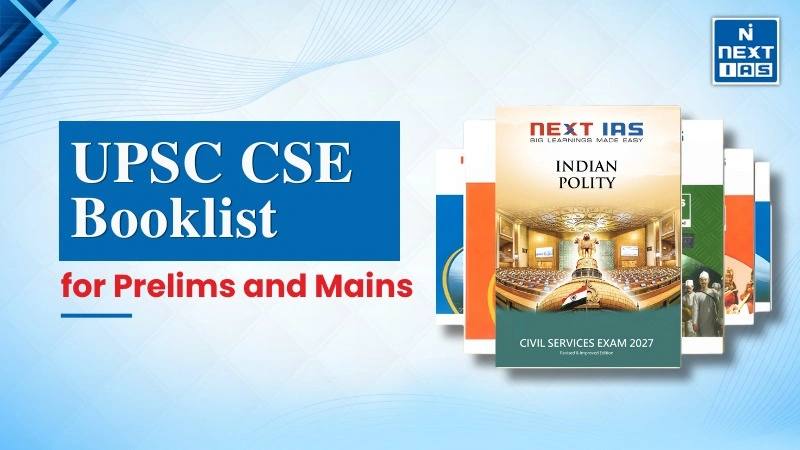
After having an idea of exam pattern, syllabus, PYQs, beginning with the preparation for any exam primarily requires the valid and authentic source or the booklist for the exhaustive syllabus coverage. UPSC Civil Services Exam is one such exam whose vast syllabus is often viewed by the aspirants as a challenge to cover it entirely in one year's time.
Booklist is equally important and is considered as the authentic source because it saves a lot of time and effort of the aspirants for making short notes. The following booklist is being suggested for the reference of the students who are seriously preparing for the UPSC CSE.
Subject-wise Booklist for UPSC Civil Services Exam
Art and Culture Booklist
Considering the importance of Art and Culture booklist and its weightage in the UPSC CSE both for Prelims and Mains, we have listed the relevant books for Art and Culture subject curated specially for the UPSC aspirants. Here’s a complete booklist coverage:
| Subject | Booklist |
|---|---|
| Art & Culture |
|
Art is the creative expression of one’s experiences, emotions and other qualities. On the other hand, Culture is the ensemble of social forms, material traits, customary beliefs, and other human phenomena that cannot be directly attributed to a genetic inheritance of a religious, racial, or social group.
Ancient History Booklist
Here’s a complete booklist coverage for Ancient History:
| Subject | Booklist |
|---|---|
| Ancient History |
|
Ancient History as a discipline forms the base for the UPSC CSE and is a crucial part of the syllabus of the exam. The period of ancient history is usually considered spanning from pre-historic Stone age to historic Harsha era (7th century).
Medieval History Booklist
Here’s a complete booklist coverage for Medieval History:
| Subject | Booklist |
|---|---|
| Medieval History |
|
Medieval History as a discipline forms the base for the UPSC CSE and is a crucial part of the syllabus of the exam. The period of medieval history is usually considered spanning from the time period from Major Dynasties (750–1200 AD) of Early Medieval India to the 18th century.
Modern History Booklist
Here’s a complete booklist coverage for Modern History:
| Subject | Booklist |
|---|---|
| Modern History |
|
Modern History as a discipline forms the base for the UPSC CSE and is a crucial part of the syllabus of the exam. The period of Modern history is usually considered spanning from the time period from mid-18th century to 1947.
Post Independence History of India Booklist
Here’s a complete booklist coverage for Post Independence History of India:
| Subject | Booklist |
|---|---|
| Post Independence History |
|
World History Booklist
Here’s a complete booklist coverage for World History:
| Subject | Booklist |
|---|---|
| World History |
|
Geography Booklist
Here’s a complete booklist coverage for Geography:
| Subject | Booklist |
|---|---|
| Geography |
|
Disaster Management Booklist
Here’s a complete booklist coverage for Disaster Management:
| Subject | Booklist |
|---|---|
| Disaster Management |
|
Indian Polity Booklist
Here’s a complete booklist coverage for Indian Polity:
| Subject | Booklist |
|---|---|
| Indian Polity |
|
International Relations (IR) Booklist
Here’s a complete booklist coverage for IR:
| Subject | Booklist |
|---|---|
| International Relations |
|
Indian Economy Booklist
Here’s a complete booklist coverage for Indian Economy:
| Subject | Booklist |
|---|---|
| Indian Economy |
|
Science and Technology Booklist
Here’s a complete booklist coverage for Science and Technology:
| Subject | Booklist |
|---|---|
| Science & Technology |
|
Environment and Ecology Booklist
Here’s a complete booklist coverage for Environment and Ecology:
| Subject | Booklist |
|---|---|
| Environment & Ecology |
|
Ethics Booklist
Here’s a complete booklist coverage for Ethics:
| Subject | Booklist |
|---|---|
| Ethics |
|
Indian Society Booklist
Here’s a complete booklist coverage for Indian Society:
| Subject | Booklist |
|---|---|
| Indian Society |
|
Internal Security Booklist
Here’s a complete booklist coverage for Internal Security:
| Subject | Booklist |
|---|---|
| Internal Security |
|
Optional Subject Booklist for UPSC Mains 2026
- The booklists for optional subjects in UPSC CSE exams work best when they are strategic, short, and precise rather than long and unstructured.
- Usually, toppers for each subject rely on one or two main standard books only, besides brief notes and selective study material, and then get the most out of it through revision, PYQs, and targeted answer practice again and again.
- Selecting the right books and study resources that suit your interest and background will not only give you clarity but also the depth and the exam-oriented preparation.
- This article will provide a subject-wise booklist for UPSC CSE to help you prepare effectively and confidently.
Why the right Optional subject book selection is necessary?
The optional subject booklist is the strategic weapon of the UPSC Civil Services Exam for achieving success in the mains. The 500 marks in optional subjects are crucial and can boost your ranking to the top position. It simplifies the enormous syllabus by 1-2 core texts per subject and eliminates confusion caused by numerous resources and allows extremely targeted revision. The toppers guarantee it, make a good choice according to one’s interest, GS overlap like PSIR, Sociology, and scoring potential to gain knowledge, develop good quality answers, and make your strength an important factor for the rank. The role of the correct booklist prevents confusion, reduces material overload, and keeps preparation focused.
Subject-wise Booklist for IAS/UPSC Optional Papers
Political Science and International Relations (PSIR)
PSIR is one of the most popular optional subjects due to its overlap with GS Papers and essays. The PSIR optional subject booklist is mentioned below.
Paper I – Political Theory & Indian Politics
- Political Theory – O.P. Gauba
- An Introduction to Political Theory – O.P. Gauba
- Politics in India – Rajni Kothari
- Indian Government and Politics – B.L. Fadia
- IGNOU BA & MA Notes (very useful for conceptual clarity)
- NEXT IAS book on PSIR
Paper II – Comparative Politics & International Relations
- Global Politics – Andrew Heywood
- The Oxford Handbook of Political Science – Robert Goodin
- India’s Foreign Policy – Rajiv Sikri
- International Relations – Pushpesh Pant
- Articles from IDSA, MEA, ORF for current updates
- NEXT IAS book on PSIR
Sociology
Sociology is a highly scoring optional subject that attracts aspirants from all educational backgrounds due to its concise syllabus. The Sociology optional subject booklist is mentioned below.
Paper I
- Sociology – Themes and Perspectives – Haralambos & Holborn
- Indian Sociological Thought – B.K. Nagla
- Sociological Theory – George Ritzer (for advanced understanding)
- IGNOU BA/MA Notes
- Sociology optional study material and books by NEXT IAS
Paper II
- Indian Society – Nadeem Hasnain
- Social Change in Modern India – M.N. Srinivas
- Caste in Modern India – M.N. Srinivas
- Handbook of Indian Sociology – Veena Das (selective reading)
- Sociology optional study material and books by NEXT IAS
Geography
Geography optional subject is very popular among aspirants because it covers scientific concepts and maps, making it both analytical and static. The Geography optional subject booklist is mentioned below.
Paper I
- Certificate Physical & Human Geography – G.C. Leong
- Physical Geography – Savindra Singh
- Human Geography – Majid Husain
- Models in Geography – Majid Husain
- NEXT IAS Geography book for optional coverage
Paper II (Indian Geography)
- India: A Comprehensive Geography – D.R. Khullar
- Geography of India – Majid Husain
- NCERT Class 11 & 12 (must-read)
- Maps: Orient Blackswan / Oxford Atlas
- NEXT IAS Geography book for optional coverage
History
History requires strong factual memorisation and analytical writing. The right sources or booklist can simplify the vastness of the UPSC CSE syllabus for optional subjects. The History optional subject booklist is as follows.
Ancient India
- Ancient India – R.S. Sharma
- A History of Ancient & Early Medieval India – Upinder Singh
- Study material by NEXT IAS
Medieval India
- Medieval India – Satish Chandra
- Study material by NEXT IAS
Modern India
- India’s Struggle for Independence – Bipan Chandra
- A Brief History of Modern India – Spectrum
- Study material by NEXT IAS
World History
- World History – Norman Lowe
- Mastering Modern World History – Norman Lowe
- Study material by NEXT IAS
Public Administration
Public Administration is highly scoring when prepared with conceptual depth. The Public Administration optional subject booklist is mentioned below.
Paper I
- Public Administration – Laxmikanth
- Administrative Thinkers – Prasad & Prasad
- Public Administration: Theories & Concepts – Rumki Basu
Paper II
- Indian Administration – Arora & Goyal
- Public Administration in India – Mohit Bhattacharya
- ARC Reports (2nd ARC – Must Read)
Anthropology
Anthropology is popular among beginners due to its scoring consistency. Many a times, aspirants change their optional subject after few attempts and consider Anthropology as a highly scoring optional subject due to the highly predictable nature of the questions by UPSC every year. The Anthropology optional subject booklist is given as under.
Paper I
- Physical Anthropology – P. Nath
- Anthropology Simplified – Vivek Bhasme
- Indian Anthropology – Nadeem Hasnain
- NEXT IAS Anthropology study material
Paper II
- Tribal India – Nadeem Hasnain
- Anthropology Optional Notes – Braintree / Vaid’s
- NEXT IAS Anthropology study material
Economics
Economics requires understanding of theory as well as contemporary issues. Economics optional subject is also very popular among numerous aspirants. The Economics optional subject booklist is listed below.
Paper I
- Microeconomics – Koutsoyiannis
- Macroeconomics – Dornbusch & Fischer
- International Economics – Dominick Salvatore
- Indian Economy – Mishra & Puri
- Economics by NEXT IAS
Paper II
- Indian Economy – Uma Kapila
- Indian Economy Since Independence – Uma Kapila
- Economic Survey & Union Budget (must-read)
- Economics by NEXT IAS
Mathematics
The Mathematics optional subject booklist is mentioned below. However, NEXT IAS mathematics books are equally good for optional subjects.
Paper I
- Lipschutz (Linear Algebra)
- Shanti Narayan (Differential & Integral Calculus)
- Loney (2D Geometry)
- Shanti Narayan (3D Geometry)
- Ross / Raisinghania (ODE)
- Spiegel (Vector Analysis)
- M. Ray (Statics & Dynamics)
- NEXT IAS book on Mathematics
Paper II
- Fraleigh / Herstein (Algebra)
- Malik & Arora (Real Analysis)
- Churchill (Complex Analysis)
- Kant & Swarup (Linear Programming)
- Jain & Iyengar (Numerical Methods)
- Timoshenko (Mechanics)
- Raisinghania (Partial and Differential Equations)
- NEXT IAS book on Mathematics
Philosophy
Philosophy is short, conceptual, and highly scoring for consistent writers. The Philosophy optional subject booklist is listed as under.
Paper I
- A Critical Survey of Indian Philosophy – C.D. Sharma
- A Critical History of Western Philosophy – Y. Masih
- An Introduction to Philosophy – O.P. Gauba
Paper II
- Books on Socio-Political Philosophy – O.P. Gauba
- Applied Ethics – Various online sources + IGNOU notes
Tips for Selecting the Best Books for Optional Subjects
While booklists prepare you well in the exam journey, effective use of them requires a robust and effective strategy.
Choose 1–2 standard books per topic.
Avoid using multiple sources for the same concept. There is always a benefit of limiting your booklists or study material so that you can revise more before exam date.
Combine theory with PYQs
UPSC has a habit of repeating themes every year. Identify & focus on them.
Make concise notes
Optional subjects require revision-oriented preparation. Thus, make short and crisp notes for a quick revision out of the booklists mentioned.
Integrate current affairs only when needed
It is important for the optional subjects like PSIR, Sociology, Geography, and Public Administration.
Test yourself regularly
Writing practice is crucial for scoring 300+ marks in the optional paper. Therefore, the role of test series cannot be ignored at all.
FAQs
Which NCERT books are essential for UPSC?
Class 6–12 NCERTs for History, Geography, Polity, Economy, Science. Start with these for conceptual clarity. Old NCERTs (RS Sharma, Satish Chandra) are best for History.
Which is the best book for Indian Polity?
NEXT IAS Indian Polity book covers the entire syllabus for Indian Polity.
What are the recommended History books for UPSC?
Ancient: RS Sharma (Old NCERT), Medieval: Satish Chandra, Modern: Bipan Chandra. Tamil Nadu History Class 11–12 for Art & Culture.
List UPSC Economy booklist for beginners?
NEXT IAS Indian Economy + Class 11–12 NCERTs. For Mains, add Economic Survey summaries, Budget highlights via newspapers.
Which is the best CSAT book for UPSC?
R. S. Aggarwal for CSAT. Practice PYQs; no need for multiple books—focus on mocks.
How should I choose the right booklist for my optional subject?
You should choose books based on the syllabus coverage, concept clarity, and author credibility. Also, look for toppers’ recommendations and ensure the books help develop both foundational understanding and exam-oriented answers.
Is it necessary to read all the books recommended for an optional subject?
No. You should prioritize one standard textbook for core concepts and use additional books only for reference.
Can I rely solely on coaching notes instead of a full booklist?
Coaching notes are useful for quick revision, but they may not fully cover the syllabus. A balanced approach-one main book + selective notes is usually most effective.
How often should I update my booklist for the optional subject?
Update your booklist only if there are syllabus changes, more effective books become available, or you feel a particular resource isn’t helping you.
