
 80813-00200


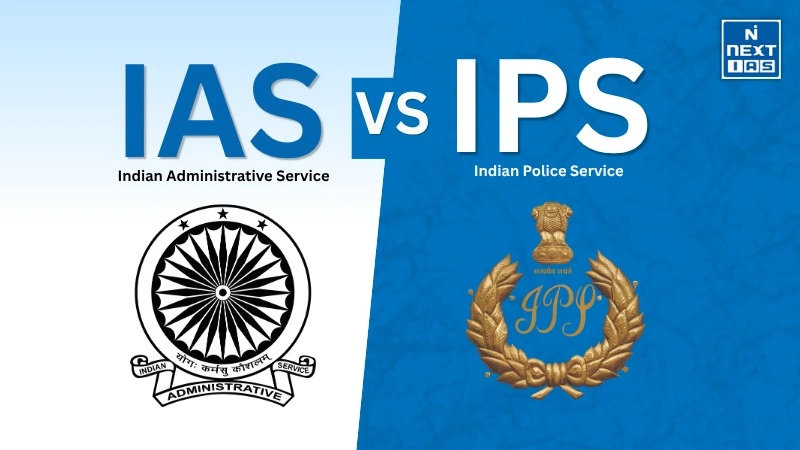
An IAS officer has executive power as a District Magistrate. It involves supervising all departments, including police, revenue, and development. The IPS officers possess law enforcement powers, draw arrest or investigation in law, and report to DMs on all law & order matters. IAS lays policy in all sectors, whereas IPS maintains security. Both are on the same salary scale. However, IAS gets protocol precedence over others.
Introduction to IAS vs IPS Powers
- Indian Administrative Service (IAS) and Indian Police Service (IPS) are both premier 'All India Services', but their roles, powers, and career paths differ significantly.
- This article will provide detailed, important information related to IAS vs IPS powers and their role in the UPSC Civil Services Examination.
Role of IAS vs IPS
- Indian Administrative Service officers play a key role in the central as well as the state governments.
- They oversee the general administration, policy implementation, and coordination of all departments at the district and ministry level.
- They also oversee law and order, development schemes, revenue administration, and disaster management.
- An IAS officer directly coordinates with the public as well as the government.
- Whereas IPS officers are specialists in law enforcement, crime control, and internal security.
- An IPS at the district level usually serves as Superintendent of Police (SP).
Salary Comparison of IAS and IPS
According to the 7th Pay Commission, both IAS and IPS have generally similar pay levels, especially at the entry and middle levels of service.
| Years of Service | IAS Post | IPS Post | Basic Pay (₹) | DA (50%) | HRA (24%) | Gross Salary (₹) |
|---|---|---|---|---|---|---|
| 1–4 yrs | SDM | ASP | 56,100 | 28,050 | 13,464 | 1,07,614 |
| 5–8 yrs | ADM | Addl. SP | 67,700 | 33,850 | 16,248 | 1,29,798 |
| 9–12 yrs | DM | SP | 78,800 | 39,400 | 18,912 | 1,52,112 |
| 13–16 yrs | Div. Comm. | DIG | 1,18,500 | 59,250 | 28,440 | 2,26,190 |
| 17–20 yrs | Prin. Secy | IG | 1,44,200 | 72,100 | 34,608 | 2,75,908 |
| 25–30 yrs | Addl. CS | ADGP | 1,82,200 | 91,100 | 43,728 | 3,47,028 |
| 30+ yrs | CS | DGP | 2,25,000 | 1,12,500 | 54,000 | 4,31,500 |
Educational and Eligibility Criteria
Eligibility criteria for both IAS and IPS are the same. The candidates must:
- Hold a bachelor's degree in any discipline from a recognized university.
- Be within the prescribed age limit (with relaxations for reserved categories).
- Must fulfil the nationality conditions specified by UPSC.
Training of IAS vs IPS
- Both IAS and IPS probationers begin with a common Foundation Course at the Lal Bahadur Shastri National Academy of Administration (LBSNAA) in Mussoorie, Uttarakhand.
- During this period, officer trainees from various services study public administration, law, economics and language.
- Both the IAS and IPS officer trainees participate in Bharat Darshan, village visits and outdoor activities to build mutual trust.
- After the commencement of the Foundation Course at LBSNAA, the IAS officers continue their professional training at LBSNAA whereas the IPS officers go to SVPNPA in Hyderabad.
- Their training curriculum emphasised on public administration, governance, law, development economics, land revenue, and district management.
- Both the IAS and IPS officers undergo attachments with district administration, courts, panchayats, and various field offices.
- IAS pursue district training under a mentor officer, before taking up their first posting as Sub-Divisional Magistrate (SDM) or equivalent.
- IPS officers, after Foundation, move to the Sardar Vallabhbhai Patel National Police Academy (SVPNPA) in Hyderabad.
- Their training primarily deals with criminal law, forensic science, weapons handling, tactics, counter-insurgency, physical fitness, and leadership roles in police operations.
- An IPS officer trainee undergoes field training in districts, police stations, armed battalions, and specialized units, preparing them for active operational roles as Assistant Superintendent of Police (ASP).
Power and Responsibilities of IAS vs IPS
- The IAS officers exercise a broad administrative and magisterial power.
- As District Magistrates (DM), they supervise all government departments in a district, coordinate development programs, maintain law and order, and exercise power of an executive magistrate.
- They can impose prohibition orders, look after the enforcement of regulations, control finances at district-level, and directly supervise emergency situations such as floods, epidemics, or communal tensions.
- At higher levels, the IAS officers formulate and implement policies in the state secretariats and central ministries which influence taxation, welfare, infrastructure, and national level schemes.
- The IPS officers exercise specific powers conferred under criminal and police laws.
- They have the power of investigation, supervise registration of First Information Reports (FIRs), authorize searches and seizures, impose raids, and command police forces.
- The responsibilities of IPS officers include crime prevention, traffic management, intelligence gathering, counter-terror operations, anti-naxal campaigns, protection of Very Important Persons (VIPs) and critical infrastructure.
- At state headquarters or central organizations like CBI, IB, NIA, or paramilitary forces, IPS officers design security strategies.
Promotion of IAS vs IPS
- The promotions in both services are governed by service rules and their performance.
- In IAS, an officer typically begins as Sub-Divisional Magistrate (SDM), then becomes Additional District Magistrate (ADM), District Magistrate (DM) or District Collector (DC).
- Later works in the state secretariat as Director, Secretary, Principal Secretary, and possibly Chief Secretary.
- Exceptional officers may rise to the Union level as Secretaries, and the senior-most IAS officer becomes Cabinet Secretary.
- In IPS, the career usually starts as Assistant Superintendent of Police (ASP), then progresses to Additional SP, SP, Senior Superintendent of Police (SSP), Deputy Inspector General (DIG), Inspector General (IG), Additional Director General (ADG), and Director General of Police (DGP) in a state.
- Some officers are deputed in central government services for training and value enhancement purposes which helps the state for long term in administration.
FAQs about IAS vs IPS Powers
Which service has more power, IAS vs IPS?
IAS have more power, but on the other hand, IPS have some specific power related to law and order.
Is the exam different for IAS and IPS?
Both exams are done through UPSC CSE and IPS also follow some physical and medical standards.
