
 80813-00200

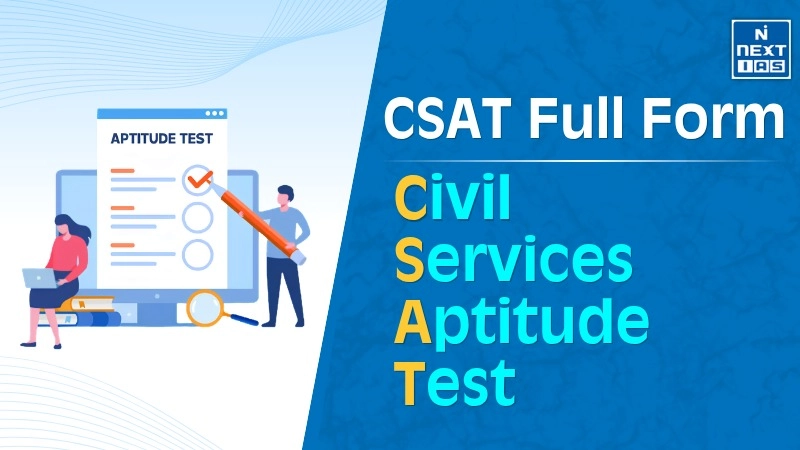
The full form of CSAT is the Civil Services Aptitude Test (सिविल सेवा अभिक्षमता परीक्षा). It is a crucial qualifying paper in the UPSC Civil Services Exam (CSE). It evaluates the analytical thinking, comprehension, and decision‑making ability that a future civil servant must possess.
About Civil Services Aptitude Test
The Civil Services Aptitude Test (CSAT) is officially the General Studies Paper‑II of the UPSC Preliminary Examination. Although it is only a qualifying paper—requiring 33% marks—it can still eliminate otherwise strong candidates who focus solely on GS Paper‑I. CSAT tests how an aspirant thinks under pressure, solves real‑life style problems, and interprets information, rather than how many facts they have memorised. For this reason, understanding the CSAT full form, structure, and demands is essential for every UPSC aspirant.
CSAT is an objective‑type paper of 200 marks, with 80 questions to be solved in 120 minutes. Each question carries equal marks, and there is negative marking (one‑third of the marks deducted for a wrong answer). To qualify, a candidate must score at least 33%—that is, 66 marks out of 200.
The syllabus of the Civil Services Aptitude Test (CSAT full form in practice) broadly covers:
- Comprehension and English language skills
- Interpersonal skills including communication
- Logical reasoning and analytical ability
- Decision‑making and problem‑solving
- General mental ability
- Basic numeracy (numbers, averages, percentages, ratios, time–speed–distance, time–work, profit–loss, interest, etc.)
- Data interpretation (tables, graphs, charts)
The difficulty is not necessarily in the syllabus itself—which is roughly of Class X level for maths—but in the time pressure and mix of questions.
Background
CSAT was introduced in 2011 as part of a major reform of the UPSC Preliminary stage. Before CSAT, Prelims had one General Studies paper and one optional‑subject paper. This favoured candidates who had studied particular optionals deeply and created disparities between subjects. CSAT replaced the optional paper with a common aptitude paper so that all candidates would face an identical test of reasoning, comprehension, and basic numeracy. Over time, the difficulty level of CSAT has fluctuated, but a clear pattern emerged: many candidates from non‑maths or humanities backgrounds began failing this "qualifying" paper, forcing aspirants to treat CSAT as seriously as any scoring component.
Role of the GS Paper II (CSAT) in Civil Services Exam
Even though CSAT is qualifying, its role in the exam ecosystem is significant:
- Screening Function
CSAT acts as a filter at the Prelims stage. A candidate may score very high marks in GS Paper‑I, but failing CSAT means automatic disqualification. Thus, it quietly ensures that candidates possess a minimum threshold of aptitude. - Balancing Academic Backgrounds
Because the CSAT full form emphasises "aptitude", it is designed to be independent of any specific academic discipline. It equalises candidates from science, commerce, arts, and professional courses by testing common skills—comprehension, reasoning, and basic maths. - Indicator of Administrative Suitability
The kinds of questions asked—case‑based decision‑making, logical puzzles, interpreting data quickly—mirror situations faced in public administration: analysing reports, understanding briefs, and making timely, ethical decisions. CSAT therefore gives UPSC an early indication of whether a candidate has the right mindset for governance. - Psychological Impact
Because it is just qualifying, many aspirants initially ignore CSAT. However, increasing instances of capable candidates failing only this paper have changed preparation patterns. CSAT has thus become a quiet but powerful influence on how seriously aspirants treat overall skill development, not just rote learning.
Preparation Strategy for the UPSC Prelims Qualifying Paper
A thoughtful, phased strategy converts CSAT from a threat into a safety net.
Diagnose Your Starting Point
- Attempt last 5 previous‑year CSAT papers under timed conditions.
- If you are able to score above 90–100 marks, your basics are strong and you need only regular practice.
- In case you are not able to score even 70 marks then you should start with daily CSAT practice.
Build Conceptual Foundations
For candidates from humanities or non‑quantitative backgrounds, this is crucial.
- Basic Numeracy: Revisit Class VI–X maths—fractions, percentages, ratio‑proportion, averages, simple and compound interest, time–work, time–speed–distance. Focus on understanding and mental calculation rather than pure formulas.
- Reasoning: Learn standard types—blood relations, directions, coding–decoding, syllogisms, seating arrangements, puzzles. Create a small notebook of patterns and common tricks.
- Comprehension: Read one or two quality editorials daily and solve at least one RC set (5–10 questions). Work on identifying the main idea, tone, and inference.
Practice with Increasing Difficulty
- You can practice topic‑wise questions from any CSAT book.
- Afterwards, shift towards practicing mixed sets of questions that combine mathematics, reasoning, and comprehension.
- Always try to focus on accuracy because the CSAT exam is qualifying in nature, therefore, speed does not matter majorly.
Master Time Management
- During mocks, experiment with different orders: some aspirants prefer finishing reasoning first, then comprehension, then maths, others start with their strongest area.
- Aim to attempt only those questions you are reasonably sure of, random guessing can destroy your score due to negative marking.
- Develop a 'two‑round' approach: in Round 1, solve all easy and moderate questions, in Round 2, attempt a few tougher ones if time permits.
Continuous Revision
- Re‑solve questions you got wrong earlier and note what went wrong—concept, calculation, or misreading.
- Maintain a formula sheet and a "mistake log". Reviewing this in the last week before Prelims gives a sharp boost to performance.
How to Select the Best Books for UPSC Prelims GS Paper II?
An efficient preparation plan needs a compact, high‑quality CSAT booklist rather than a long, confusing one.
-
Comprehensive CSAT Guides
- A standard all‑in‑one CSAT manual (from any leading civil services publisher) that covers maths, reasoning, and comprehension with examples and practice sets.
- Choose the edition that is updated with the latest pattern and has chapter‑wise previous‑year questions.
-
Specialised Maths & Reasoning
- A basic quantitative aptitude book focusing on school‑level maths, aims for one that explains concepts with numerous solved examples.
- A reasoning book which covers puzzles, analytical questions, and data interpretation in depth.
-
Reading Comprehension and English
- For aspirants weak in English, a book on reading comprehension and verbal ability can help.
- Alternatively, consistent practice with past CSAT papers and high‑quality editorials (from reputed newspapers or magazines) may suffice.
-
Previous Year Question Papers (PYQs)
- A compilation of last 10–12 years of CSAT papers is indispensable. It helps identify repeating themes, difficulty trends, and your own strong/weak areas.
- Solve these papers at least two times: once for diagnosis, and once closer to the exam for revision.
FAQs about CSAT
What is the full form of CSAT in the UPSC exam?
The full form of CSAT is the Civil Services Aptitude Test and also known as General Studies Paper‑II in the UPSC Preliminary Exam.
Is CSAT only qualifying?
Yes. A candidate must score at least 33% (66 out of 200 marks). The marks are not counted for the final Prelims merit list, but failing CSAT disqualifies the candidate.
How many questions are there in the CSAT paper?
There are 80 objective type questions in the CSAT paper. Each question carries equal marks, and there is a penalty of one‑third mark for every wrong answer.
