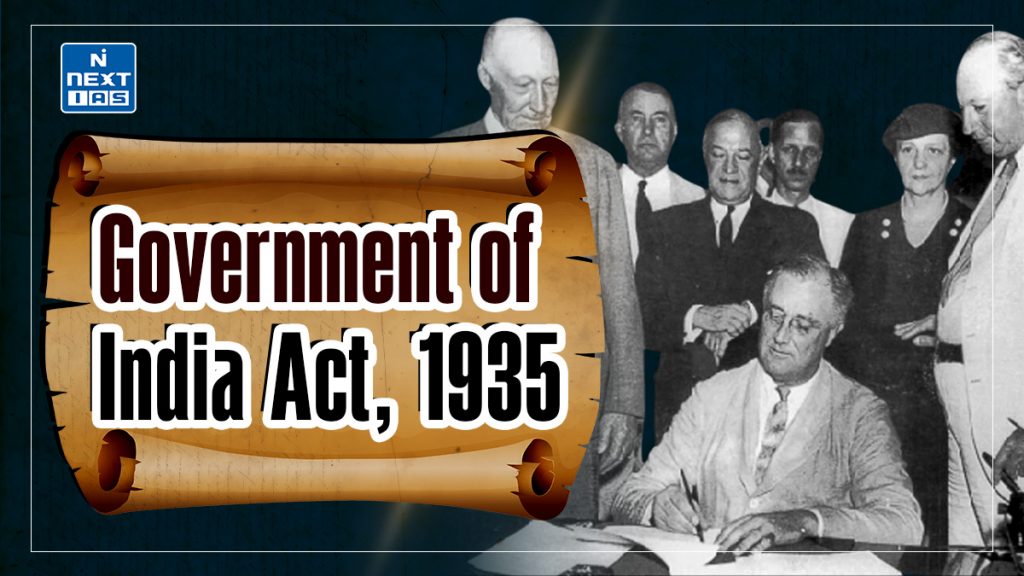
The growing aggressive demand for self-rule by Indians in the pre-independence period paved the way for provincial autonomy. Therefore, to appease common people and avoid further mass movements, the britishers came up with the Government of India act 1935.
The act was a historic constitutional reform passed in the British Parliament before Indian independence. However, the government of India act 1935 had provided many provisions in favour of the Indians but still the absolute or the real power was with the British government in England.
This act was instrumental at the time of drafting of Indian Constitution in 1950 as most of the constitutional provisions were taken from the government of India act 1935.
The act of 1935 led to the formation of a federal court in 1937 to settle the provincial disputes. The Reserve Bank of India and Public Service Commission were also created by the government of India act 1935. The act completely abolished Dyarchy at the provincial level which gave actual powers to local Indians in the departments like health and education. However, dyarchy was still present at the central level.
About Government of India Act, 1935
- The Government of India Act of 1935 marked a significant milestone in India’s political evolution under British rule, laying the groundwork for its eventual transition toward self-governance.
- While the Montagu-Chelmsford Reforms of 1919 had provided limited political autonomy, they failed to satisfy Indian aspirations for responsible governance.
- The 1935 Act addressed some of these demands by proposing extensive constitutional reforms, though it fell short of granting full self-rule.
Causes Behind Government of India Act, 1935
- Rising Demand for Indian Participation: Since the late 19th century, Indians had consistently demanded a greater role in the governance of their country.
- Simon Commission and Constitutional Deadlock: The Simon Commission (1927) faced widespread opposition, and its report led to a deadlock that intensified calls for substantive reforms.
- Round Table Conferences: The Round Table Conferences (1930–32) aimed to resolve constitutional issues but failed to achieve consensus.
- White Paper of 1933: The British government released a White Paper based on the recommendations of these conferences, which served as the basis for the 1935 Act.
Salient Features of Government of India Act, 1935
Federal Government Reforms
- Governor-General’s Role: The Governor-General was the linchpin of the constitution, holding powers to act independently on matters of national security.
- Three Legislative Lists: The Act proposed Federal, Provincial, and Concurrent legislative lists, but the federal structure still needs to materialize.
- Dyarchy at the Centre: Dyarchy was introduced at the Centre, dividing responsibilities between the executive and legislature, though it has yet to come into operation.
- Direct Elections: Direct elections were introduced for the first time, extending the franchise to 37 million people from the previous 5 million.
- Legislative Structure: The Council of States became a permanent body with a third of its members retiring every three years, while the Federal Assembly had a five-year tenure.
- Residuary Powers: The Governor-General retained significant powers, including veto rights, ordinance issuance, and financial authority.
Provincial Government Reforms
- Provincial Autonomy: Dyarchy at the provincial level was abolished, and greater autonomy was granted. Provinces derived authority directly from the Crown.
- Governors’ Powers: Governors were Crown nominees with extensive powers, including overriding provincial governments when deemed necessary.
- Separate Electorates: The communal award of separate electorates for minorities was implemented.
- Bicameral Legislatures: Six provinces—Assam, Bengal, Bombay, Bihar, Madras, and the United Provinces—adopted bicameral legislatures.
- Direct Elections: All provincial assembly members were directly elected, enhancing the role of Indian representatives in governance.
Institutional Developments
- Federal Court: The Act provided for the establishment of a Federal Court, which began functioning in 1937.
- Abolition of the Council of India: The advisory body to the Secretary of State for India was abolished.
- Creation of the Reserve Bank of India: The RBI was established in 1935 to manage India’s monetary policy.
- Public Service Commissions: The Act led to the creation of Provincial Public Service Commissions and a Joint Public Service Commission.
Analysis of Government of India Act, 1935
The Government of India Act, 1935, was a complex and extensive legislation with significant implications:
Successes of Government of India Act, 1935
- Establishing the Reserve Bank of India and the Federal Court were major achievements.
- Provincial autonomy, introduced in 1937, allowed Indian leaders to form provincial governments, marking a step toward responsible governance.
- The Act’s electoral provisions created political awareness and participation among a broader segment of Indians.
Limitations of Government of India Act, 1935
- The proposed All-India Federation never materialized due to lack of support from princely states.
- The Governor-General and provincial governors retained overriding powers, limiting real autonomy.
- Communal awards and separate electorates further divided Indian society on religious lines, fueling tensions.
- The continued use of emergency powers by British authorities undercut democratic principles.
Conclusion
The Government of India Act 1935 was a landmark reform that shaped India’s constitutional framework. Although it fell short of granting complete self-rule, it provided a foundation for future governance models, including the Constitution of India in 1950. The Act highlighted the growing assertion of Indian leaders and the colonial government’s gradual retreat from absolute authority, setting the stage for India’s independence movement.
Frequently Asked Questions (FAQs)
What is Government of India Act 1935?
The Government of India Act, 1935, was a landmark legislation introduced by the British Parliament to provide a framework for governing India. It aimed to grant autonomy to Indian provinces and establish a federal structure for the country, though the federal system was never fully implemented.
What were the main features of the Government of India Act 1935?
The Government of India Act, 1935, introduced provincial autonomy, proposed a federal structure, and established a Federal Court. It expanded the electorate, created bicameral legislatures in some provinces, and separated Burma from India.