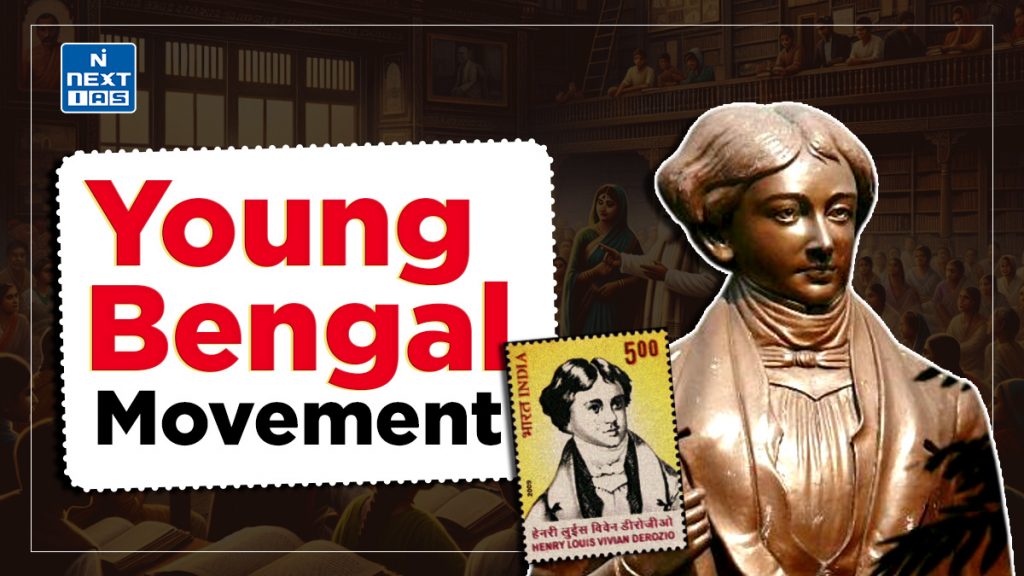
The Young Bengal Movement was a 19th century radical movement against orthodox society founded by Henry Vivian Derozio. The movement emphasized freethinking and western radicalism. The Hesperus, The Enquirer, Parthenon, Bengal Spectator were some of the journals or newspapers that were published during the movement. These journals spread radical anti-orthodox views in front of the common people. The core demands of the movement includes Female Education, Freedom of Press and Labour Reforms.
Derozio founded one of the first debating societies, ‘Academic Association’, in 1828 which was primarily driven by his brilliant college students. LSome of his famous intellectual students include Radhanath Sikdar who was known for calculating the height of Mount Everest, Peary Chand Mitra who was a pioneer of Bengali literature, Krishna Mohan Banerjea who was a prolific writer and later became a christian minister.
About Young Bengal Movement
- The Young Bengal Movement was initiated by Henry Vivian Derozio (1809–1831), a young Anglo-Indian teacher at Hindu College in Calcutta.
- His followers, known as Derozians, included notable figures like Krishnamohan Bondopadhyaya, Tarachand Chakraborty, Dakshinaranjan Mukhopadhyaya, Ramgopal Ghosh, Ramtanu Lahiri, and Pearychand Mitra.
Key Contributions and Ideals of Young Bengal Movement
- Spirit of Rational Thinking: Derozio inspired his students to think freely and rationally with his famous motto, “He who will not reason is a bigot; he who cannot is a fool, and he who does not is a slave.”
- Educational and Cultural Efforts: The Derozians established the Calcutta Public Library in 1835, which later became the National Library, India’s largest library. They also set up schools at their own expense and advocated for using the mother tongue as the medium of instruction.
- Challenge to Orthodoxy: They questioned religious and social orthodoxies of Hinduism and founded the Society for the Acquisition of General Knowledge in 1838.
- Advocacy for Social Change: The Young Bengal Movement initially supported atheism (though this belief later declined) and opposed societal issues such as caste discrimination, child marriage, polygamy, and restrictions on widow remarriage.
Programmes and Objectives of Young Bengal Movement
The Young Bengal Movement fiercely opposed orthodox rituals and customs, actively challenging social injustices and advocating for progressive reforms. Among their primary demands were:
- Protection of Ryots (Peasants) from Oppressive Zamindars: The Derozians stood against the exploitation of peasants by wealthy landlords, known as zamindars, who often forced ryots into heavy tax burdens and harsh working conditions.
- The movement called for fair treatment and protection of ryots to improve their living conditions and prevent abuses of power by the landed elite.
- Individual Liberty and Freedom of the Press: Inspired by Enlightenment ideas, the Young Bengal Movement championed freedom of expression.
- They argued that a free press was essential for exposing injustice, challenging orthodoxy, and fostering an informed and liberated society.
- The Derozians believed freedom of thought and expression were fundamental to India’s progress and self-awareness.
- Jury Trials and Better Treatment of Indian Labor in Colonies: The movement demanded impartial jury trials, which would allow fair legal representation for Indians.
- They also advocated for the humane treatment of Indian labourers in British colonies, many of whom faced gruelling conditions, low pay, and racial discrimination.
- By demanding these reforms, the movement sought to protect Indian citizens from legal injustices and oppressive labour practices.
- Women’s Rights and Access to Education: The Derozians recognised the importance of women’s empowerment and actively supported women’s rights, including access to education.
- They believed educated women could better contribute to family and society, thus promoting broader social reform.
- Their calls for women’s education and rights marked a progressive step in the male-dominated society of the time.
Analysis of Young Bengal Movement
- Surendranath Banerjee described the Derozians as “the pioneers of the modern civilisation of Bengal, the conscript fathers of our race whose virtues will excite veneration and whose failings will be treated with gentlest consideration.”
- The movement faced a sudden decline following Henry Vivian Derozio’s death, and its influence was limited due to:
- Viewing all aspects of Hinduism as negative, thus alienating them from society’s realities.
- Reliance on Western education, rationalism, and scientism distanced them from the masses.
- Failure to organise a widespread social movement to support their reform agenda.
Conclusion
Though short-lived, the Young Bengal Movement marked an essential step in India’s reform journey by challenging established norms and fostering a spirit of rationality and inquiry. Despite its limitations, the movement inspired future reformers and set the stage for social change, underscoring the need for continuous efforts in education, gender equality, and social justice. Its legacy as a pioneering force in India’s intellectual awakening endures in the ongoing pursuit of an enlightened, egalitarian society.
GS - 1