
 80813-00200

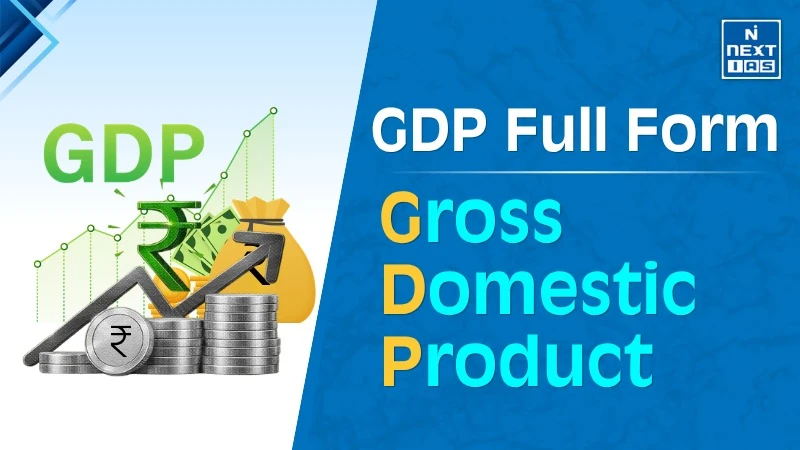
GDP full form is Gross Domestic Product (सकल घरेलू उत्पाद), which denotes the total monetary value of goods and services produced in the country within a financial year. GDP was first elaborated by economist Simon Kuznets in the 1930s to understand the true depth of the Great Depression.
There are 3 methods to calculate GDP are as follows:
- The Production (Output) Approach: It means the sum of the value added by all businesses across all sectors, such as manufacturing, services, and agriculture, excluding the cost of intermediate goods.
- The Income Approach: The sum of all income earned by individuals and businesses in the country, including wages, rent, interest, and profits.
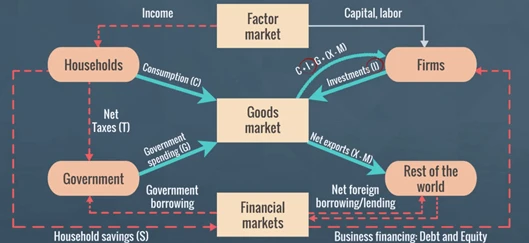
- The Expenditure Approach: The sum of all spending in the economy: Consumption + Investment + Government Spending + (Exports - Imports).
Here: C=Consumption, I=Investment, G=Government spending, Exports - Imports (X - M)
GDP of India
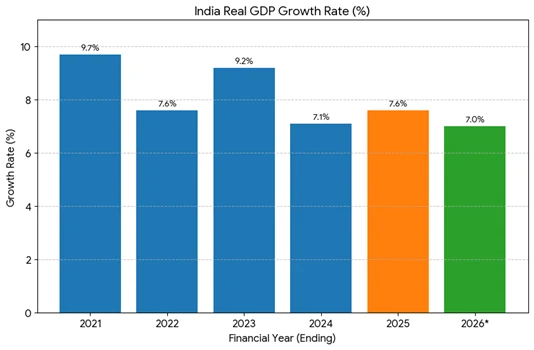
The real GDP of India is estimated to grow by 7.6% in the current financial year (FY 2025–26) according to the second advance estimates the government released . The current levels are a revision of the previously anticipated growth of 7.4 since the economy has been resilient even amidst trade uncertainties in the global markets.
About GDP Growth Rate of India
GDP Growth rate is the percentage rate of growth in gross domestic product (GDP) of a particular country in a given time period, typically, the yearly or quarterly rate. It is the most popular economic indicator of the size and overall health of an economy. Policymakers, businesses, and financial institutions therefore use the trend of GDP to plan and make decisions in the economy.
- GDP Growth Rate shows the economic wellness and well being of a nation.
- Increase in rate implies expansion of the economy.
- A decreasing rate of growth is a sign of contraction or recession of an economy.
- It can be measured in real terms (adjusted for inflation) or nominal terms (without adjustment).
Key Growth Figures of GDP of India (FY 2025-26)
| Indicator | Growth Rate |
|---|---|
| Real GDP Growth | 7.6% |
| Nominal GDP Growth | 8.6% |
| Manufacturing GVA | 8.4% (H1) |
| Services GVA | 9.3% (H1) |
Key Highlights
- By early 2026, India is still the fastest-growing major global economy. The country has a nominal GDP of about 4.5 trillion, which is strongly on track of becoming the third largest economy in the world.
- Updated Framework: India has updated its base year of GDP to 2022-2023 to better reflect sectors of the economy that are growing more rapidly.
- Global Positioning: India is the fastest growing major economy in the G20, surpassing such large economies as China and the United States.
Sectoral Contribution to GDP Growth
The Indian economy is said to be a three legged stool: Agriculture, Industry, and Services. All three legs set a firm stage with their weight, though their heights vary.
Agriculture: The Resilience Factor
- It is projected that agriculture will increase at 3.1% in FY26. Although its proportion of the total GDP is gradually weakening (currently about 17.7 percent), the significance as an employer is enormous.
- This move to the more stable Allied Activities such as fisheries and livestock which increase at a slower pace (5-6 percent) has stabilized rural incomes despite the fluctuation in crop production.
Industry and Manufacturing: "Make in India" 2.0
- The growth in the manufacturing sector has been recorded in double-digit in the recent quarters. The Manufacturing & Construction industry is estimated to record 7.0% growth.
- The Production Linked Incentive (PLI) plans have finally reached their maturity that they are not limited to assembly before they are able to manufacture the component parts.
- India: India now leads export of smartphones, but in 2026, it has switched to semiconductors and Electric Vehicle (EV) batteries, with initial indigenous semiconductor chips already beginning to come out of factories in Gujarat and Karnataka.
Services: The Digital Powerhouse
- Services Projected to grow by 9.1% in FY26. Services continue to prevail, as they mean more than 54 percent of the GDP.
- However, the nature of services is changing. It is not only back-office IT support anymore.
- India has emerged as a Global Capability Centre (GCCs) hub, where MNCs conduct all their global R&D, legal, and financial work in Indian cities such as Bengaluru, Hyderabad, and Pune.
|
Key Manufacturing Categories Record Notable Gains (Year-on-year IIP growth (%)) |
||
|---|---|---|
| Manufacturing category | Q1 2025-26 | Q1 2026-27 |
| Electrical Equipment | 9.7 | 27.0 |
| Other Transport Equipment | 3.8 | 19.5 |
| Computer, electronic and optical products | 8.8 | 12.4 |
| Machinery and equipment | 6.6 | 9.1 |
Future Growth Projections
The following is the future prognosis of major international and domestic institutions:
- Government/RBI: Projects a real GDP growth range of 6.8% – 7.2% for FY 2026–27.
- OECD: Forecasts 6.1% for 2026–27 and 6.4% for 2027–28.
- Moody's: Estimates growth at 6.4% in 2026 and 6.5% in 2027.
- IMF: Expects a growth rate of 6.2% for 2026.
Socio-Economic Indicators (The Inclusive Growth Angle)
- Unemployment: The rate has gone down to 4.8% (according to PLFS 2025-26), but there is the dilemma of underemployment.
- Female Labour Force Participation rate (FLFPR): The level of FLFPR has increased dramatically to more than 40%. This is much because of the feminization of agriculture and the emergence of the gig economy that gives women flexible work options in the cities.
- Poverty Alleviation: According to Multi-dimensional Poverty Index (MPI) the index has reduced by half (55) ten years to 11.28% in 2026.
Terminology Related to GDP
| Term | Meaning |
|---|---|
| GDP | Total value of final goods and services produced within a country during a specific period. |
| Nominal GDP | GDP measured at current market prices. |
| Real GDP | GDP adjusted for inflation, reflecting changes in actual output. |
| GDP Deflator | Price index measuring changes in prices of domestically produced final goods and services. |
| GDP Growth Rate | Percentage change in real GDP between two periods. |
| GDP per Capita | GDP divided by the country’s population. |
| GVA | Gross Value Added measures the value added by producers across economic activities. |
| NDP | Net Domestic Product = GDP – depreciation of capital assets. |
| GNP | Gross National Product measures output/income associated with a country's residents, including net factor income from abroad. |
| Final Goods | Goods purchased for final use rather than for further production. |
| Intermediate Goods | Goods used as inputs in producing other goods and services. |
| Depreciation | Reduction in the value of fixed capital due to wear, tear or obsolescence. |
| Purchasing Power Parity (PPP) | Method of comparing economies based on the relative purchasing power of currencies. |
| Gross Capital Formation | Investment in fixed assets, inventories and valuables within an economy. |
| Net Exports | Exports - imports of goods & services. |
Key Drivers of India's Growth
- High Domestic Consumption: The largest part of GDP is made by private consumption; almost 57 percent of the total proves it. An increase in demand has been maintained by rising incomes, urbanization, and purchasing power.
- Government Expenditure : This has been a major growth spur as a result of government spending on infrastructure, welfare schemes, and capital expenditure.
- Investment Growth : The investment, which is measured in terms of Gross Fixed Capital Formation (GFCF), has been exhibiting consistent growth.
- Digital Economy Expansion: India is developing a new driver of growth in the digital sector. It will account for almost 20% of GDP by 2029-30.
- Structural Reforms: GST, Insolvency and Bankruptcy Code (IBC) and digital governance are the types of reforms that enhance efficiency and transparency.
Challenges Affecting GDP
- Global Economic Uncertainty: Exports and investment can be influenced by geopolitical tensions, trade imbalance, and declining world demand. Such as The conflict in West Asia has pushed crude oil prices to over $150 per barrel at times.
- Employment Issues: while the GDP is growing job creation has not kept pace, the situation causes worries of jobless growth. The unemployment rate has lowered to 4.7. The task is to shift the workers out of low-productivity agriculture into high-productivity manufacturing.
- Inflation and Price Stability: Despite the decline in inflation in recent times, the changes in food and fuel prices can push consumption.
- Sectoral Growth Inequality: Agriculture and informal sectors develop behind, resulting in income and development inequality.
- Infrastructure Gaps: Infrastructure bottlenecks limit industrial growth despite the progress made in infrastructure.
- Climate Change: Unpredictable weather patterns have ceased to be traced as a risk in the future but a reality in the present. Crops may be ruined by unpredictable heatwaves, or the productivity of labor decreased.
Way Forward
- Increase Employment Generation to encourage labor-intensive industries and competency building.
- Increasing the use of technology and innovation in order to make Manufacturing more competitive.
- Agricultural reforms on productivity, irrigation and access to markets.
- Investment in infrastructure development and transportation, logistic, and energy.
- Inclusive income to decrease income disparities across regions.
- Increasing Human Capital e.g. education and health systems.
FAQs
What is GDP?
GDP (Gross Domestic Product) is the sum of money value of all the final goods and services that have been produced in a nation's geographical boundary during a particular period.
What is the importance of GDP?
GDP is used to measure the magnitude and growth rate of the economy and is also used as an important measure of economic performance.
What are the different components of GDP?
Expenditure approach takes into account consumption, investment, government expenditure and net exports (export-import).
How nominal GDP differs from real GDP?
Nominal GDP is calculated in terms of current price level, while real GDP considers the change in the price level.
