


Syllabus: GS3/Economy
Context
- Recently, Andhra Pradesh launched Pillale Sampada (‘Children are Wealth’) at a World Population Day programme, signalling a shift from population control towards addressing low fertility and ageing.
About Demographic Transition in India
- India is moving from high birth and death rates to low fertility, mortality and population growth.
- The SRS Statistical Report 2024 places India’s Total Fertility Rate (TFR) at 1.9, below the replacement level of about 2.1.
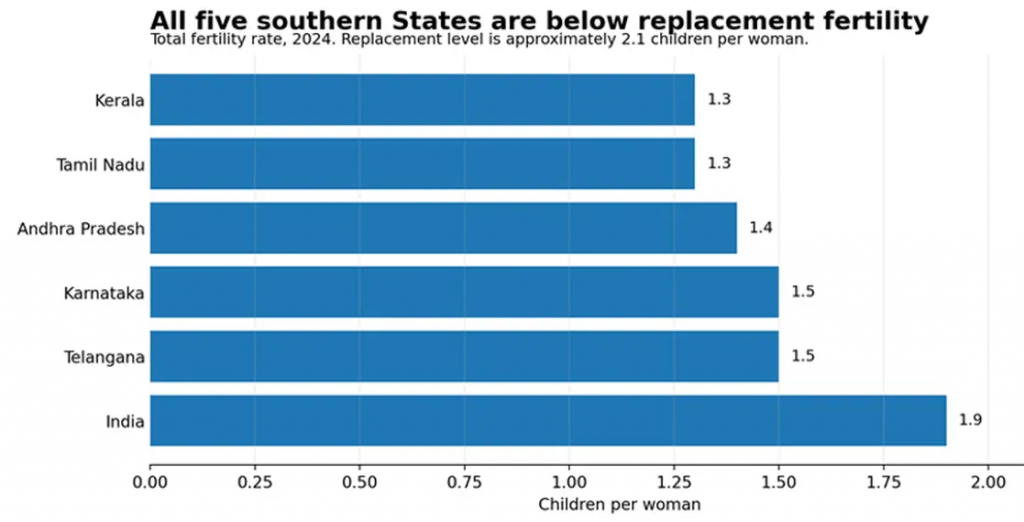
- The crude birth rate differs from TFR because its denominator includes the entire population, whereas TFR measures births over a woman’s reproductive life.
- However, below-replacement fertility does not mean immediate population decline.
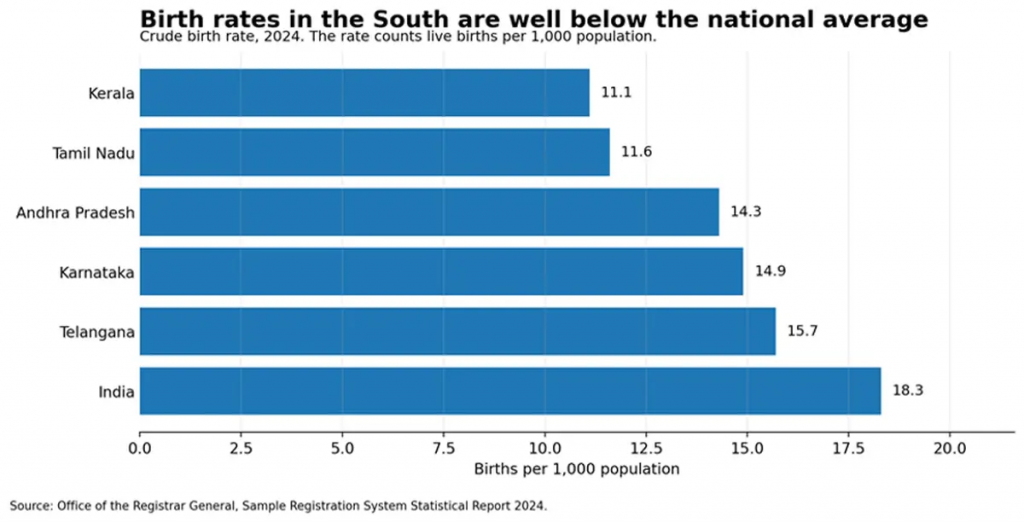
- Kerala, for instance, fell below replacement fertility in the late 1980s but continued to grow subsequently.
Demographic Transition: South India vs North India
- The South completed the fertility transition earlier, while several northern States retain younger age structures and relatively higher fertility.
- It creates a regional demographic divergence: the South is moving towards ageing and potentially labour shortages, while the North currently has a larger pool of young workers.
- But the South still possesses a substantial workforce.
- In 2021, the 15–59 age group constituted 67.1% of Andhra Pradesh, 67.5% of Telangana, 66.4% of Karnataka and Tamil Nadu, and 63.1% of Kerala, compared with 64.2% nationally.
- By 2036, Andhra Pradesh, Karnataka and Telangana are projected to remain around or above the national working-age share; Kerala falls to 59.5% and Tamil Nadu to 63.6%.
Advantages With South India
- It provides AP and Telangana a demographic-dividend window. But age structure alone cannot generate growth.
- Employment, skills, productivity, women’s workforce participation and migrant-worker integration determine whether the dividend materialises.
- Migration is another advantage. Southern construction, manufacturing, hospitality, transport and care sectors increasingly depend on workers from younger States, an example of replacement migration.
Related Issues & Concerns
- Rapid Ageing: In 2021, persons aged more than 60 comprised 16.5% of Kerala, 13.7% of Tamil Nadu and 12.3% of AP.
- By 2036, this is projected at 22.8%, 20.8% and 19%, respectively; Karnataka and Telangana reach 17.2% and 17.1%.
- The elderly-to-child ratio is expected to rise from 81:100 in Kerala, 69:100 in Tamil Nadu and 60:100 in AP in 2021 to approximately 129, 134 and 121, respectively, by 2036.
- Telangana reaches 106:100, Karnataka about 100:100, while India remains younger at around 74:100.
- Elderly Vulnerability: The India Ageing Report 2023 reports that over 40% of elderly are in the poorest wealth quintile, 18.7% have no income, and the more than 80 population could increase by around 279% between 2022 and 2050.
- Nearly a quarter of older persons have functional disability, potentially raising household living costs by 30–50%.
- Limits of Baby Bonuses: UNFPA-linked research finds one-time incentives generally produce modest, short-lived fertility increases, often affecting timing rather than completed family size.
- Childcare, parental leave, flexible work and financial support are more comprehensive levers.
- Reproductive Choice: AP removed its more than 2-child local-election disqualification in November 2024, followed by Telangana in January 2026.
- Policy should enable people to achieve their desired family size rather than impose numerical targets.
- Data Gap: Current projections largely rely on Census 2011 and pre-pandemic assumptions.
- A new Census is therefore essential for updated age, migration and labour-market planning.
Way Forward: A Differentiated Policy Roadmap
- Kerala & Tamil Nadu: Prioritise geriatric healthcare, long-term/home care, social pensions and senior-friendly infrastructure.
- Kerala’s 2026–27 Elderly Budget and its May 2026 Department of Senior Citizens Welfare orders indicate this direction.
- Andhra Pradesh & Telangana: Maximise the current demographic dividend through jobs, skilling, women’s employment and migrant integration rather than relying primarily on birth incentives.
- Karnataka: Combine workforce productivity with early preparation for rising old-age dependency.
- All Southern States: Expand childcare, parental leave, reproductive healthcare, infertility services and portable welfare for migrants.
- Promote a ‘second demographic dividend’ by enabling healthy older persons to work longer and deploy accumulated savings productively.
Conclusion
- Pillale Sampada highlights a genuine demographic challenge, but the immediate issue is not a shortage of children, it is preparing for fewer young people, more elderly citizens and a changing workforce.
- A sustainable population policy should focus on three outcomes i.e. desired fertility, productive employment and dignified ageing.
- The South can therefore become a laboratory for managing India’s post-demographic-transition future.
| Daily Mains Practice Question [Q] Discuss the emerging demographic challenges in Southern India and suggest a differentiated policy roadmap to harness the demographic dividend while preparing for population ageing. |
Previous article
India–China Relations: A Nash Equilibrium on the Border?
Next article
India’s Counter-Terror Strategy
