


Syllabus: GS3/Security
Context
- Terrorism has evolved from large hierarchical organisations into decentralised networks using drones, cyber tools and emerging technologies, pushing India to adopt a comprehensive counter-terrorism strategy.
Evolution of Terrorism
- From Hierarchical Networks to Decentralised Cells: The al-Qaeda attacks of September 11, 2001fundamentally altered global counter-terrorism and the subsequent decades witnessed the weakening of centralised organisations.
- Persons such as Osama bin Laden and Abu Bakr al-Baghdadi, alongside the emergence of smaller autonomous cells and lone-wolf attacks.
- Technology as a Force Multiplier: Terrorist networks increasingly exploit drones, encrypted communication, social media, instant messaging, dark web, crypto-wallets and cyber capabilities for recruitment, propaganda, financing and operations.
- The MHA’s National Counter-Terrorism Policy & Strategy identifies risks from robotics, cyber-attacks and CBRNED materials (Chemical, Biological, Radiological, Nuclear, Explosive and Digital).
India’s Early Experience
- Multiple and Evolving Threats: India’s cross-border terrorism in Kashmir intensified during the early 1990s.
- The assassination of Rajiv Gandhi in 1991 by the LTTE in Sriperumbudur demonstrated that terrorism was not confined to Kashmir.
- The Mumbai serial blasts (1993) & the hijacking of IC-814 (December, 1999) brought the Pakistan connection into sharper focus. India released terrorists including Ahmed Omar Sheikh and Masood Azhar in exchange for more than 160 hostages.
- The Parliament attack (December, 2001), attributed to Pakistan-based Jaish-e-Mohammed (JeM), resulted in Operation Parakram, involving large-scale military mobilisation.
- Other major attacks included Akshardham (2002), Varanasi (2006), German Bakery, Pune (2010) and attacks in Delhi i.e. Red Fort (2000), serial market blasts (2005), Delhi blasts (2008) and the Delhi High Court blast (2011), which killed 15 people.
- However, nuclear deterrence and escalation risks led to international diplomatic intervention and eventual disengagement after nearly two years.
India: From Strategic Restraint to Cross-Border Strikes
- Uri and Surgical Strikes: The Uri attack (September, 2016) by JeM terrorists was followed by India’s surgical strikes across the LoC against terrorist launch infrastructure.
- Pulwama and Balakot: Following the Pulwama attack on a CRPF convoy (February, 2019), the IAF conducted strikes on a JeM camp at Balakot, marking the first Indian Air Force strike across Pakistani airspace against a terrorist target.
- Pahalgam and Operation Sindoor: The Pahalgam terror attack (April, 2025) was followed by Operation Sindoor.
- India’s approach has evolved from primarily diplomatic and defensive responses towards intelligence-led prevention combined with calibrated cross-border action.
Related Efforts & Initiatives
- Global:
- UN Security Council counter-terrorism mechanisms and terrorist-designation regimes.
- International cooperation on terror financing, extradition and intelligence sharing.
- Financial Action Task Force (FATF) Action: Since becoming a member in 2010, India has actively used the FATF platform to strengthen global action against terror financing and expose state-sponsored terrorism.
- No Money for Terror Ministerial Conference (2018-19): India called for the early adoption of the UN Comprehensive Convention on International Terrorism (CCIT) and advocated the impartial and non-politicized enforcement of FATF standards.
- Coordination With INTERPOL: BHARATPOL portal connects the CBI (as INTERPOL’s National Central Bureau for India) with all law enforcement authorities in India on a single platform, covering areas including transnational organised crime, narcotics trafficking, arms, cybercrime, economic fraud, child pornography, and terrorism.
India’s Emerging Comprehensive Approach & Strategy
- Unlawful Activities (Prevention) Amendment Act, 2019: It strengthened India’s anti-terror legal framework by expanding the powers of the Central Government and investigative agencies.

- National Investigation Agency Amendment Act, 2019: It aims to expand the NIA’s jurisdictional mandate and it is enabled to investigate terror-related offences committed outside India against Indian interests.
- Strengthening of Prevention of Money Laundering Act (PMLA) Provisions: These have provided the Enforcement Directorate (ED) with sharper instruments to trace, freeze, and confiscate terror-linked assets.
- Bharatiya Nyaya Sanhita (BNS), 2023: It is for the first time that terrorism and organised crime has also been defined, and provisions for stringent punishment have been made under the new criminal laws.
- Arms (Amendment) Act, 2019: It strengthened India’s response to terrorism, insurgency, and organised crime by targeting illegal arms networks.
- National Counter-Terrorism Policy & Strategy (PRAHAAR): It provides a comprehensive framework based on seven pillars:
- Prevention of terrorist attacks;
- Swift and proportionate response;
- Aggregation of internal capacities through whole-of-government coordination;
- Human rights and rule-of-law-based processes;
- Addressing conditions conducive to radicalisation;
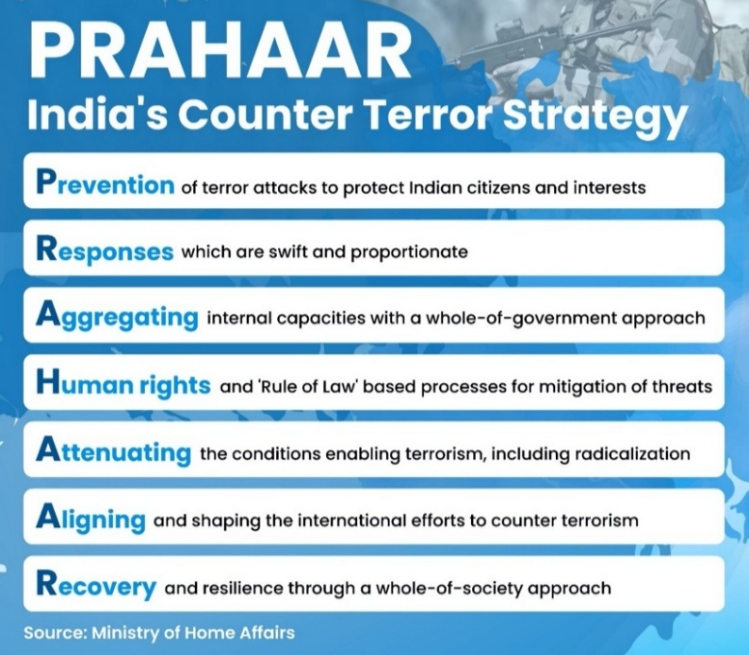
- International cooperation; and
- Recovery and resilience through a whole-of-society approach.
- It targets terrorists and their financiers, facilitators, over-ground workers, weapons networks and digital propaganda systems.
- It emphasises cooperation among intelligence agencies, police, CAPFs, NIA and NSG.
Way Forward
- Strengthen real-time intelligence fusion between Centre, States and security agencies.
- Build uniform CT/ATS structures, resources, training and investigation capabilities across States/UTs.
- Enhance counter-drone, cyber and AI-enabled threat detection.
- Disrupt terror financing through stronger domestic and international cooperation.
- Pursue de-radicalisation, counter-narratives, education and community engagement while safeguarding constitutional rights.
- Improve prosecution through early involvement of legal experts in investigations.
- Deepen international cooperation against safe havens, terrorist financing, weapons and digital ecosystems.
- Maintain a balance between national security, proportionality, human rights and rule of law.
Conclusion
- Twenty-five years after 9/11, terrorism has not disappeared; it has fragmented, technologised and transnationalised.
- India’s counter-terrorism architecture is consequently moving from reactive security to an integrated model combining prevention, intelligence, response, international cooperation, de-radicalisation and societal resilience, the core logic of PRAHAAR.
| Daily Mains Practice Question [Q] Examine the changing nature of terrorism and analyse the evolution of India’s counter-terrorism strategy from strategic restraint to a comprehensive, intelligence-led approach under PRAHAAR. |
