


Syllabus: GS2/International Relations
Context
- The recent ‘Eight Points of Outcomes and Consensus’ and the Modi–Xi meeting at the BRICS Summit have revived debate over whether bilateral ties are entering a durable détente.
About Nash Equilibrium
- In game theory, a Nash equilibrium is a situation in which no player can improve its expected outcome by unilaterally changing its strategy.
- Applied to India-China relations, it suggests a situation where neither side can realistically improve its territorial position without incurring disproportionate military and political costs.
- Thus, the present border situation may be viewed as a stable but unresolved equilibrium : diplomatic and military friction may recur, but neither side is likely to achieve a decisive and lasting alteration of the Line of Actual Control (LAC).
Nash Equilibrium & India-China Border Issues
- The boundary dispute has three broad sectors:
- Western sector: Aksai Chin, administered by China but claimed by India.
- Middle sector: Himachal Pradesh and Uttarakhand.
- Eastern sector: Arunachal Pradesh, administered by India but substantially claimed by China.
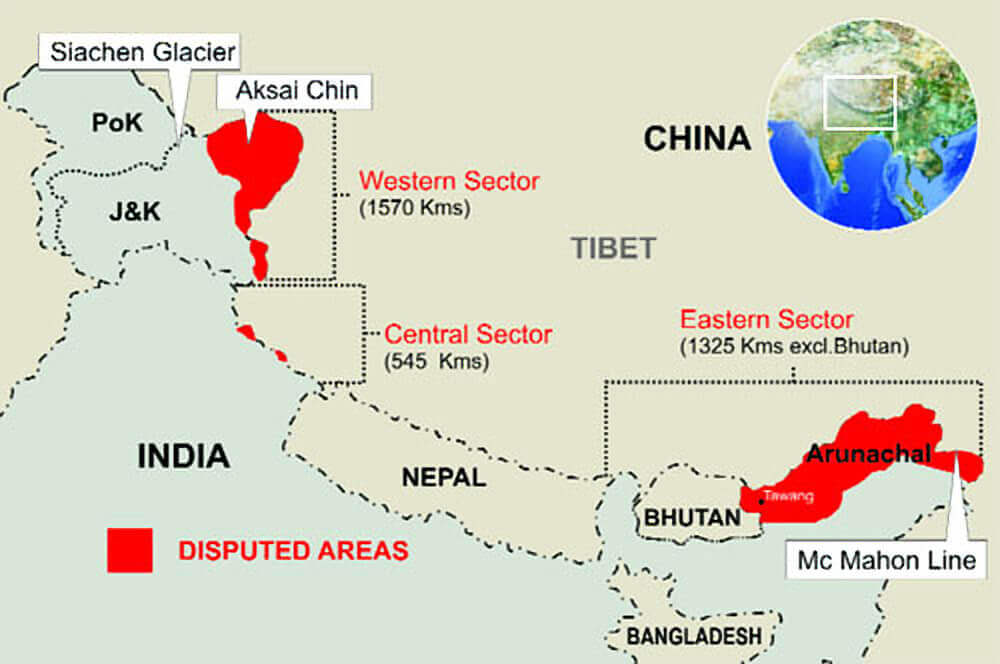
- India’s maximal objective would involve restoring its claim over Aksai Chin while retaining its position elsewhere.
- China’s maximal objective would involve securing Arunachal Pradesh up to the southern slopes while retaining its existing position in other sectors.
- Terrain, extreme climate, logistics and entrenched military deployments make large and permanent territorial gains exceptionally difficult.
- Consequently, barring major strategic miscalculation or internal political collapse, the status quo possesses considerable resilience.
Why a Final Boundary Settlement Remains Difficult?
- India and China have negotiated almost continuously since 1981:
- Secretary/Vice-Minister-level talks (1981–88)
- Joint Working Group (1989–2005)
- Special Representative Mechanism (2003–present)
- Over more than 45 years, the two sides have met roughly once a year on average, yet substantive progress has been limited.
- The key achievement remains the 2005 Agreement on Political Parameters and Guiding Principles for the Settlement of the India-China Boundary Question. It envisaged:
- a package settlement, nothing is final until the entire boundary is settled;
- a political settlement, rather than merely a cartographic or legal exercise;
- consideration of strategic concerns, history, national sentiment, practicality, geography and the interests of settled populations.
- The gap between maximal territorial claims and political feasibility therefore remains the fundamental obstacle.
Related Issues & Concerns
- Dalai Lama Succession: China is expected to appoint its preferred successor to the Dalai Lama, while Tibetan institutions are likely to assert their own choice.
- India could consequently face a difficult strategic dilemma.
- A contested succession could intensify India-China tensions, with Tibet’s political instability potentially becoming a security catalyst, as it was among the factors surrounding the 1962 conflict.
- India-Pakistan Conflict: A future India-Pakistan confrontation could acquire a dangerous two-front dimension if China becomes directly involved.
- During Operation Sindoor in 2025, India detected Chinese support to Pakistan.
- Greater Chinese involvement in a future conflict could therefore destabilise the existing India-China equilibrium.
Both Countries’ Efforts Related to Border Issues
- Eight-point Outcomes and Consensus Statement: It calls for an early and substantial harvest in boundary negotiations.
- It does not necessarily abandon the 2005 package principle. Instead, it appears to encourage an incremental or early-harvest approach: make progress in one section, consolidate it, and then move to another.
- Under the existing framework, however, sectional progress would ultimately require acceptance as part of the overall boundary settlement.
- The Modi–Xi BRICS meeting readouts similarly do not fundamentally alter the 2005 framework.
- The significance is therefore less a breakthrough on the boundary and more a nudge towards stabilisation and practical cooperation.
- Both sides have combined military deterrence with diplomatic engagement, while maintaining mechanisms for dialogue and border management.
- The 2005 political parameters, subsequent agreements and Special Representative talks provide the institutional foundation.
- The current détente could additionally facilitate trade, visas, supply-chain resilience and cooperation over transboundary rivers, creating wider incentives against renewed confrontation.
Way Forward
- India should pursue a dual-track strategy:
- maintain credible military preparedness and infrastructure along the LAC;
- accelerate Special Representative-level negotiations;
- pursue sector-wise confidence-building and early harvests without compromising the eventual package settlement;
- develop safeguards against crises arising from Dalai Lama succession and India-Pakistan tensions;
- use expanding economic and people-to-people ties to create strategic insulation;
- strengthen communication and crisis-management mechanisms to prevent local incidents from escalating.
Conclusion
- The Eight-point Outcomes and Consensus Statement statement and Modi–Xi engagement indicate stabilisation rather than a final settlement.
- India and China appear to recognise that neither can easily obtain its maximal territorial objective.
- The immediate task, therefore, is not to mistake détente for resolution, but to convert the existing Nash equilibrium into durable strategic stability while preparing for shocks that could overturn it.
| Daily Mains Practice Question [Q] The India–China border dispute increasingly resembles a Nash equilibrium, where neither side can significantly improve its territorial position without imposing prohibitive costs on itself. Critically analyse. |
