


Syllabus: GS3/Economy
Context
- The Centre has extended the production-linked incentive (PLI) scheme for domestic manufacturing of medical devices up to 2035-36.
About the Scheme
- The PLI-MD scheme was launched in 2020-21.
- It has led to domestic manufacturing of over 60 high end medical devices and components.
- The scheme has resulted in production valued at over ₹16,000 crore.
- PLI-MD 2.0 aims to fulfil the vision of Atmanirbhar Bharat and Make in India, develop indigenous supply chains, attract investment, generate employment, and enhance India’s global competitiveness in high-end medical technologies.
- The government has scrapped the minimum sales threshold previously mandatory to claim cash payouts and lowered the minimum investment requirement.
- Manufacturers can apply across multiple product categories, with a three-year window provided to set up greenfield or brownfield facilities.
- The policy also seeks to shift domestic output away from basic packaging towards advanced engineering.
India’s Medical Device Sector
- Medical devices are instruments, apparatus, appliances, implants, reagents and software used for the diagnosis, prevention, monitoring, treatment or alleviation of diseases.
- India’s medical device sector, currently valued at around $14 billion, is projected to reach $30-50 billion within this decade, and likely to reach $250 billion by 2047.
- India is the fourth-largest medical devices market in Asia and ranks among the top 20 globally.
- However, hospitals and diagnostic labs continue to rely on overseas suppliers for 70% to 80% of their equipment needs.
- Under the National Medical Devices Policy 2023, the Centre aims to expand the domestic market from $11 billion in 2020 to $50 billion by 2030.
Significance of the Medical Device Sector
- Affordable healthcare: Local production can reduce dependence on expensive imported equipment, which can lower healthcare costs for patients.
- Economic growth: The sector promotes investment, employment generation, entrepreneurship and the development of the manufacturing ecosystem.
- Import substitution: Domestic production of advanced medical devices can reduce India’s dependence on foreign suppliers and strengthen supply-chain resilience.
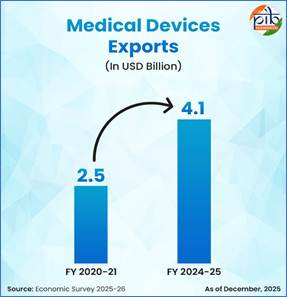
- Export potential: Indian manufacturers have the potential to become global suppliers of affordable and quality medical devices. India’s medical device exports reached USD 4.1 billion in FY 2024–25, with exports to 187 countries.
- Technological advancement: The sector encourages innovation in artificial intelligence, robotics, 3D printing, wearable devices and advanced diagnostic technologies.
Challenges Facing India’s Medical Device Sector
- Import dependence: India continues to depend heavily on imports for high-end medical equipment, advanced diagnostic devices and critical components.
- Limited R&D: Inadequate investment in research and development restricts indigenous innovation and the development of advanced medical technologies.
- Lack of infrastructure: Limited access to specialised testing laboratories, calibration facilities, sterilisation units and manufacturing infrastructure increases production costs.
- Dependence on imported components: Domestic manufacturers often rely on imported raw materials, electronic components and specialised technologies.
- MSME constraints: A large number of domestic manufacturers are small enterprises facing difficulties in accessing finance, advanced technology, skilled manpower and global markets.
Government Initiatives
- Scheme for Promotion of Medical Devices Parks: The scheme aims to provide common testing and laboratory facilities/centres at one place.
- Three parks are being set up and are at an advanced stage of development in Uttar Pradesh (Greater Noida), Madhya Pradesh (Ujjain), and Tamil Nadu (Kanchipuram).
- Promotion of Research and Innovation in Pharma-MedTech Sector (PRIP): It aims to strengthen research and innovation in the pharmaceutical and medical technology sectors.
- It supports research infrastructure and Centres of Excellence to promote innovation and technology development.
- Scheme for Strengthening of Medical Device Industry (SMDI): It was launched with an outlay of ₹500 crore for FY 2024–25 to FY 2027–28.
- It focuses on developing common facilities, reducing import dependence, skill development, clinical studies and promotion of the medical device industry.
Conclusion
- India’s medical device sector is strategically important for achieving Atmanirbhar Bharat and affordable healthcare.
- Strengthening domestic manufacturing, innovation, research and quality standards can help India emerge as a global hub for affordable and high-quality medical technology.
Source: PIB
Previous article
ECI Extends MCC Curbs to Retired Govt. Officials
