


Syllabus: GS3/Defence & Security
Context
- Forward-Deployed Engineering (FDE) has gained prominence as AI adoption shifts from experimentation to operational deployment, with defence and other sectors seeking engineers to adapt AI to real-world workflows.
About ‘Forward-Deployed Engineering’ (FDE)
- It was pioneered by Palantir around 2006 that embedded software engineers with users.
- The engineer in FDE observes operational problems, modifies or develops software rapidly, and feeds field experience back to the core product team.
- Palantir initially paired a ‘Delta’ (FDE) with an ‘Echo’ (deployment strategist), often a former military officer/domain expert. It brought together technical expertise and institutional knowledge.
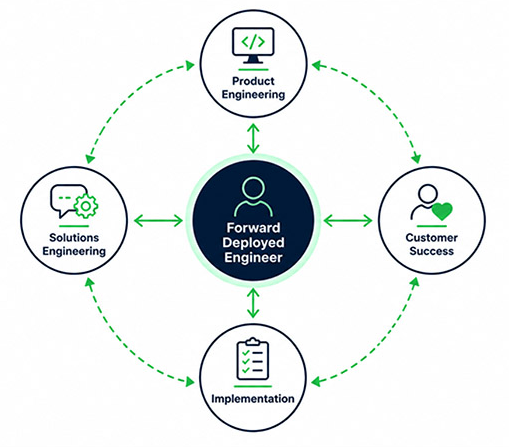
- Thus, an FDE combines three roles:
- Engineer: Builds and modifies software/AI solutions.
- Product Strategist: Converts operational requirements into technological solutions.
- Field Operator / Technology Intermediary: Understands how technology performs under actual conditions.
Core Characteristics of FDE
- Product Ownership: The FDE remains an employee of the technology company and retains influence over product design.
- Instead of creating a new system from scratch, existing capabilities can be customized for a specific military mission, reducing costs and adoption time.
- Bi-directional Knowledge Flow: FDE creates a continuous bridge between developer and user. Engineers explain technological capabilities to military personnel, while users communicate failures, unforeseen situations and operational requirements back to developers.
- It helps close the AI capability–operational utility gap.
- Field-Driven Productisation: Custom solutions developed for one client can become reusable product features.
- Repeated field iterations therefore improve the core product and make subsequent deployments faster.
Why FDE Matters for Defence AI?
- Modern military effectiveness increasingly depends on AI, software, cloud infrastructure, data and digital networks.
- However, possessing advanced technology does not automatically translate into mission success.
- Defence deployment adds classified/unclassified information, access controls, legacy databases, incompatible systems and mission-specific workflows.
- This is the deployment gap, the difference between what AI can theoretically do and the operational value it actually delivers.
- A MIT study in 2025 reported that 95% of AI pilots failed to generate business value, highlighting organisational silos and data-integration problems.
- FDE addresses this by putting technical expertise alongside operational users. It converts generic AI capability into context-specific military capability.
Case Study: Project Maven
- Project Maven, launched by the US Department of Defense in 2017, initially used machine learning to analyse the enormous volume of drone imagery and video generated during operations in Iraq and Afghanistan, which human analysts could not process efficiently.
- Over time, it evolved into the Maven Smart System (MSS), a broader AI-enabled command-and-control platform covering battlespace management, target management, AI-enabled deliberate planning and execution, and machine-assisted disclosure.
- Maven Smart System (MSS) has supported Ukrainian forces during the Russia–Ukraine war, including AI-enabled decision support for targeting.
- MSS capabilities helped US forces strike more than 1,000 identified targets, around 10 times the number possible without MSS during operations in Iran.
- The wider lesson is that AI is becoming an additional layer between battlefield sensors i.e. satellites, drones and personnel and commanders, fusing information into actionable situational awareness.
Challenges & Concerns Related to FDE
- Skill dependency: When external FDEs leave, militaries may lack personnel capable of maintaining customised AI systems.
- Vendor lock-in: Close developer-user relationships can make military requirements and infrastructure dependent on one firm.
- Cost and duration: FDEs are expensive and should operate against defined milestones rather than indefinitely.
- Security: Embedded personnel must operate within stringent military data, cybersecurity and classification protocols.
- Requirement capture: FDEs can influence future military requirements, raising questions of institutional autonomy and procurement neutrality.
India’s Effort: Supporting FDE Ecosystem
- India already possesses several building blocks: iDEX/DIO, DRDO, Service Headquarters, Technology Development Fund (TDF), DRDO Industry–Academia Centres of Excellence, CAIR and DYSL-AI.
- However, an explicit operational bridge between technology developers and military users remains important.
- For example, an iDEX DISC challenge seeks an ‘AI Module for UAS for Autonomous Recognition, Identification and Targeting’.
- Developers such as DIO, HAL or defence start-ups could embed engineers during user testing, pilot testing, operational experimentation and iteration rather than ending engagement at the prototype stage.
Way Forward
- India should institutionalise FDE as a time-bound deployment and learning mechanism, with clear milestones, interoperability and data-security standards.
- In the long term, the Armed Forces should develop indigenous FDE talent by leveraging structures such as the Army Corps of Engineers and Military Engineer Services (MES), alongside DRDO and technical institutions.
- The objective should be clear: not merely acquiring AI, but mastering its deployment, adaptation and sustained operational use.
- In the AI age, technological superiority will depend as much on the ability to integrate technology with soldiers and military workflows as on possessing sophisticated algorithms.
| Daily Mains Practice Question [Q] Examine the role of Forward-Deployed Engineering (FDE) in integrating AI into defence operations. Discuss its potential and challenges for India’s defence ecosystem. |
Previous article
India’s Youth: Powering World’s Ageing Economies
