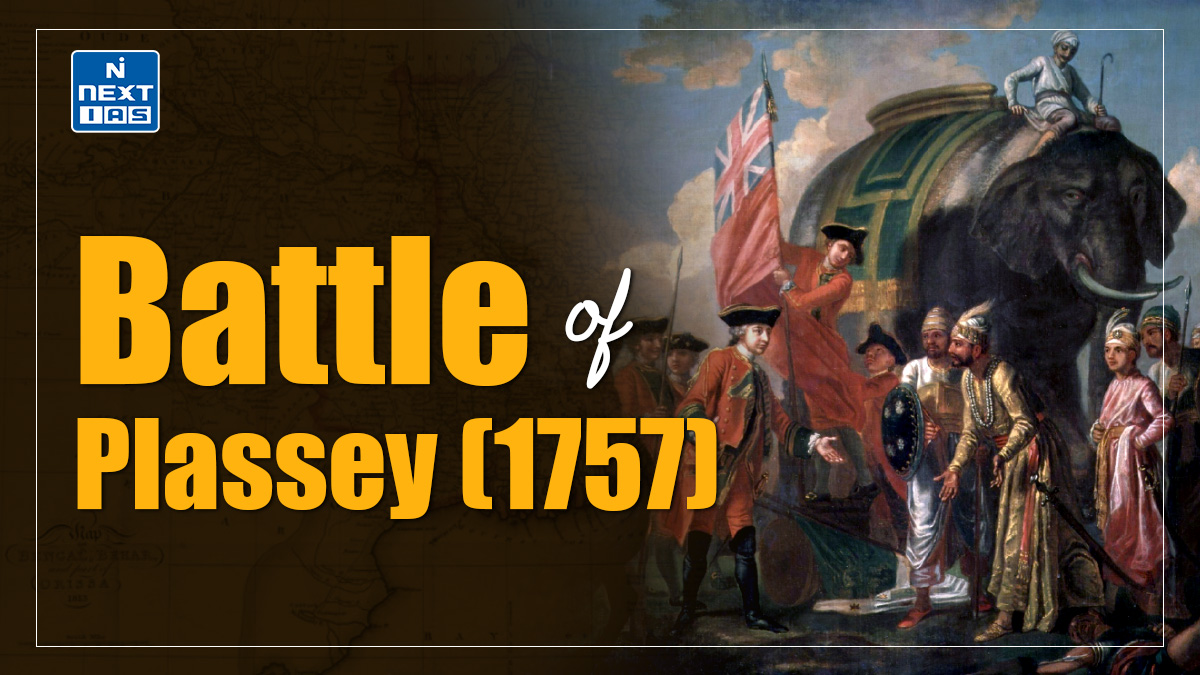
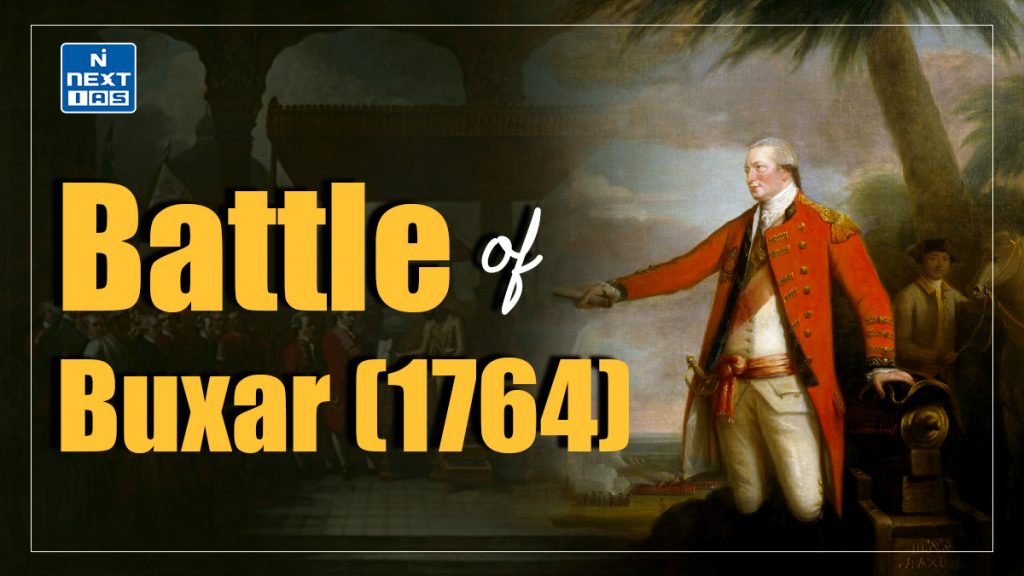
The Battle of Buxar was fought on 22 October 1764 between the British East India Company under Major Hector Munro and the tripartite alliance of Nawab of Bengal Mir Qasim, Mughal Emperor Shah Alam II and Nawab of Awadh Shuja-ud-daulah. Although the Britishers including Indian sepoys were having around 17,000 troops but using superior artillery and trained personnel, they defeated about 40,000 troops of the combined armies of the Mughal empire. Buxar was a decisive battle that reaffirmed British dominance over Bengal and Bihar after their victory in the Battle of Plassey in 1757.
The Battle of Buxar 1764 was concluded with the Treaty of Allahabad 1765 wherein the Mughal Emperor granted the Diwani Rights or the rights to collect tax revenues over Bengal, Bihar and Odhisha. At that time, these 3 provinces were the wealthiest in India and for the 1st time a private company became the tax collector of an empire. Britishers used Indian tax money to purchase Indian goods and exported the items to England for profit.
In 1765, the Dual System of Governance where Diwani were given to Britishers & Nizamat, the responsibility of administration, law and order was retained by the Mughal empire. It gave power without responsibility to the East India Company who drained the wealth of Bengal that finally led to the Great Bengal Famine in 1770.
About the Battle of Buxar
- The Battle of Buxar, fought on October 22, 1764, was a decisive conflict between the forces of the British East India Company and a combined alliance of Indian rulers led by Mir Qasim, the Nawab of Bengal; Shuja-ud-Daula, the Nawab of Awadh; and the Mughal Emperor Shah Alam II.
- Following the growing tensions and confrontations stemming from British interference and Mir Qasim’s attempts to reclaim authority over Bengal, a series of skirmishes escalated into full-scale war.
- Despite the English’s initial victories in battles at Katwa, Murshidabad, Giria, Sooty, and Monghyr, Mir Qasim sought to strengthen his position through alliances, culminating in the pivotal Battle of Buxar.
- This battle ultimately marked a turning point, as the English emerged victorious, solidifying their power in Bengal and laying the foundation for British dominance in India.
Causes of the Battle of Buxar (1764)
- The Company wanted Mir Qasim to be its puppet and meet its financial demands, but Mir Qasim failed to fulfil the Company’s expectations.
- The Nawab-Company tussle over transit and trade duty led to wars between the English and Mir Qasim in 1763, eventually leading to the battle of Buxar in 1764.
Events and Aftermath of the Battle
| Events | Aftermath |
|---|---|
| – After being defeated in successive wars against the English, Mir Qasim escaped to Oudh and organised the confederacy with the Nawab of Oudh Shuja-ud-daula and Emperor Shah Alam II in a final bid to oust the British from the Bengal. – The combined armies of three powers, between 40,000 and 60,000, met an English army of 7072 troops commanded by Major Munro at the battlefield of Buxar on 22 October 1764 in a closely contested battle. The superior English military won the battle for them. | – Mir Jafar was once again reinstated as the Nawab of Bengal. – A treaty of Allahabad was signed between Lord Clive and Shah Alam, the Mughal Emperor. – The English established a dual system of governance in Bengal after receiving the Diwani rights of Bengal, Bihar, and Odisha. |
The Treaty of Allahabad
Robert Clive concluded two important treaties at Allahabad in August 1765: one with the Nawab of Oudh and the other with the Mughal Emperor.
Nawab Shuja-ud-Daula
- Agreed to surrender Allahabad and Kora to Emperor Shah Alam II;
- Pay Rs 50 lakhs to the Company as war compensation.
- Give Basant Singh, Zamindar of Banaras, full possession of his estate.
Shah Alam II
- Issued a Farman granting the Diwani of Bengal, Bihar and Odisha to the East India Company for an annual payment of Rs. 26 lakhs.
- The Company is provided Rs. 53 lakhs in return for Nizamat functions (military, defence, police, and administration of justice) of the said provinces.
- The treaty made the Nawab a friend of the Company and turned Oudh into a buffer state. It made the Emperor a useful ‘rubber stamp’ of the Company. Besides, the Emperor’s farman legalised the political gains of the Company in Bengal.
Significance of the Battle
- It was one of the most decisive battles of Indian history as it demonstrated the superiority of the English Army over the combined army of three major Indian powers.
- The Company ceased to be a trading company and became a ruling power.
- The importance of this battle lay in the fact that the British defeated not only the Nawab but also the Emperor.
- The victory made the English a power to reckon with in Northern India and contenders for the supremacy of the whole country.
- The battle of Buxar confirmed battle of Plassey’s decision.
Conclusion
The Battle of Buxar holds a crucial place in the annals of Indian history as a turning point that elevated the British East India Company from a mercantile entity to a sovereign power. The subsequent Treaty of Allahabad, which formalised British authority over Bengal, Bihar, and Odisha, marked the beginning of British dominance in Indian governance. Ultimately, the battle confirmed the Company’s position as a political power in India, setting the stage for the colonial system that would rule India for nearly two centuries. This conflict underscored the Company’s intent to control Indian territories beyond trade, shaping the subcontinent’s future in ways that would have lasting repercussions for India and its people.
FAQs about the Battle of Buxar
Who won the Battle of Buxar?
The British East India Company won the Battle of Buxar.
When was the Battle of Buxar fought?
The Battle of Buxar was fought on 22nd October 1764.
What is the Battle of Buxar?
The Battle of Buxar was a significant conflict between the British East India Company and the combined forces of Mughal Emperor Shah Alam II, the Nawab of Awadh (Shuja-ud-Daula), and the Nawab of Bengal (Mir Qasim). It solidified British control over Bengal and paved the way for further expansion in India.
What were the results of the Battle of Buxar?
The British victory at Buxar led to the Treaty of Allahabad in 1765, which granted the East India Company the right to collect revenue in Bengal, Bihar, and Orissa. This treaty marked a major shift in power, establishing British political and economic dominance in India.