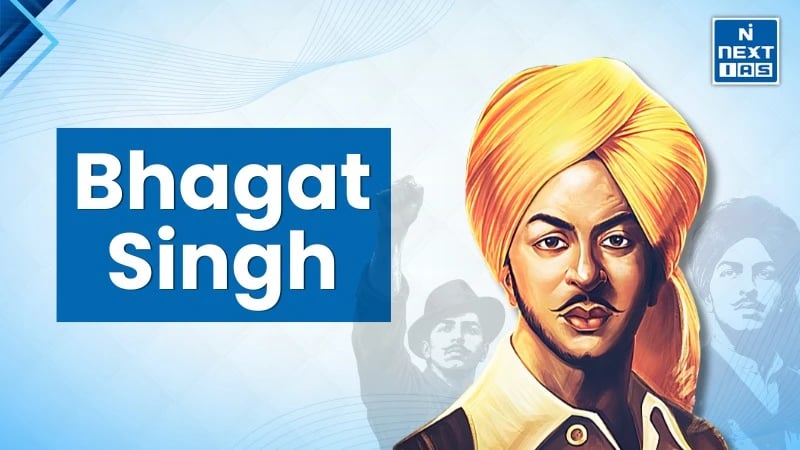
Bhagat Singh, often referred to as Shaheed-e-Azam (Greatest of Martyrs) was a legendary freedom fighter and icon of the Indian independence movement against British colonial rule. He sacrificed his life at the age of just 23, and is known for his fearlessness and intellectual depth.
He was born on 27 September 1907 in Banga, Punjab and educated at National College in Lahore. He was hanged by the colonial government on March 23, 1931 in Lahore Jail alongside his comrade friends Sukhdev and Rajguru.
The Lahore Conspiracy case in 1928 was associated with Bhagat Singh. He was also associated with the Central Assembly Bombing in 1929, in which he threw the bomb into the Central Legislative Assembly in Delhi to make the deaf hear and protest against draconian laws like the Public Safety Bill.
The Ideology and legacy of Bhagat singh includes the political thoughts influenced by Marxism, Socialism, and Anarchism, advocating for a society free from exploitation. His religious ideas denote rejection of religious beliefs in favour of reason and realism in his literary work ‘Why I am an Atheist’.
About Bhagat Singh
- Bhagat Singh was born into a family steeped in revolutionary activities.
- Influenced by his uncle Ajit Singh, he adopted nationalist and revolutionary ideals at a young age.
- In 1926, he founded the Naujawan Bharat Sabha, an organization focused on mobilizing youth against colonial oppression.
- He also joined the Hindustan Republican Association (HRA), later renamed the Hindustan Socialist Republican Association (HSRA), reflecting its shift towards socialism.
- His affiliations with groups like the Kirti Kisan Party and Kranti Dal further cemented his role as a key figure in the revolutionary movement.
- Bhagat Singh, a luminary in India’s freedom movement, was a symbol of indomitable courage, unflinching patriotism, and progressive thought.
- His life was marked by a relentless fight against British imperialism until his martyrdom on March 23, 1931.
- A fiery revolutionary, Bhagat Singh’s actions, ideologies, and writings have left an indelible mark on India’s history.
Major Revolutionary Activities
Saunders Killing
- In 1928, during protests against the Simon Commission, Lala Lajpat Rai succumbed to injuries from a brutal lathi charge by police.
- Bhagat Singh, Rajguru, and Sukhdev sought to avenge Rai’s death.
- Mistakenly targeting Assistant Superintendent of Police J.P. Saunders instead of the intended officer, the trio executed their plan, showcasing their fearless defiance of colonial rule.
Central Legislative Assembly Bombing
- In April 1929, Bhagat Singh and Batukeshwar Dutt orchestrated a bombing in the Central Legislative Assembly in Delhi to protest the Public Safety Bill.
- The bombs were intentionally non-lethal, aimed at making a political statement rather than causing harm.
- Their arrest followed the act, a deliberate move to use the trial as a platform to expose the injustices of British rule and to propagate their revolutionary ideals.
Ideology and Vision of Bhagat Singh
Bhagat Singh’s political ideology encompassed socialism, nationalism, anarchism, and communism. The writings of Marx, Lenin, and Trotsky influenced his transformation from a nationalist to a committed Marxist.
- Secularism: Bhagat Singh’s vision of India was secular and inclusive. His organisation, Naujawan Bharat Sabha, welcomed members from all religious communities, breaking barriers of caste and creed.
- Socialism: Bhagat Singh envisioned an India free from class exploitation, caste oppression, and religious bigotry. He sought economic independence through the abolition of landlordism and equitable distribution of resources.
- Atheism: Through works like Why I Am an Atheist, Bhagat Singh criticised blind faith and advocated for rationalism and scientific temper.
- Revolutionary Action: Inspired by the Bolshevik Revolution in Russia, Bhagat Singh believed in armed struggle as a legitimate means to overthrow imperialism. His slogans, “Inquilab Zindabad” and “Down with British Imperialism”, became rallying cries for the movement.
Contributions in Freedom Struggle
- Bhagat Singh was a revolutionary freedom fighter whose courage and ideology impacted India’s struggle for independence.
- He was a key member of the Hindustan Socialist Republican Association (HSRA) and advocated for armed resistance to British colonial rule.
- Bhagat Singh gained national attention with acts like the bombing of the Central Legislative Assembly in 1929, aimed at protesting oppressive laws without causing casualties.
- His writings and ideas inspired the youth to fight for justice and equality.
- His execution at the age of 23 made him a martyr, symbolising the spirit of sacrifice for India’s freedom.
Ideology and Legacy
- Bhagat Singh was a revolutionary freedom fighter whose courage and ideology left an enduring impact on India’s struggle for independence.
- He was a key member of the Hindustan Socialist Republican Association (HSRA) and advocated for armed resistance to British colonial rule.
- Bhagat Singh gained national attention with acts like the bombing of the Central Legislative Assembly in 1929, aimed at protesting oppressive laws without causing casualties.
- His writings and ideas inspired the youth to fight for justice and equality.
- His execution at the age of 23 made him a martyr, symbolizing the spirit of sacrifice for India’s freedom.
- Bhagat Singh’s contribution transcended his revolutionary acts. He became a symbol of youth-led transformation, inspiring generations to question oppression.
- While imprisoned, his hunger strikes demanded better treatment for political prisoners, revealing his commitment to justice and equality.
- His writings, including The Jail Notebook and Words of Freedom: Ideas of a Nation, continue to inspire thinkers and activists.
- In a 2008 poll by India Today, Bhagat Singh was voted the Greatest Indian, surpassing icons like Mahatma Gandhi and Subhash Chandra Bose, reflecting his enduring legacy.
Ideological Differences: Gandhi ji vs Bhagat Singh
While both Mahatma Gandhi and Bhagat Singh were pivotal to India’s freedom struggle, their ideologies and methods were markedly different.
| Dimension | Mahatma Gandhi | Bhagat Singh |
| View on Each Other | Criticised Bhagat Singh’s violence but admired his patriotism. | Criticized Gandhi’s non-violence as impractical and utopian. |
| Approach to Religion | Believed in the harmony of religion and politics, emphasizing ahimsa and spiritual politics. | Advocated secularism, rejecting religion’s role in politics, and embraced rationalism and atheism. |
| Economic Vision | Supported village socialism and opposed large-scale industrialization. | Advocated for economic equality, emphasizing abolition of landlordism and capitalism. |
| Method of Resistance | Promoted non-violence as an active, moral force. | Justified violence as a necessary tool against oppression. |
| Vision of Freedom | Focused on Dominion Status for India. | Championed Purna Swaraj, envisioning a society free of caste, class, and imperialism. |
Similarities Between Gandhi ji and Bhagat Singh
Despite their differences, Gandhi and Bhagat Singh shared certain ideals:
- Caste and Untouchability: Both leaders criticized caste discrimination and untouchability, working towards an egalitarian society.
- Satyagraha: While their methods differed, Bhagat Singh’s hunger strikes in jail reflected a form of resistance akin to Gandhi’s satyagraha.
- Universal Brotherhood: Both believed in Vasudhaiva Kutumbakam (the world is one family), advocating for a just and harmonious global order.
Conclusion
Bhagat Singh’s life and legacy continue to resonate as a call for justice, equality, and selfless service to the nation. His revolutionary spirit and intellectual depth have made him a timeless icon, representing the aspirations of a free and progressive India. His contributions, alongside other luminaries like Gandhi, form the bedrock of India’s struggle for independence, showcasing the diversity of thought and action in the freedom movement.
FAQs about Bhagat Singh
Who is Bhagat Singh?
Bhagat Singh was a revolutionary freedom fighter who played a significant role in India’s independence movement through his bold actions and socialist ideology, becoming a symbol of resistance against British colonial rule.
When was Bhagat Singh born and when did he die?
Bhagat Singh was born on September 28, 1907, in Banga, Punjab, and was executed on March 23, 1931, in Lahore at the age of 23.