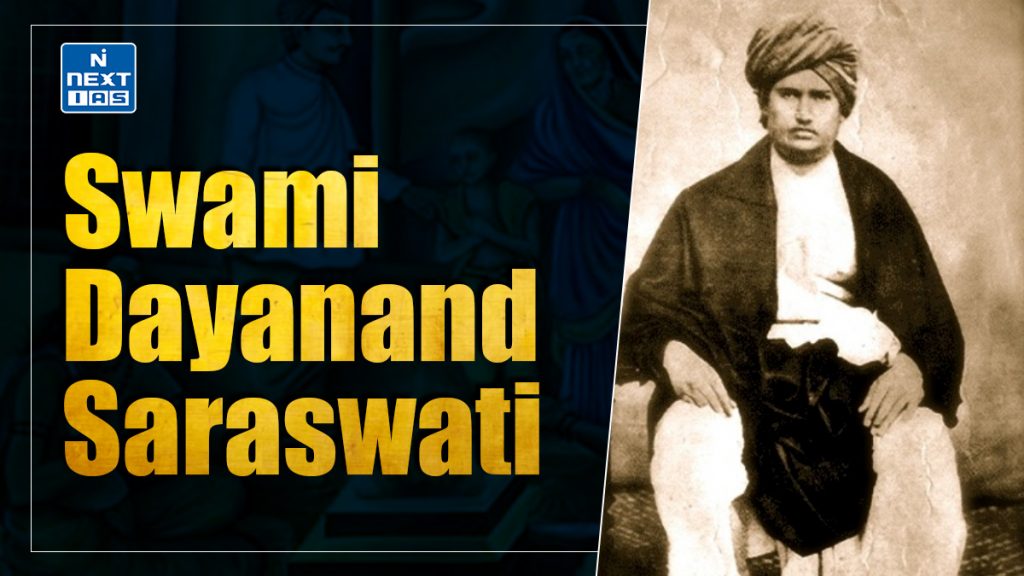
Swami Dayanand Saraswati (1824–1883) was a visionary Hindu reformer and the founder of Arya Samaj (1875). He rejected idol worship after watching a mouse (rodent) eating offerings on Lord Shiva’s idol, doubting the omnipotence of God. Without creating a new religion, he just wanted to purify the existing religion & believed the Vedas were the only purest form of knowledge & later, the Puranas have polluted it. His Satyarth Prakash book was originally written in hindi in 1875. It is among the influential books of Vedic philosophy & social reform.
Dayanand Saraswati was the first person to use the word ‘Swaraj’ long before Gandhiji & Tilak. He is also known for the introduction of ‘Shudhi Movement’ to bring back the earlier converted people. The radical views of Dayanand regarding superstitions earned him many enemies. It is said that in 1883 during his stay at the court of the Maharaja of Jodhpur, he was poisoned. His efforts were pivotal in eradicating social evils, promoting education, and instilling nationalism, shaping the socio-religious fabric of 19th-century India.
Swami Dayananda Saraswati Biography
- Swami Dayanand Saraswati (1824–1883) was a pioneering figure who dedicated his life to reforming Hinduism and addressing the pressing socio-religious issues of 19th-century India.
- Known for his revolutionary ideas, he sought to restore the Vedic principles of Hinduism, advocating for a rational, scientific, and egalitarian approach to religion.
- His efforts left an indelible mark on Indian society and laid the foundation for numerous reformist movements.
Early Life & Mission
- Born on February 12, 1824, in Tankara, Gujarat, Dayanand Saraswati was deeply influenced by his traditional Hindu upbringing.
- However, his quest for spiritual and intellectual enlightenment led him to question the prevailing religious practices and social customs.
- This quest culminated in his mission to revitalize Hinduism based on the teachings of the Vedas, which he regarded as the ultimate source of knowledge and truth.
Ideological Framework of Swami Dayananda Saraswati
- Swami Dayanand Saraswati’s ideology was rooted in the principles of the Vedas.
- He believed in their infallibility and scientific truths, asserting that Hinduism was a blend of profound ideas and scientific thought. His slogan, “Back to the Vedas,” became a clarion call for the revival of ancient wisdom.
- The view of Dayanand Sarawati on Idol Worship was that he vehemently opposed idolatry, polytheism, ritualistic practices, and the dominance of the Brahminical class.
- Dayanand Saraswati criticized the caste system for its degradation of lower castes but supported the Chaturvarna system, which he believed was the original and egalitarian basis of Indian society.
Reformist Stance of Dayananda Saraswati
Swami Dayanand Saraswati was a fierce critic of several entrenched social evils:
- Against Ritualistic Religion: He condemned practices like Sati, child marriage, purdah, and polygamy, advocating for their abolition.
- Advocacy for Widow Remarriage: He supported widow remarriage and worked to uplift the social status of women.
- Education for All: Dayanand emphasized the importance of education as a means to revive Indian society. He believed Sanskrit should be accessible to all, irrespective of caste or gender, challenging its traditional association with Brahmins.
Swami Dayananda Saraswati & Arya Samaj
- In 1875, Dayanand Saraswati established the Arya Samaj, a reformist organization based on Vedic philosophy.
- The Arya Samaj social reforms became a beacon, particularly in North India and the Punjab region.
- It sought to eradicate caste-based discrimination, promote women’s rights, and instill a sense of nationalism among Indians.
- The Dayanand Anglo-Vedic (DAV) schools, founded under his guidance, combined modern education with Vedic teachings, creating a unique blend of traditional and contemporary learning.
Contributions to Indian Society
Swami Dayanand Saraswati’s contributions extended far beyond religious reforms:
- Social Equality: He championed the entry of all castes into temples and fought against untouchability.
- Educational Reforms: His efforts to make Sanskrit and education accessible to all laid the groundwork for widespread educational reform.
- Nationalism and Self-Respect: By glorifying India’s Vedic past, he instilled a sense of pride, unity, and nationalism among Indians.
Influence on Freedom Movement
- Dayanand Saraswati’s ideas and the work of the Arya Samaj played a crucial role in inspiring early nationalistic movements in India.
- By emphasizing self-reliance, education, and social unity, he sowed the seeds of resistance against colonial rule and cultural subjugation.
Dayanand Saraswati as a Social Reformer
- The Arya Samaj Founder Swami Dayanand Saraswati was regarded as a notable social reformer who questioned orthodox practices.
- Dayanand Saraswati child marriage opposition stemmed from the Vedic principles and supported minimum age at marriage and consent.
- He supported girl’s education through Vedic education and stressed upon equal status to girls in education.
- Through Arya Samaj, Dayanand Saraswati cow protection campaigns promoted cows as sacred, a source of livelihood and emphasized on its economical importance in agriculture.
- Moreover, he established goshalas and advocated for laws against cow slaughter.
- He also established the Arya Samaj Punjab branch in Dayanand Saraswati Lahore 1877, and initiated the Shuddhi movement & widow remarriage campaign.
- He opposed the caste-based system, idol worship and superstitious practices. His book ‘Satyarth Prakash’ led the way for many societal reforms.
- Through his ideas and support for women education and revival of Vedic practices, he became a transformational reformer of the 19th century.
Conclusion
Swami Dayanand Saraswati was a visionary who fearlessly challenged the socio-religious norms of his time. Through his reforms, he redefined Hinduism as a rational and inclusive way of life while addressing critical social issues like caste discrimination and gender inequality. His establishment of Arya Samaj and advocacy for Vedic ideals not only transformed Indian society but also empowered generations to strive for equality, knowledge, and national pride. Swami Dayanand’s legacy continues to inspire reform, progress, and unity in India.
FAQs about Swami Dayanand Saraswati
Who is Swami Dayanand Saraswati?
Swami Dayanand Saraswati was a prominent 19th-century social reformer and founder of the Arya Samaj, a movement aimed at reforming Hinduism.
What was the Shuddhi Movement in Arya Samaj?
The Shuddhi Movement Arya Samaj aimed at reconverting non-Hindus back to Hinduism to counter the impact of conversion to other religions.
How did Dayanand Saraswati die in 1883?
Dayanand Saraswati death 1883 took place in Ajmer. He is believed to have been poisoned by the royal chef of the Maharaja of Jodhpur.
What were Dayanand Saraswati’s views regarding British rule?
Dayanand Saraswati British views was that he condemned the British colonial administration while praising their governance system & educational institutions.
Discuss the Arya Samaj principles.
The Arya Samaj 10 principles revolve around the belief in one supreme being without shape or form, Vedic supremacy and social reforms, among others.
What was Dayanand Saraswati’s position regarding caste divisions?
Dayanand Saraswati caste system was that he denounced the practice of caste division based on birth and promoted the original varna system of the Vedas which is determined by merit, quality, and occupation.
What is the Significance of Satyarth Prakash book?
Dayanand Saraswati’s Satyarth Prakash summary (1875) relates to Vedic monotheism, criticize idolatry & other religions and outlines social reforms.