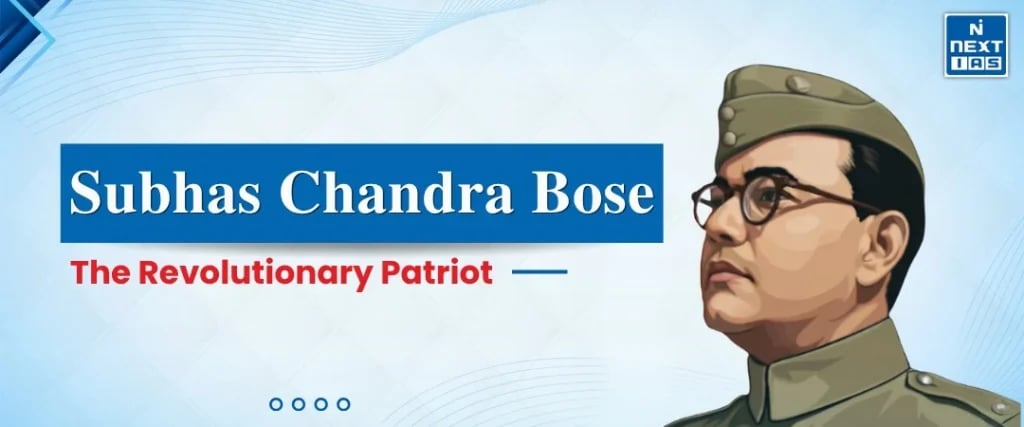
Subhas Chandra Bose, affectionately known as Netaji, was a fearless nationalist whose uncompromising pursuit of India’s freedom made him a prominent leader of the independence movement. His efforts to organise the Indian National Army and seek international alliances showcased his revolutionary approach to achieving complete independence. This article aims to study in detail Bose’s ideologies, leadership, and his enduring legacy in India’s struggle for freedom.
About Netaji Subhas Chandra Bose
- Subhas Chandra Bose, born on January 23, 1897, in Cuttack, Odisha, into a wealthy family.
- He was a radical Indian nationalist, Often referred to as Netaji (respected leader).
- SC Bose is well remembered as a symbol of militant nationalism and supreme sacrifice as his birth anniversary, January 23rd, is celebrated as Parakram Diwas (Day of Valor).
- Originally associated with INC, but due to his ideological difference with Gandhi and others he left the congress as he believed in achieving complete independence through decisive action, even if it meant adopting armed struggle.
- Known for his radical approach, dynamic leadership, and unwavering commitment to India’s freedom, Bose left an indelible mark on Indian history.
Early Life and Influences
- Bose’s early years were marked by academic excellence and a keen sense of patriotism, significantly influenced by Swami Vivekananda’s teachings.
- He completed his education at the prestigious Presidency College in Kolkata and later at the University of Cambridge, where he cleared the Indian Civil Service Examination in 1920.
- However, Bose resigned from the coveted position, driven by his commitment to join the Indian independence movement.
- He regarded Chittaranjan Das as his political mentor and Swami Vivekananda as his spiritual guide, who shaped his political ideology and deep sense of social responsibility.
Parakram Diwas
- Parakram Diwas is celebrated every year on 23rd January, the birth anniversary of legendary freedom fighter Netaji shubhas chandra bose.
- This day has been officially declared by the Government of India in 2021 as the tribute to the fierce spirit of Netaji and his selfless service to the country.
- It is captured by numerous activities nationwide, such as the hoisting of flags, culture and shows.
Parakram Diwas 2026
- On January 23, 2026 the 129th birthday anniversary of Bose was celebrated.
- The 2026 celebrations draw an element of change of parakram (valour) to pragati (progress) and his legacy of sacrifice, as a unifying force of the nation, particularly through the Ministry of Culture.
- The countrywide celebration (23rd-25th January) involves cultural events, Drone Show, and his life, and legacy showcases.
Ideological Vision of Subhas Chandra Bose
Nationalism and Socialism
Bose’s ideology was rooted in the principles of nationalism, socialism, and leftist thought:
- Complete Independence: Unlike many leaders of his time, Bose insisted on achieving Purna Swaraj (complete independence) rather than settling for dominion status.
- Socialist Vision: He envisioned an industrialised and modernised India, advocating state ownership of major industries and economic planning.
- Secularism: Bose upheld a secular vision, emphasising unity beyond religion, caste, or region.
- Militant Approach: Disenchanted with Gandhi’s strategy of non-violence, Bose believed in armed resistance as a viable path to freedom.
Political Journey
Role in Congress
Bose joined the Indian National Congress and quickly rose to prominence:
- Elected President of the Youth Wing of the Congress.
- Became Congress President in 1938 and 1939, steering the party towards a more radical stance on independence.
- Differences with Mahatma Gandhi over achieving independence led to his resignation in 1939 and the subsequent formation of the Forward Bloc.
Formation of the Indian National Army (INA)
During World War II, Bose sought alliances with Axis powers, leveraging the global conflict to challenge British rule in India.
- In 1942, Bose formed the Indian National Army (INA) with the support of Japan, revitalising it with captured Indian soldiers.
- The INA was an inclusive force with soldiers from diverse regions, religions, and ethnicities, including women.
- Slogans like “Jai Hind,” “Give me blood, and I will give you freedom,” and “Dilli Chalo” became rallying cries for the freedom movement.
Key Contributions of Netaji Subhas Chandra Bose
Revitalizing the Independence Movement
- Bose’s leadership inspired a more militant approach to independence, balancing the movement’s moderate and extremist ideologies.
- His advocacy for immediate and uncompromising independence galvanised younger leaders and freedom fighters.
International Alliances
- Bose’s collaboration with Axis powers showcased his strategic acumen, though it sparked controversy due to ethical concerns about partnering with regimes like Nazi Germany and Imperial Japan.
- The INA’s campaigns, though militarily unsuccessful, significantly undermined British morale and paved the way for the eventual withdrawal of colonial rule.
Role of Subhas Chandra Bose in the Freedom Struggle
- Subhas Chandra Bose was a charismatic leader who played a significant role in India’s freedom struggle by advocating for complete independence and rejecting British dominion status.
- He founded the Forward Bloc and revitalized the independence movement with his militant approach.
- Bose is best known for leading the Indian National Army (INA) and forming the Azad Hind Government in exile, rallying Indian expatriates and prisoners of war to fight against British rule.
- His slogan, “Give me blood, and I will give you freedom,” inspired millions, and his relentless pursuit of liberation left an indelible mark on India’s struggle for independence.
The National Planning Committee (NPC)
- In 1938, the Congress President Subhas Chandra Bose, constituted the National Planning Committee (NPC), and Jawaharlal Nehru became the chairperson, to come up with the national economic plan of India.
- It centered on industrialization, reduction of poverty and agrarian changes and issued 26 volumes of reports on different aspects of development, when World War II disrupted its work.
All India Forward Bloc
- He founded the All India Forward Bloc (AIFB), on May 3, 1939, and revitalized the independence movement with his militant approach.
- AIFB was a left-wing political party in India, which was formed after Bose left the presidency of the Congress on ideological grounds (when he disagreed with Gandhi on the matters of independence).
Azad Hind Fauj (INA)
- Formation & Leadership: The INA had first been founded by Mohan Singh, but was rejuvenated by Subhas Chandra Bose who took over from Rash Behari Bose as the next commander on July 4, 1943.
- Mission and Slogan: The army set to topple the British armed struggle and their motto is Ittehad, Itmad aur Qurbani (Unity, Faith and Sacrifice).
- Military Action: The INA joined the Japanese forces in the Burma-India conflict, against the British.
- Impact: The INA, though it did not play out to its military advantage, above all, in the trials of the red forts had caused an outburst of patriotism in the whole nation and accelerated the decline of British rule.
- His slogan, “Give me blood, and I will give you freedom,” inspired millions, and his relentless pursuit of liberation left an indelible mark on India’s struggle for independence.
- Key Figures:
- Rash Behari Bose was one of the masterminds and the presidents of the Indian Independence League, whereas Captain Mohan Singh was the First leader.
- One of the first all female combat units in modern history, the Rani of Jhansi Regiment, which was led by Captain Lakshmi Swaminathan.
Turning Point of INA
- The Battles of Imphal and Kohima were critical decisive battles of World War II, where the Allies (British-Indian Army) fought against the Japanese Army assisted by the Indian National Army (INA) which was led by Netaji Subhas Chandra Bose.
- Though won by Britishers, was mainly assisted by the Naga people, left almost 60,000 Japanese dead, and is today known as the Stalingrad of the East. It marked the beginning of Japan’s decline in Southeast Asia.
- Many INA soldiers were captured by the British, and the popular INA Trials took place in Red Fort (1945-46) by the British.
- Its officers such as Shah Nawaz Khan, Prem Kumar Sehgal and Gurbaksh Singh Dhillon were put on trial. Criminal proceedings instigated mass demonstrations throughout India.
The Great Escape
- In July 1940, the British authorities placed Subhas Chandra Bose (Netaji) under house arrest in Calcutta after he agitated to remove the Holwell Monument.
- He escaped in disguise as a Pathan (named Mohammad Ziauddin) on January 16-17, 1941. He toured Peshawar and Kabul and later reached the Axis in Berlin, Germany by April 1941 in search of support for Indian independence.
- This incident also refers to the Great Escape, a daring escape of Netaji Subhas Chandra Bose from British controlled India during World War II.
Azad Hind Government 1943
- On October 21, 1943, Netaji Subhas Chandra Bose, in Singapore, proclaimed the Azad Hind Government (also known as Provisional Government of Free India, or Arzi Hukumate-Azad Hind) to free India under the assistance of Axis powers.
- The key points:
- Formation: This provisional government was established, with the help of Japan, Germany, and Italy on Oct 21, 1943 in Singapore.
- Leadership: The head of state was Subhas Chandra Bose, the supreme adviser was Rash Behari Bose.
- INA Mobilization: The government was the political arm of the Indian National Army (Azad Hind Fauj) and was restructured by Bose to initiate a military action against British troops with battle cry being Chalo Dilli.
- Rani of Jhansi regiment: in October, 1943, an all-women combat regiment was formed, which was led by Captain Lakshmi Swaminathan.
- Administration & Finance: The government formed its own bank, the Azad Hind Bank in Rangoon to facilitate the collection of donations by Indians in East Asia and issued its own currency and postage stamps.
Taihoku Plane Crash 1945
- As Japan was collapsing, Netaji Subhas Chandra Bose wanted to escape and restructure his resistance probably by enlisting the help of the Soviet Union. To keep this in mind he left Southeast Asia (from Saigon) along with Japanese officials.
- In August 1945, World War II was coming to its conclusion as the atomic bombing of Hiroshima and Nagasaki resulted in the surrender of Japan.
- On 18 August 1945, a Japanese military aircraft carrying Netaji Subhas Chandra Bose, crashed at Taihoku (present-day Taipei, Taiwan). The crash supposedly took place shortly after take-off from Taihoku airport.
Role of Japan and Germany in Netaji’s Freedom Struggle
Netaji Subhas Chandra Bose was oriented to the Axis powers in World War II, following the concept of Britain as an enemy of India and its friend.
Role of Germany (1941–1943)
- In 1941 Bose escaped from (House Arrest) India to Berlin where he sought refuge.
- In Berlin with the help of Germans he established The Free India Centre.
- In January 1942, Bose opened Azad Hind Radio which was used to transmit messages to India to resist.
- Created the Free India Legion of Indian POWs in Europe, with the help of Hitler.
- Though, German assistance was poor and somewhat ineffective since Hitler was keen on the European front.
- In 1943, Bose moved to East Asia through a submarine journey.
Role of Japan (1943–1945)
- Upon arriving in Singapore in July 1943, Bose took command of INA from Rash Behari Bose and Mohan Singh who led its formation with Japanese help in 1942.
- The Japanese military provided arms, training, and money to the INA.
- Assisted in the Provisional Government of Azad Hind (1943) which Japan recognized.
- Japan handed over administrative control of the Andaman and Nicobar Islands to the Provisional Government in late 1943, which were renamed “Shaheed” and “Swaraj” islands.
- INA fought on the same side in Imphal-Kohima, 1944 as Japan.
Philosophy of S. C. Bose
- Subhas Chandra Bose was centred on nationalism, self-reliance, and militant resistance to colonial rule.
- He believed in achieving complete independence through force, if necessary, diverging from Gandhi’s nonviolent methods.
- Bose advocated for a strong, authoritarian state to rebuild India and emphasised the importance of socialism for economic equality and social justice.
- He followed the philosophy of inclusiveness, seeking unity among all religions, castes, and regions to create a cohesive national identity.
- Bose also prioritised mobilising youth and fostering international alliances, especially with countries opposed to British imperialism, to achieve India’s liberation.
Subhas Chandra Bose vs. Mahatma Gandhi
S.C. Bose and Gandhi reflected the diversity of approaches within the freedom movement which is evident in the following points:
| Dimension | Mahatma Gandhi | Subhas Chandra Bose |
|---|---|---|
| Ideological Basis | Advocated non-violence (Ahimsa) and moral purity through Satyagraha. | Believed in political violence and armed resistance for independence. |
| Religion in Politics | Integrated religious values into political life; prayers often had political messages. | Advocated secularism, separating religion from politics. |
| Economic Vision | Supported village-centric, labour-intensive economies; opposed industrialisation. | Envisioned industrialisation and a modernized, state-controlled economy. |
| Response to British | Favoured truce and negotiation, including Dominion Status in early years. | Advocated for Purna Swaraj from the outset; opposed concessions. |
| Approach to Movements | Suspended Non-Cooperation Movement after Chauri Chaura incident. | Criticised the suspension as premature and harmful to momentum. |
| State and Governance | Opposed modern state machinery, favouring decentralised governance. | Favoured a robust and centralised state modelled on Soviet-style socialism. |
Legacy of Netaji
- Bose’s efforts to foster unity among Indians of all backgrounds left a legacy of inclusivity, exemplified by the INA’s diverse composition.
- His advocacy for industrialisation and state planning influenced India’s post-independence economic policies, particularly under Nehru’s leadership.
- Bose’s life and ideals inspire Indians, with his slogans and philosophy serving as enduring symbols of courage and determination.
Sri Vijaya Puram
- Sri Vijaya Puram is the capital city of the Andaman and Nicobar formerly known as Port Blair, which was renamed in September 2024 due to its colonial connotations.
- It is located in the South Andaman Island, which includes the historic Cellular Jail (Kala Pani) during the colonial period, naval bases, and tourist attractions.
- The name was dedicated to the triumph during the struggle of freedom in India and is a reference to the power of the Chola Empire that ruled there during the 11th century.
- Netaji Subhas Chandra Bose unfurled the national flag at Port Blair on 30 December 1943, being the first time it was hoisted on Indian soil.
- The 2026 Netaji Drone Show was in fact a 2026 centennial event, on January 23, 2026, at the Netaji Subhas Chandra Bose Stadium in Sri Vijaya Puram (Port Blair), as part of the Parakram Diwas.
- The dazzling display, complete with hundreds of drones, dedicated the 129th birthday of Netaji by retracing his path, the Azad Hind Fauj and the legacy of his creation of a modern self-sustaining India.
Conclusion
Subhas Chandra Bose was a visionary leader whose radical approach complemented the broader strategy of the Indian freedom struggle. While his methods often clashed with Gandhi’s, the two leaders shared an unwavering commitment to India’s independence. Bose’s call for decisive action, his emphasis on modernity, and his belief in the power of unity make him a timeless figure in India’s history. His life serves as a reminder of the diverse paths that contributed to India’s freedom and the sacrifices made in the journey towards independence.
FAQs on S.C. Bose
Who is Subhas Chandra Bose?
Subhas Chandra Bose was a prominent leader in India’s freedom struggle, known for his revolutionary approach and leadership of the Indian National Army (INA) to fight British colonial rule.
Why is Subhas Chandra Bose famous?
Subhas Chandra Bose is famous for his role in establishing the Indian National Army (INA) and the Azad Hind Government to overthrow British rule, as well as his inspiring slogan, “Give me blood, and I will give you freedom.”