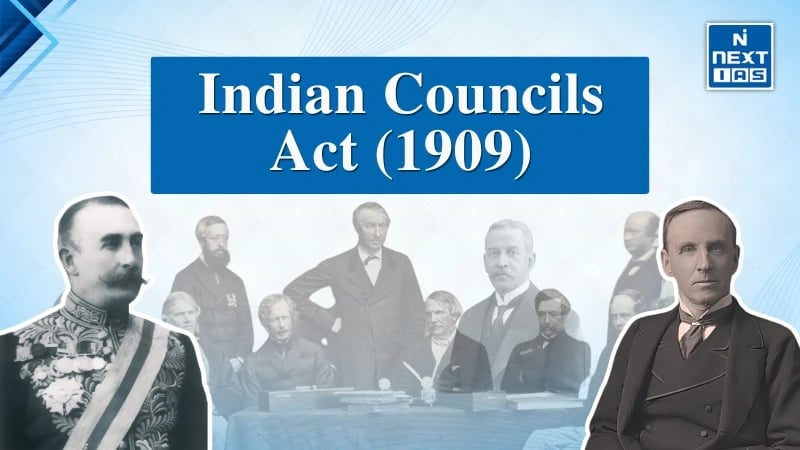
The Indian Councils Act of 1909, also known as the Morley-Minto Reforms is a British Parliament Act for Colonial India to address the rising demands of Indian masses and avoid any further conflict. It introduced separate electorates for Muslims and expanded the legislative councils at both central and provincial levels.
Its important features include expansion of councils where the members of the Central Legislative Council were increased from 16 to 60 members. Provincial councils in major provinces were expanded to 50 members. The Separate Electorate System for Muslim members who were exclusively elected by Muslim voters and regarded Lord Minto as Father of the Communal Electorate. In the viceroy’s executive council, the first Indian member was Satyendra Prasad Sinha as a Law member.
About Indian Councils Act (1909)
The Indian Councils Act (1909), also known as the Morley-Minto Reforms, and the Government of India Act (1919), based on the Montagu-Chelmsford Reforms, were two significant legislative acts aimed at introducing reforms in the administration of India under British rule.
- While the former sought to enlarge the legislative councils and introduce separate electorates, the latter attempted to lay the foundation for responsible governance by granting more powers to the legislatures and introducing dyarchy in provinces.
- These reforms resulted from mounting Indian discontent and political activism against colonial rule.
Indian Councils Act, 1909
Causes behind Morley-Minto Reforms
- Failure of the Indian Councils Act, 1892: The Act failed to meet the demands of nationalist leaders for meaningful representation and reforms.
- Exclusion of Indians from administration: Indians were primarily excluded from government services and higher administrative roles, fueling resentment.
- Lord Curzon’s policies: Curzon’s disregard for Indian aspirations, as seen in his partition of Bengal (1905), aggravated discontent.
- Growth of extremism: Rising extremist tendencies in the Congress, advocating for “Swaraj,” alarmed the British.
- Divide and rule policy: The British sought to appease Muslims by introducing separate electorates to counteract growing nationalist unity.
Salient Features of Indian Councils Act, 1909
- Separate Electorates: Muslims were granted separate electorates, allowing them to elect representatives exclusively from their community.
- Increased Membership: The Central Legislative Council membership was expanded to 60 members, while provincial councils also saw an increase.
- Indian Participation: For the first time, Indians were associated with the Viceroy’s Executive Council. Satyendra Prasad Sinha became the first Indian to hold this position.
- Non-official Majority in Provinces: Provincial legislative councils were allowed a majority of non-official members.
- Rights of Members: Members could discuss the budget, move resolutions, and ask supplementary questions, though with restrictions.
Analysis of Morley-Minto Reforms
- The Act represented a limited step towards Indian representation but primarily served British interests.
- The separate electorate system sowed seeds of communal division.
- While the reforms introduced elected representation, it needed to be more meaningful, as voting rights were limited, and official majorities persisted at the central level.
- It was a calculated strategy to appease moderate leaders, suppress extremism, and divide Indian society.
Conclusion
The Indian Councils Act (1909) and the Government of India Act (1919) reflect Britain’s attempts to balance nationalist demands with imperial control. While these reforms introduced incremental changes, such as representation and legislative powers, they were overshadowed by the divisive policies of separate electorates and restrictive franchises. The Acts, instead of meeting Indian aspirations, further fueled the demand for complete self-governance, setting the stage for subsequent constitutional advancements.
GS - 1