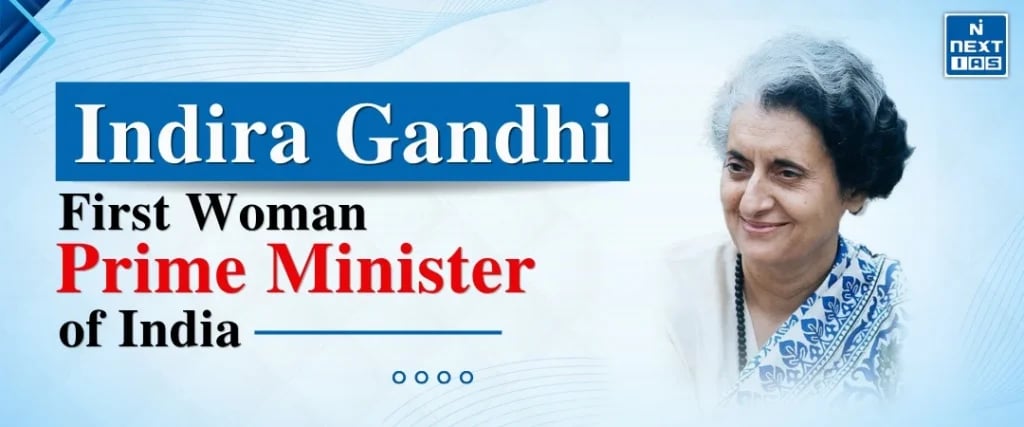
Indira Gandhi, the first female Prime Minister of India, served twice between 1966 and 1984. She was one of the significant political leaders in post-independence India. She played an influential role in shaping India’s Economic, Military, and Diplomatic policies with bold steps like the 1971 War, Nationalisation of banks, and the imposition of Emergency in India.
Historical Background
- Indira Gandhi assumed the position of the Prime Minister of India on 24 January, 1966 following the unfortunate death of Lal Bahadur Shastriji (the second Prime Minister of India).
- She was elected to the Lok Sabha in 1967.
- She was expelled from Congress in 1969 as a result of growing tensions within the party.
- Following her expulsion, she organized the ‘New’ Congress Party, as a splinter group within the Congress, with support of most party members.
- The New Congress group achieved a landslide victory by defeating a coalition of conservative parties in the 1971 Lok Sabha elections.
- After gaining a strong majority in the Lok Sabha, Indira Gandhi extended her strong support for the cause of East Pakistan, which led to the formation of a new country called Bangladesh.
- India’s victory over East Pakistan and creation of Bangladesh gave her a soaring popularity. As a result, in March 1972, her party won a significant number of state elections.
Individual Journey of Indira’s Life
- Indira Gandhi was born on November 19, 1917. She was the daughter of Jawahar Lal Nehru (the first Prime Minister of India).
- After completing her school and university education, Indira Gandhi pursued a doctorate degree & also received the Columbia University Citation of Distinction.
- On March 26, 1942, she married Firoz Gandhi & had two sons – Rajeev Gandhi and Sanjay Gandhi.
- In 1955, Indira Gandhi joined the Congress Working Committee and participated in the party’s Central Election.
- She served on the Central Parliamentary Board of Congress in 1958 & presided over the Women’s Department of All India Congress Committee and National Integration Council of the All India Youth Congress in 1956.
- In 1959, she was elected as the President of Indian National Congress (INC).
- From 1964-1966, Indira Gandhi served as the Minister of Information and Broadcasting.
- From January 1966 to March 1977 and again from 14 January 1980 – 31 October 1984, she served as the Prime Minister of India.
- She took over as Chair of the Planning Commission in January 1980.
Major Achievements and Contributions of Indira Gandhi
The contributions of Indira Gandhi in the growth of the nation are as follows –
Twenty Point Programme
- Indira Gandhi’s “Twenty Point Programme” (1975) focused on poverty reduction and improvement in living standards and was later in tune with the National Common Minimum Programme and the United Nations Millennium Development Goals, while being updated in 1982, 1986, and 2006.
- The programme included such crucial elements as drinking water, agriculture, irrigation, health, education, and environment.
Economic Reform
- Economic reforms were put in place by Indira Gandhi with the intention of becoming self-sufficient and lowering down external reliance or assistance.
- Some of her notable economic policies are – Green Revolution which revolutionized India’s agricultural sector and the nationalization of banks which stabilized the Indian banking system.
Nationalisation of Bank
- The contributions of Indira Gandhi in the banking sector where she announced the nationalization of 14 commercial banks in India on July 19, 1969. This was done on the basis of the 1949 Banking Regulation Act.
- This significant economic policy decision was put into effect as the first step towards the Indian economy adopting a socialist pattern.
- The rationale behind this decision was to ensure easy access to banking services and credit facilities for the farmers and rural populace.
- The nationalisation of banks was also prompted by India’s dire financial situation following wars with China and Pakistan, droughts, and a lack of public investment.
Read our detailed article on Nationalisation of Banks in India.
Abolition of Privy Purse
- Article 291 and Article 362 of the Indian Constitution provided “privy purse” payments to the rulers of the princely states.
- Indira Gandhi claimed that the “privy purse” not only increases the government’s revenue deficit but also infringes upon the Right to Equality.
- Accordingly, Gandhi brought about the 26th Amendment to the Indian Constitution in 1971, which struck down Articles 291 and 362 of the Constitution and eliminated the Privy Purse.
- Consequently, the unique rights and privileges that the ruling class had been enjoying, and which were in direct opposition to the principles of social justice and equality, came to an end.
Garibi Hatao
- She responded to her opposition’s campaign slogan of “Indira Hatao” with her slogan of “Garibi Hatao,” meaning eradication of destitution.
- It, later, was transformed into a government program and was included in the Fifth Five-Year Plan. The plan focussed upon raising agricultural productivity, creating job opportunities, and reducing poverty.
- The contributions of Indira Gandhi towards the eradication of the poverty helps the masses to raise their standards of living.
Contributions in India’s National Movement
- Indira Gandhi actively participated in India’s freedom struggle & had made a wide impact by making awareness of the children and the youths of the country.
- For instance, she organized Bal Charkha Sangh in her childhood and Vanar Sena in the year 1930, composed of young children to support the Civil Disobedience Movement.
1971 War & Bangladesh Liberation
- The 1971 Indo-Pakistan War, known also as the Bangladesh Liberation War, took place due to the Bengali liberation struggle in East Pakistan and the subsequent Pakistani Army operation called Searchlight initiated on 25 March 1971.
- Nine months of warfare resulted in the deaths of hundreds of thousands of people and the displacement of millions, creating a humanitarian crisis with millions of refugees flooding into India.
- Indian support for the Mukti Bahini (freedom fighters) included political, military training, and eventually armed military support.
- On 3 December 1971, the Pakistani Air Force attacked Indian airbases and India responded with a full-scale war campaign on two fronts, eastern and western.
- The Indian Army working together with the Mukti Bahini quickly captured Dhaka in the east.
- As a result, General A.A.K. Niazi surrendered to Lt Gen Jagjit Singh Aurora at Dhaka on 16 December, with more than 93,000 troops surrendered, which was the biggest surrender after World War II.
- As a result, there was a creation of a new nation known as Bangladesh and the legitimacy of the Pakistani claim as an integrated state was diminished.
- From India’s perspective, the success reaffirmed Indira Gandhi as a powerful leader, and changed the regional power structure.
Indo-Soviet Treaty (1971)
- The Treaty served as a strong relationship between India and the Soviet Union.
- For their bilateral relationship, it established the highest standards of cooperation, while for security, it was an indicator of an alignment of interests amid regional and international threats.
- The Treaty was an indicator of the extraordinary convergence of the national interests of both states on fundamental questions regarding peace and war.
- The 1971 Treaty of Friendship and Cooperation between India and the Soviet Union was perhaps the most significant international treaty that India signed since Independence.
- It was not a military alliance but rather an effort to strengthen the foundation of strategic autonomy and independent action.
- In 1971, the Indo-Pakistani War resulted in the formation of a new state called Bangladesh.
- Although the Treaty itself belongs to history and was signed for a past era, its geopolitical foundations continue to be relevant, as evidenced by the strategic partnership between India and Russia in the 21st century, which is known as the Special & Privileged Strategic Partnership.
Indira Doctrine
- The ‘Indira Doctrine’ is the foreign policy adopted by the Indian Prime Minister, Indira Gandhi, following the resounding success of India in the Bangladesh Liberation War of 1971.
- The doctrine stipulates that India’s national security cannot be separated from that of South Asia & any attempt by an outside entity to interfere in South Asian affairs shall be viewed as a threat to India’s national security.
- The doctrine emphasized the use of military strength and deterrence as important tools in foreign policy, particularly in limiting the influence of other major powers like the US, China, and the then USSR in South Asia.
- Additionally, the doctrine emphasized the bilateral resolution of disputes within South Asia and an increase in India’s influence among the smaller nations in the region.
Smiling Buddha (1974)
- ‘Smiling Buddha’ (Pokhran-I) marked India’s first successful nuclear test on 18 May 1974 from Pokhran Test Range in Rajasthan.
- It was because of this test that India became the sixth nation to enter into the exclusive club of nations armed with nuclear weapons.
- This test had a long-term impact on India’s nuclear policy and export regulations of nuclear technology.
National Emergency 1975
- The ‘Emergency’ (25 June 1975–21 March 1977) was a 21-month period in which Prime Minister Indira Gandhi declared a state of emergency on the recommendation of President Fakhruddin Ali Ahmed, leading to the suspension of basic freedoms and concentration of executive authority.
- This was preceded by a ruling of the Supreme Court that had invalidated her election, along with massive anti-Gandhi demonstrations spearheaded by Jayaprakash Narayan.
- Large numbers of opposition political workers, social activists, and the press were put behind bars, newspapers faced censorship, and constitutional conventions were either bypassed or openly disregarded.
- The 42nd amendment act (1976) of the Constitution of India granted more power to Parliament and the Centre, while the campaign of family planning under Sanjay Gandhi was condemned by the people.
- However, the Emergency came to an end in 1977 with the announcement of elections which resulted in a big loss for the Congress party, thus forming a government by the Janata Party.
- This period in history is of great importance in terms of civil rights and democracy.
Operation Blue Star (1984)
- Operation Blue Star (June 1-10, 1984) was a military operation initiated by the Indian Prime Minister Indira Gandhi for the removal of Sikh fundamentalist separatists.
- The separatists were commanded by Jarnail Singh Bhindranwale, from the premises of the Golden Temple in Amritsar, the most sacred shrine for the Sikhs.
- They occupied the site, stored weapons, and called for an independent state named Khalistan that would have a majority Sikh population.
- Operation Bluestar was successful in eliminating Bhindranwale and his accomplices, and removing them from their hold on the temple complex.
- Moreover, the use of the Indian Army in an attack on such a religious structure damaged Sikh feelings deeply, resulting in further alienation and insurgency.
- The hatred by the sikh community against the Prime Minister Indira Gandhi was seen, after the suppression.
- The event led to her assassination in October 1984 at the hands of Sikh guards in her security team.
- Operation Bluestar is considered a crucial event in the politics of northern India.
Indira Gandhi vs. Jayaprakash Narayan
- The political ideology of Indira Gandhi, the Prime Minister of India and Jayaprakash Narayan, a socialist and Gandhian leader, were different in many ways.
- While Indira Gandhi believed in the centrality of power and worked towards maintaining her regime by exercising central power, Jayaprakash Narayan advocated Total Revolution (Sampoorna Kranti) and fought against corruption, authoritarianism, and curtailment of fundamental rights.
- This conflict reached its peak following the decision of the Allahabad High Court to uphold the election of Indira Gandhi, following which Jayaprakash Narayan asked the public servants to resign from their posts and not obey any unconstitutional order.
- Indira Gandhi, on the other hand, declared the Emergency in June 1975 and placed Jayaprakash Narayan under arrest, thereby making him the moral icon of opposition.
- Ultimately, the Jayaprakash Narayan-led campaign resulted in the formation of the Janata party that defeated the Congress in 1977.
Honours and Accolades
- Received Bharat Ratna in 1972
- Mexican Academy Award for Liberation of Bangladesh (1972)
- 2nd Annual Medal, FAO (1973)
- Sahitya Vachaspati by Nagari Pracharini Sabha in 1976.
- Received Mothers’ Award, U.S.A. in 1953,
- Islbella d’Este Award of Italy for outstanding work in diplomacy and Yale University’s Howland Memorial Prize.
- Diploma of Honour was conferred to her by the Argentine Society in 1971 for the Protection of Animals.
Books by Indira Gandhi
Her famous publications include –
- ‘The Years of Challenge’ (1966-69)
- ‘The Years of Endeavour’ (1969-72)
- ‘India’ (London) in 1975
- ‘Inde’ (Lausanne) in 1979 etc.
Her vision of an inclusive and self-dependent India, along with her tenacity and courage to take bold decisions, fetched her an image of one of the strongest Prime Ministers of India. She was a true stateswoman who devoted her life to serving the country and advancing the rights of the underprivileged. Future generations can be guided by the leadership and enduring legacy of Indira Gandhi. Additionally, the contributions of Indira Gandhi in India’s foreign policy also played a significant role.
FAQs on Indira Gandhi
How is the Emergency period associated with Indira Gandhi?
Following Indira Gandhi’s recommendations, President Fakhruddin Ali Ahmed announced a country-wide Emergency in June 1975, during which fundamental rights were suspended and laws were passed by decree.
What is Indira Gandhi’s contribution to the Bangladesh Liberation War?
Indira Gandhi played an important role in the Bangladesh liberation struggle in 1971, which led to the emergence of Bangladesh.
What is Indira Gandhi’s contribution to the Blue Star Operation?
In 1984, she initiated the Blue Star Operation in order to clear the Golden Temple of Sikh militants.