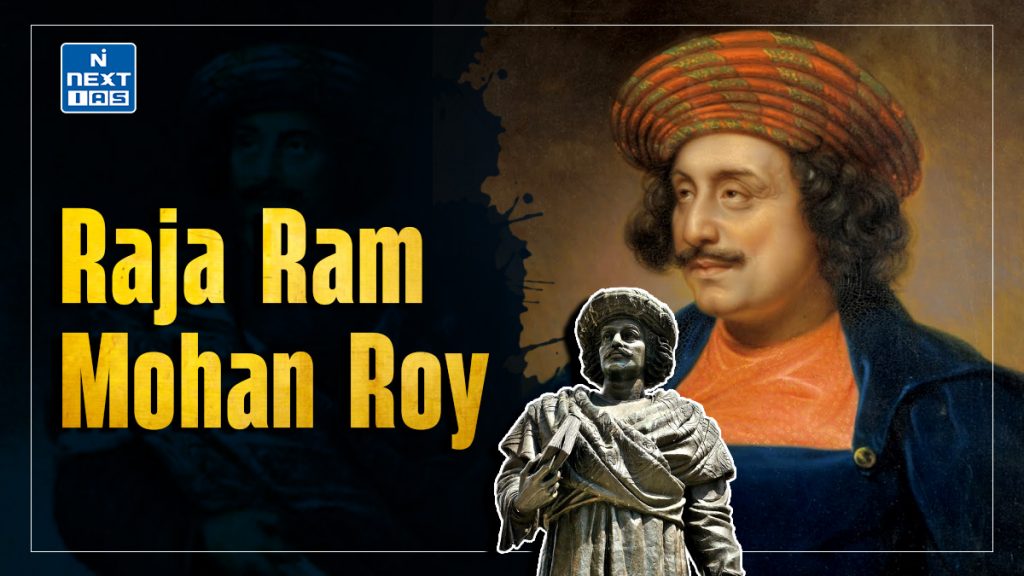
Raja Ram Mohan Roy was a social reformer and also known as the ‘Father of Indian Renaissance’. He knew more than 10 languages, for example he learned Hebrew and Greek languages just to read the bible in its actual format. One of his most significant achievements was the campaign against the social evil of the Sati system. In which the wife or widow had to accept the funeral pyre along with her ‘dead’ husband and was simultaneously burnt in the fire.
In 1811, Raja Ram Mohan Roy’s own sister was forced into the funeral pyre after the death of her husband. His sincere efforts led to the legal abolition of Sati in 1829 by Governor-General Lord William Bentinck. In 1831, the title ‘Raja’ was conferred on him by Akbar Shah II. Later, he supported Roy for going to England to argue for the legalisation of the abolition of Sati. In 1828, he founded Brahmo Samaj who advocated Monotheism or belief in one god and rejected idol worship and unnecessary rituals.
Raja Ram Mohan Roy was a pioneer in journalism and published the first Bengali weekly ‘Sambad Kaumudi’ in 1821 and a Persian weekly ‘Mirat-ul-Akbar’ in1822. He was a strong supporter of Western Scientific Education and was instrumental in establishing the Hindu college in Calcutta in 1817.
About Raja Ram Mohan Roy
- Raja Ram Mohan Roy, often revered as the Father of Modern India, was a trailblazer who laid the foundation for social, religious, and educational reforms in 19th-century India.
- Born on 22nd May 1772 in Radhanagar, Bengal, and passing away on 27th September 1833, his contributions significantly shaped modern Indian society.
- His visionary ideas transcended his era, earning him a lasting legacy in the annals of Indian history.
Early Life and Philosophy
- Raja Ram Mohan Roy was a polymath and a gifted linguist, fluent in more than twelve languages.
- His intellectual pursuits and a deep understanding of diverse philosophies shaped his progressive outlook.
- A devout advocate of monotheism, he wrote Gift of Monotheists to promote the idea of one God, and translated sacred texts such as the Vedas and Upanishads into Bengali to make their knowledge accessible to the masses.
- In Precepts of Jesus, he emphasized the moral and philosophical teachings of Christianity, fostering interfaith dialogue, though it drew opposition from Christian missionaries.
Ideology of Raja Ram Mohan Roy
- Scientific Approach to Religion: Roy emphasized a modern, scientific analysis of religious beliefs, advocating dignity and reason over superstition.
- Equality and Women’s Rights: A pioneer in women’s empowerment, he vehemently opposed social evils like Sati, child marriage, polygamy, and the subjugation of women.
- Promotion of Western Education: Roy championed the inclusion of Western scientific knowledge and humanities in Indian education to modernise the system.
- Monotheism and Rationality: He believed in the existence of one God and sought to integrate the moral teachings of all religions, dismissing rituals like idolatry and caste rigidities.
Key Contributions of Raja Ram Mohan Roy
Religious Reforms and the Brahmo Samaj
- Raja Ram Mohan Roy founded the Atmiya Sabha and later the Brahmo Sabha (which became Brahmo Samaj) to propagate his reformist ideas.
- Through these organisations, he campaigned against caste discrimination, idolatry, and social evils like Sati and untouchability, aiming to reform Hinduism and uplift society.
Abolition of Sati
- Roy was instrumental in abolishing the barbaric practice of Sati, where widows were forced to immolate themselves on their husband’s pyre.
- His relentless advocacy led to the enactment of a law against Sati by Lord William Bentinck in 1829.
Educational Contributions
- Roy established the Vedanta College and supported the foundation of the Hindu College alongside David Hare.
- These institutions laid the groundwork for modern education in India, blending traditional Indian values with Western scientific knowledge.
Rational Opposition to British Rule
- While opposing British exploitation, Roy advocated for reforms such as freedom of the press, trial by jury, judicial equality, and the Indianization of British administrative services.
- His rational critique of British policies sowed seeds of national consciousness.
Social Awakening and Nationalism
- Roy’s reformist agenda aimed to unite Indians across caste and creed, fostering a sense of national identity.
- He opposed Christian missionaries’ religious conversions while emphasising the need for a united, reformed society.
Legacy of a Great Social Reformer
- Raja Ram Mohan Roy’s relentless efforts earned him the title of “Father of Modern Indian Renaissance.”
- His contributions provided a framework for later reformers and freedom fighters, who carried forward his vision of a progressive, equitable, and united India.
- His legacy inspires the pursuit of social justice, education, and national unity in modern India.
Conclusion
Raja Ram Mohan Roy was a revolutionary thinker whose reforms catalysed India’s transformation during the colonial era. By addressing deep-rooted social evils and advocating for rationality, equality, and modern education, he laid the foundation for a progressive society. His pioneering efforts bridged the gap between tradition and modernity, making him a beacon of enlightenment in India’s history. His life and work remain a testament to the power of reform and rational thought in shaping a nation’s destiny.
GS - 1