

Project Tiger was launched on 1 April 1973 under the leadership of Prime Minister Indira Gandhi at the Jim Corbett National Park in Uttarakhand. It is a Centrally Sponsored Scheme of the Ministry of Environment and Forests, administered by the National Tiger Conservation Authority.
This project was successful in inhabiting 75% of the world’s tiger population. It has helped increase the tiger population from 1,827 in 1972 to an estimated 3,682 in 2022, the latest comprehensive census.
The 1st director of this project was Kailash Sankhala, famously known as the Tiger-Man of India. It also helped in increasing from 9 in 1973 to 58 protected tiger reserves spread across 18 states. The main strategy of Project Tiger is a core buffer strategy, a strictly protected, human-free ‘Core Zone’ and an outer ‘Buffer Zone’ where sustainable activities and regulated ecotourism are allowed. Recently, Madhav National Park in Madhya Pradesh was declared the 58th tiger reserve of India.
About Project Tiger in India
- Project Tiger is a Centrally Sponsored Scheme of the Ministry of Environment and Forests administered by the National Tiger Conservation Authority.
- The Indian tiger population at the end of the 20th century was estimated at 20,000 to 40,000 individuals.
- The first country-wide tiger census in 1972 estimated the population to comprise more than 1,800 individuals, highlighting a significant reduction in tiger numbers.
- Project Tiger was launched in Jim Corbett National Park of Uttarakhand in 1973, and various tiger reserves were created in the country based on a ‘core-buffer’ strategy.
| Note: India has more than 106 national parks and 565 Sanctuaries, some of which have been declared Tiger reserves. Tiger reserves are governed by Project Tiger (1973). Project Tiger aims to protect tigers from extinction by ensuring a viable population in their natural habitats. The government has set up a Tiger Protection Force under Project Tiger to combat poachers. |
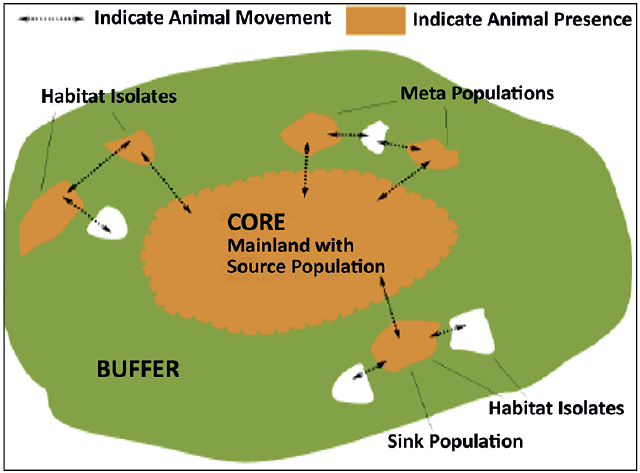
Tiger Reserves – Core and Buffer Strategy
The Tiger Reserves are constituted on a ‘core-buffer strategy’.
Core Zone
- The core area is free from biotic disturbances and forestry operations, where the collection of minor forest produce, grazing, and human disturbances are not allowed.
- These areas must be kept for tiger conservation without affecting the rights of the Scheduled Tribes or other forest dwellers.
- The State Government notifies these areas in consultation with an Expert Committee (constituted for that purpose).
Buffer Zone
- The Act defines a buffer zone as peripheral to the critical tiger habitat or core area, providing supplementary habitat for dispersing tigers and offering scope for the coexistence of human activity (tribals).
- The concerned Gram Sabha determines the limits of such areas, and an Expert Committee is constituted.
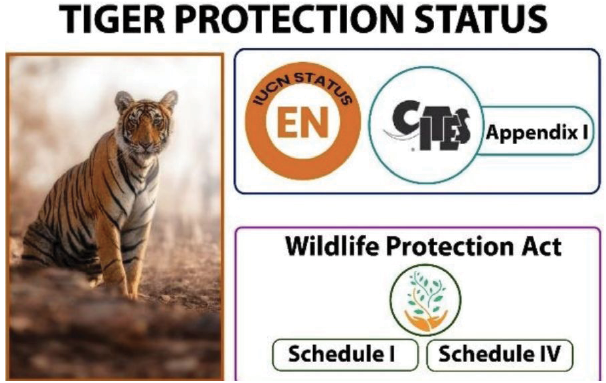
Tiger Task Force
- The implementation of Project Tiger over the years has highlighted the need for a statutory authority with legal backing to ensure tiger conservation.
- Based on the recommendations of the National Board for Wildlife, a Task Force was set up to address the problems of tiger conservation in the country.
- The Task Force’s recommendations include strengthening Project Tiger by giving it statutory and administrative powers.
National Tiger Conservation Authority (NTCA)
- The Wild Life (Protection) Amendment Act 2006 created the National Tiger Conservation Authority (NTCA) and the Wildlife Crime Control Bureau.
- Established in December 2005 following the Tiger Task Force recommendations, the NTCA administers Project Tiger.
- Tiger reserves in India are governed by NTCA guidelines, with field directors overseeing administration.
- Changes to reserve boundaries require NTCA recommendations and the approval of the National Board for Wildlife, and no state government can de-notify a reserve without these approvals.
Members in National Tiger Conservation Authority (NTCA)
- The National Tiger Conservation Authority (NTCA) was established under the Chairmanship of the Minister for Environment and Forests.
- The National Tiger Conservation Authority (NTCA) includes eight experts with qualifications in wildlife conservation and tribal welfare, three Members of Parliament, and the Inspector General of Forests (in charge of Project Tiger) as the ex-officio Member Secretary, among others.
Functions of National Tiger Conservation Authority (NTCA)
The functions of the National Tiger Conservation Authority (NTCA) are:
- The National Tiger Conservation Authority lays down standards and guidelines for tiger conservation in Tiger Reserves, National Parks, and Sanctuaries.
- National Tiger Conservation Authority is required to prepare an Annual Report and Audit Report, which are laid before the Parliament.
- State-level Steering Committees will be established in the Tiger States under the chairmanship of respective Chief Ministers to ensure coordination, monitoring, and protection of tigers.
- Additionally, State Governments are required to prepare a Tiger Conservation Plan and establish a Tiger Conservation Foundation based on successful practices from some tiger reserves.
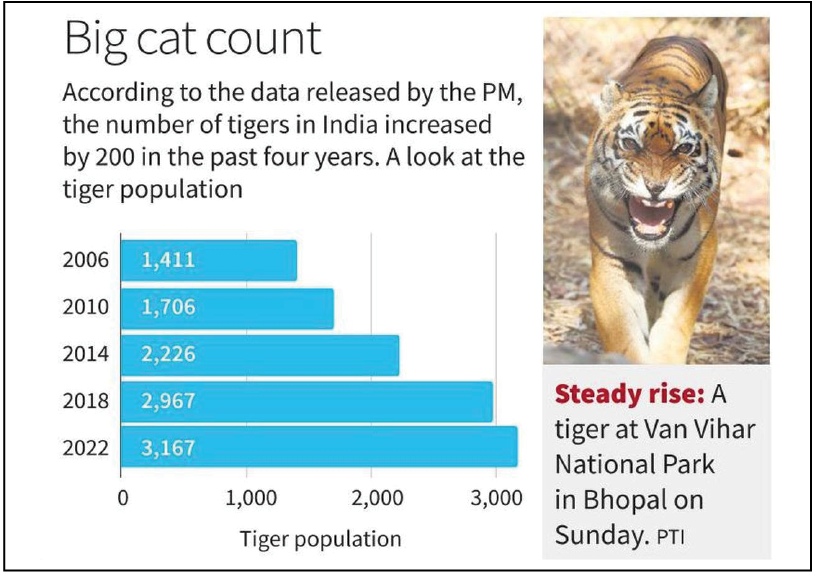
Tiger Census
- The tiger census estimates the number of tigers in a given area every four years.
- The tiger census is conducted regularly to know the current tiger populations and trends.
- The method estimates the number of tigers and helps gather information on the population density and associated prey density.
- The most commonly used technique was the Pugmark Census Technique.
- In this method, the imprints of the tiger’s pugmark were recorded and used to identify individuals.
- The tiger census is used mainly as one of the indices of tiger occurrence and relative abundance.
- Recent methods used to estimate the number of tigers are camera trapping and DNA fingerprinting.
- In-camera trapping involves photographing the tiger, and individuals are differentiated based on the stripes on their bodies.
- In the latest DNA fingerprinting technique, tigers can be identified from their scats.
Conclusion
Project Tiger has made significant strides in conserving tigers in India, from establishing numerous tiger reserves to implementing scientific techniques for population monitoring. Despite the challenges, the NTCA, state governments, and local communities’ continuous efforts have contributed to stabilising and growing the tiger population. Protecting tigers and their habitats remains vital for maintaining biodiversity and ecological balance in India.
Read our detailed article on Wildlife Conservation Projects in India.
Frequently Asked Questions (FAQs)
What is Project Tiger?
Project Tiger is a wildlife conservation program that protects tigers and their habitats in India.
How many tiger reserves are in India?
As of now, there are 53 tiger reserves in India.
Who launched Project Tiger?
The Government of India launched Project Tiger.
Project Tiger was started in?
Project Tiger was started in 1973.
Project Tiger was launched in?
Project Tiger was launched in Jim Corbett National Park.