


Syllabus: GS2/Governance
Context
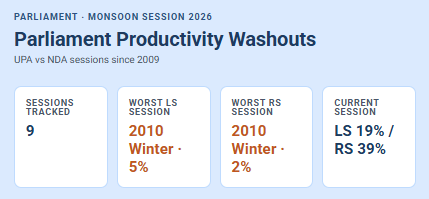
- Recently, the Parliamentary Affairs Minister reported productivity of 19% in Lok Sabha and 39% in Rajya Sabha after the Monsoon Session, reviving concerns over legislative disruptions.
About Parliamentary Disruptions in India
- Parliamentary disruption refers to repeated interruptions, adjournments, protests, sloganeering or other actions that prevent the Houses from conducting scheduled business.
- Persistent disruption undermines Parliament’s deliberative and accountability functions while disruption can be a legitimate instrument for the Opposition to draw attention to urgent issues.
Past Disruptions
- Winter Session (2010): A near-total washout amid the 2G spectrum controversy and the Opposition’s demand for a JPC; Lok Sabha functioned for only 5% and Rajya Sabha 2% of scheduled time.
- Winter Session (2013): Protests over the 2G JPC findings, Telangana, and other issues reduced productivity to 6% in Lok Sabha and 19% in Rajya Sabha.
- Interim Budget Session (2014): Productivity remained low at 21% and 27%, respectively.
- Monsoon Session (2015): Lok Sabha functioned for 46%, while Rajya Sabha functioned for only 9%, amid the Lalit Modi and Vyapam controversies.
- Winter Session (2016): Demonetisation protests reduced productivity to 15% and 18%.
- Budget Session (2018): Cauvery dispute, Andhra Pradesh’s special-category-state demand and PNB-related allegations contributed to productivity of 21% and 27%.
- Monsoon Session (2021): Pegasus allegations and protests over farm laws resulted in productivity of 21% and 29%.
- Budget Session (2023): The Adani controversy, Rahul Gandhi’s remarks abroad and his subsequent disqualification contributed to productivity of 33% in Lok Sabha and 24% in Rajya Sabha.
Declining Legislative Productivity in India
- The 17th Lok Sabha (2019–2024) held only 274 sittings across 15 sessions, the lowest for any full-term Lok Sabha in Indian history.
- The proportion of Bills referred to Parliamentary Standing Committees declined from 71% during the 15th Lok Sabha (2009–14) to 27% during the 16th Lok Sabha (2014–19) and around 16% during the 17th Lok Sabha (2019–24).
- During the Monsoon Session 2025, the Lok Sabha functioned for only 29% of its scheduled time, while the Rajya Sabha functioned for only 34% of its scheduled time.
Why Parliamentary Disruptions Matter?
- Legislative scrutiny suffers: Bills may receive inadequate debate and committee examination.
- Executive accountability weakens: Question Hour and discussions on government policies are lost.
- Public money is wasted: Parliamentary time is a valuable public resource.
- Federal concerns get limited space: Rajya Sabha provides representation to States and must function effectively.
- Democratic deliberation declines: Parliament is constitutionally intended to reconcile competing interests through debate.
Key Concerns & Issues
- Increasing political polarisation and confrontation.
- Frequent resort to disruption as a parliamentary strategy.
- Limited opportunities for structured Opposition expression.
- Reduced referral of important Bills to parliamentary committees.
- Absence of sufficient incentives for maintaining order.
- Risk of passing legislation without adequate deliberation.
Way Forward: Strengthening Measures
- Greater consensus-building: Government should provide adequate space for Opposition concerns through Business Advisory mechanisms.
- Protect Question Hour: Disruptions should not routinely eliminate the primary instrument of executive accountability.
- Strengthen committees: More Bills should undergo detailed committee scrutiny.
- Time-bound discussion: Dedicated slots can be created for major national and State-specific issues.
- Enforce rules impartially: Presiding Officers should apply disciplinary provisions consistently while protecting legitimate dissent.
- Increase parliamentary sitting days: More scheduled time can reduce pressure to transact large amounts of business in limited sessions.
- Promote parliamentary ethics: Political parties should evolve bipartisan norms against persistent obstruction.
Conclusion
- Parliamentary disruption is sometimes a necessary democratic tool, but continuous disruption is not a substitute for deliberation.
- The objective should be a Parliament where the Opposition can effectively question the government and the government can efficiently legislate within a framework of debate, accountability and constitutional restraint.
Previous article
News In Short 13-08-2026
Next article
The New Era of Indian Agriculture and Allied Sectors
