


Kazakhstan Opted For Cloud-Seeding
Syllabus: GS1/Geography; GS3/Science
Context
- To tackle the severe droughts and water shortages that plague the country, Kazakhstan has resorted to cloud seeding, a weather modification method previously unseen in Central Asia.
What is Cloud Seeding?
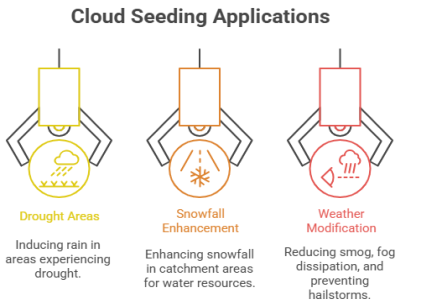
- Cloud seeding is a weather modification method to enhance a cloud’s ability to produce rain or snow.
- History: First demonstrated in 1946 by Vincent J. Schaefer, an American chemist and meteorologist.
- Seeding Agents: Clouds are usually injected with salts like silver iodide, potassium iodide, or sodium chloride to trigger condensation.
- Silver iodide and dry ice (solid CO2) – effective in supercooled clouds (below freezing).
- Calcium chloride – used for warmer clouds (above freezing).
- Working Principle: The salts, or the seeding agents, serve as nuclei around which water droplets can form or ice can crystallise.
- As water droplets grow, they collide with others in the cloud. As they become heavy, the cloud gets saturated and it rains.
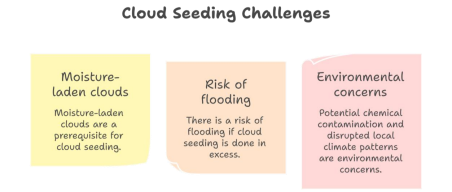
- Meteorologists identify clouds for seeding which have sufficient moisture but are unable to produce enough precipitation on their own.
- Methods of Delivery: These particles are dispersed into clouds using special aircraft, rockets, or dispersion devices kept on the ground.
Source: TH
Supreme Court Clarifies Scope of Police Custody under BNSS
Syllabus: GS2/Polity and Governance
Context
- Recently, the SC held that Section 187(2) of the Bharatiya Nagarik Suraksha Sanhita (BNSS), enlarges the window during which police custody may be sought by the investigating agency.
SC Observations
- Expanded Scope: The police custody is now available in parts during the first 40/60 days of detention though not exceeding 15 days.
- Earlier it was confined to the first 15 days of remand alone.
- Right to Meet an Advocate: The right to meet an advocate of choice is guaranteed under Section 38 of the BNSS; it does not mean continuous ongoing physical presence of an advocate for the entirety of each interrogation session.
- Role of Magistrate: A magistrate or a court while exercising its supervisory jurisdiction, cannot place an absolute and non-extendable outer limit on custody.
- The Court permitted 7 days of (additional) police custody so that the total period of police remand, including that granted by the lower courts would not exceed 15 days.
- This legislative change was intended to meet situations where fresh facts, discoveries or leads may emerge during the course of investigation.
- Therefore, the window of police remand was enlarged beyond the initial 15 days, up to 40 days or 60 days of investigation.
Current Law on Police Remand
- Section 58 of the BNSS provides that any person arrested by the police without warrant cannot be detained for more than 24 hours, unless authorised by a magistrate under Section 187.
- The maximum period of police custody is 15 days. It may be spread over:
- 60 days where the offence is punishable with at least 10 years of imprisonment, or 40 days for any other offence.
- Section 187(3) provides that the magistrate may authorise the (judicial) detention of an accused person beyond the period of 15 days, if he is satisfied that adequate grounds exist for doing so, for a period exceeding:
- 90 days, where the investigation relates to an offence punishable with death, imprisonment for life or imprisonment for a term of 10 years or more;
- 60 days, where the investigation relates to any other offence.
- Thus, in case the probe is not completed within the above stipulated time period, the accused person may be released, which is widely known as default bail.
Source: TH
Glueball
Syllabus: GS3/Science and Technology
Context
- The Beijing Spectrometer (BESIII) Experiment has provided the evidence that X(2370) may be a glueball—a particle composed predominantly of gluons, the carriers of the strong nuclear force.
What is a Glueball?
- A glueball is a hypothetical composite particle made primarily of gluons.
- Gluons are the force-carrying particles of the strong nuclear force, which binds quarks together inside protons and neutrons.
- Glueballs are predicted by Quantum Chromodynamics (QCD), the theory governing strong interactions.
Types of Particles
- Elementary Particles: These are the most basic particles, not made up of anything smaller. For example, quarks, leptons, and gauge bosons.
- Composite Particles: Made up of elementary particles. The most famous examples are protons and neutrons (made of quarks).
Source: TH
Black-necked Cranes (BNC)
Syllabus: GS3/Species
Context
- The Bombay Natural History Society (BNHS) has sterilised over 2,950 Free Ranging Dogs (FRD) to save Black-necked Cranes (BNC) and wildlife in Ladakh.
Black-necked Crane (Grus nigricollis)
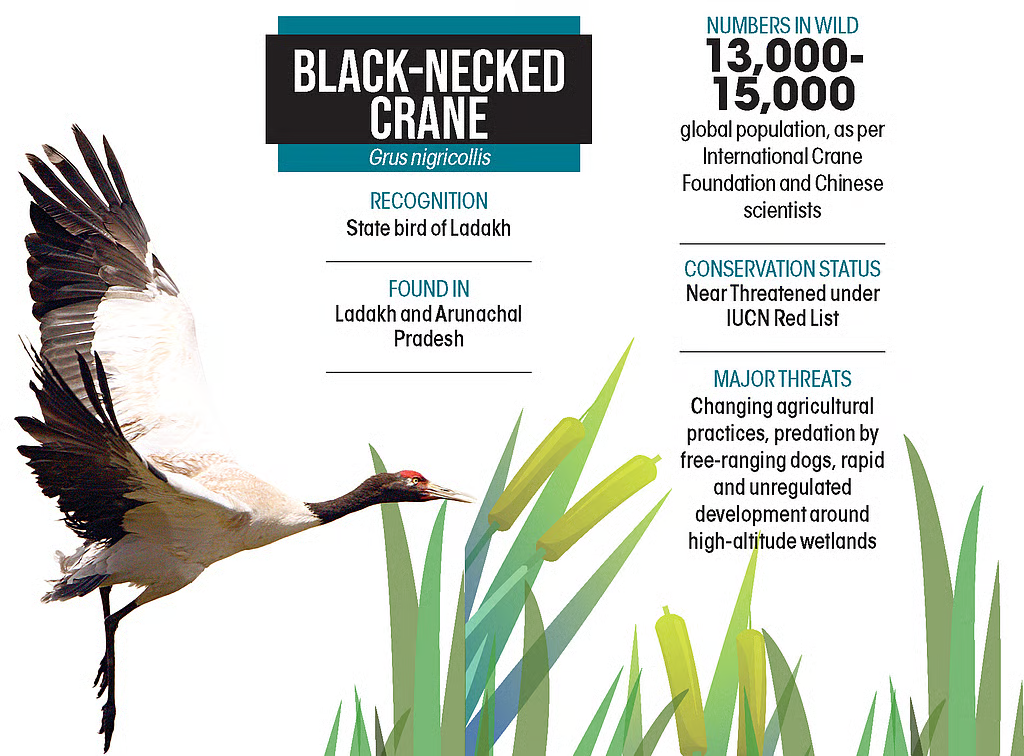
- Of the 15 crane species found worldwide, the Black-necked Crane is considered the only high-altitude/alpine crane species.
- Habitat & Distribution: In India, it is found in Ladakh and Arunachal Pradesh, particularly in high-altitude wetlands and marshes.
- Its global range extends across the Tibetan Plateau and adjoining Himalayan regions, including China, India, Bhutan and Nepal.
- Population: Fewer than 100 Black-necked Cranes are estimated to remain in India, out of a global population of around 15,000.
- Major Threats: Predation by free-ranging dogs, changing agricultural practices, rapid and unregulated development around high-altitude wetlands.
- Conservation Status: The species receives the highest legal protection under Schedule I of the Wildlife (Protection) Act, 1972, and is also protected under CITES and the Convention on the Conservation of Migratory Species, or CMS.
- Near Threatened under IUCN Red List.
- State Bird: It is the State bird of Ladakh and holds special significance in Ladakh’s Buddhist culture.
Bombay Natural History Society (BNHS)
- BNHS is one of the largest and oldest non-governmental organizations in India dedicated to nature conservation and biodiversity research.
- Founded on September 15, 1883, in Mumbai, its mission is to conserve nature through action based on research, education, and public awareness.
Source: DTE
Green Hydrogen
Syllabus: GS3/Environment
In News
- Germany is looking to deepen its partnership with India in green hydrogen and renewable energy, with a possibility to import Indian green hydrogen to lower its reliance on fossil fuels.
Hydrogen as a fuel
- It is the most abundant element in nature, but it is not found in the free state and must be liberated from compounds such as water.
- It is a clean fuel, but the process to find it is energy intensive.
- It is categorised into different ‘colours’ depending on its source and the way it is produced.
Types
- Grey hydrogen: Hydrogen produced from fossil fuels is called grey hydrogen.
- Currently, most of the hydrogen produced for industrial consumption and applications is grey hydrogen.
- Blue hydrogen: Hydrogen generated from fossil fuels with carbon capture and storage options is called blue hydrogen.
- Green hydrogen: It refers to hydrogen produced from water electrolysis—splitting water into hydrogen and oxygen—by using renewable energy-powered electrolysers.
- It is considered a virtually emission-free pathway for hydrogen production.
Green Hydrogen and Its Benefits
- It is hydrogen produced via electrolysis of water using sustainable energy sources such as solar, wind, or hydropower.
- It is a clean-burning molecule that can be used to decarbonize a variety of industries, such as transportation, chemicals, and iron and steel.
- Its manufacturing can lead to very low greenhouse-gas emissions.
- It does not produce any CO 2 when used as fuel, hence, it is considered a clean fuel.
Steps Taken
- The National Green Hydrogen Mission (NGHM) was approved by the Union Cabinet in 2023, recognising the role of Green Hydrogen in India’s ambitions of energy independence by 2047 and Net Zero by 2070.
- It is supported by the Ministry of New and Renewable Energy (MNRE).
- It views Green Hydrogen as a sunrise sector for India. It has the objective of making India a global hub for the production, usage and export of Green Hydrogen and its derivatives.
- The 2030 target for green hydrogen production capacity under the NGHM is 5 million tonnes per annum, contributing to a reduction in dependence on imports of fossil fuels.
- Achievement of the mission targets is expected to reduce India’s fossil fuel imports by a cumulative Rs 1 lakh crore by 2030.
Source:TH
Previous article
Rising Recoveries Reflect Strengthening Banking Sector Health
Next article
Parliamentary Productivity & Disruptions in India
