


Syllabus: GS3/Mineral Resources
Context
- Recently, the Lok Sabha passed the Mines and Minerals (Development and Regulation) Amendment Bill, 2026, seeking to centralise taxation of mineral rights after the Supreme Court’s 2024 ruling.
Mining Landscape in India
- India possesses significant reserves of coal, iron ore, bauxite, manganese, limestone and several critical minerals.
- It is vital for infrastructure, manufacturing, energy security and emerging technologies such as electric vehicles and renewable energy.
- The mining sector has acquired strategic importance because access to critical minerals is increasingly linked to global supply-chain resilience.
- However, mining is geographically concentrated in mineral-rich regions such as Odisha, Jharkhand, Chhattisgarh and eastern-central India.
MMDR Act, 1957 & Key Amendments
- The MMDR Act, 1957 is the principal legislation governing the development and regulation of mines and minerals.
- Over time, amendments have sought to improve transparency, auction mineral concessions, increase exploration and attract investment.
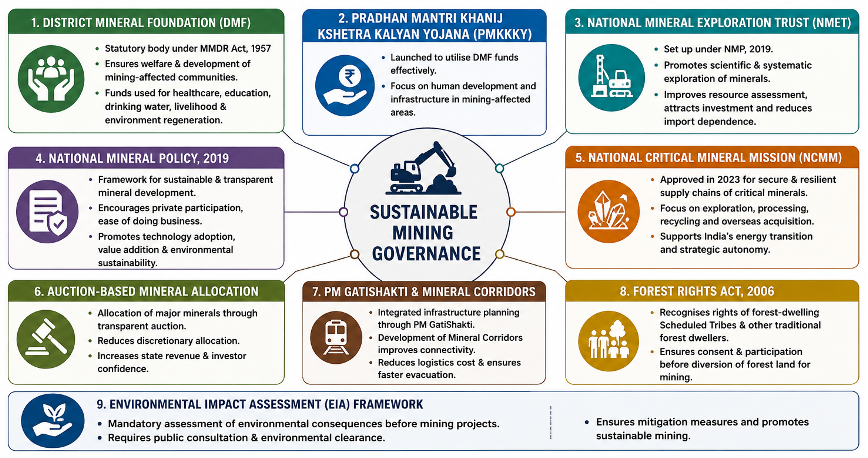
- 2015 Amendment: Shifted mineral concessions towards an auction-based regime and introduced mechanisms such as the District Mineral Foundation (DMF) and National Mineral Exploration Trust (NMET).
- 2021 Amendment: Sought to liberalise mineral production, improve utilisation of mining leases and facilitate greater private-sector participation.
- 2023 Amendment: Focused significantly on critical and strategic minerals, reflecting their importance for clean energy, electronics, defence and strategic supply chains.
- These reforms indicate a broader transition from administrative allocation towards market-oriented, transparent and strategic mineral governance.
Features of the MMDR Amendment Bill, 2026
- The central thrust of the 2026 legislation is to alter the fiscal consequences of the 2024 Supreme Court judgment by restoring a more centralised framework for taxation associated with mineral rights.
- Potential Benefits:
- Greater tax predictability: A uniform framework can reduce uncertainty for mining companies.
- Investment climate: Predictable taxation can support long-term capital-intensive investments.
- Strategic minerals: Central coordination can help secure supplies of critical minerals important for clean energy, defence and advanced manufacturing.
- Avoidance of overlapping levies: A more standardised regime may reduce the possibility of multiple or inconsistent state-level fiscal burdens.
Impact of the Bill
- Before:
- Mineral-bearing lands were outside the Union’s regulatory reach.
- Mining was taxed differently in every State.
- New levies could be introduced even after mining operations started.
- Retrospective tax demands could be raised at any time.
- The maximum burden fell on small and medium miners.
- After:
- Mineral-bearing lands are brought under Union regulation.
- A single, Centre-directed tax framework will apply under New Section 9D.
- States cannot impose new levies except under conditions set by the Central Government.
- All pending retrospective dues are now declared invalid.
- Every miner now benefits from a fair and equal framework.
Issues & Concerns in India’s Mining Sector
- Environmental and social asymmetry: Mining can cause deforestation, habitat fragmentation, water pollution, displacement and livelihood losses.
- Tribal and forest-dependent communities often bear these costs despite receiving only a fraction of the economic gains.
- Centralising fiscal authority could weaken the bargaining position of mineral-bearing States unless revenue-sharing and local benefit mechanisms are strengthened.
- Fiscal federalism: The decision comes against the backdrop of shrinking State fiscal autonomy, particularly after GST subsumed several State taxation powers.
- States already depend substantially on tax devolution and grants.
- Using legislation to override the fiscal consequences of a significant judicial ruling therefore raises questions about the balance between Union authority and State autonomy.
- Development versus sustainability: A narrow focus on ‘ease of doing business’ may encourage extraction without adequately pricing ecological and social externalities.
- Sustainable mining requires that economic efficiency be accompanied by environmental justice and inter-generational equity.
Related Constitutional & Legal Provisions
- Article 246 and Seventh Schedule: Legislative powers are divided between the Union and States.
- Entry 54, Union List: Parliament can regulate mines and mineral development in the public interest.
- Entry 50, State List: States can impose taxes on mineral rights, subject to limitations imposed by Parliament.
- The Supreme Court of India, in Mineral Area Development Authority v. Steel Authority of India Ltd. (2024), held that royalty is not a tax and that States possess constitutional authority to tax mineral rights, subject to Parliament’s power under Entry 50.
- Article 243G: Provides for devolution of powers to Panchayats, relevant to participatory local governance.
- Fifth Schedule: Provides special governance arrangements for Scheduled Areas and tribal communities.
- PESA Act, 1996: Strengthens Gram Sabha participation in Scheduled Areas, including matters affecting community resources.
Way Forward: Strengthening Measures
- The objective should not be to choose between investment and federalism, but to reconcile them.
- Establish a predictable and transparent national fiscal framework while protecting legitimate State interests.
- Strengthen DMF and PMKKKY implementation, with greater community participation and outcome-based monitoring.
- Ensure effective implementation of PESA, Forest Rights Act and environmental safeguards.
- Consider mechanisms for equitable sharing of mineral revenues with producing States and affected communities.
- Make environmental restoration, mine closure and rehabilitation integral to mining economics.
- Institutionalise Centre-State consultation on major changes affecting mineral revenues.
Conclusion
- The MMDR Amendment Bill, 2026 highlights a larger constitutional dilemma: economic efficiency cannot come at the cost of democratic accountability and fiscal federalism.
- A predictable mining regime is essential for India’s strategic and economic ambitions, but its legitimacy will ultimately depend on whether mineral-rich States and affected communities receive a fair share of the benefits.
| Daily Mains Practice Question [Q] Critically examine the implications of the Mines and Minerals (Development and Regulation) Amendment Bill, 2026 for Centre–State relations, mining-affected communities and sustainable mineral development in India. |
Previous article
Challenges Facing India’s Higher Education
Next article
India’s Democracy Needs Different Electoral Rhythms
