


Syllabus: GS1/ Human Geography
Context
- India’s population has reached an estimated 146.39 crore by April 2025, according to the United Nations report titled “State of the World Population 2025: The Real Fertility Crisis.”
India’s Status as per the 2025 Report
- Current Population Status: India is the world’s most populous country with 146.39 crore people, surpassing China (141.61 crore).
- The population is expected to peak at 170 crore before beginning to decline in approximately 40 years.
- Decline in Fertility Rate: TFR is now 1.9, below the replacement level of 2.1.
- Among the states that had fertility rates higher than national average were Bihar (2.98), Meghalaya (2.9), Uttar Pradesh (2.35), Jharkhand (2.26), and Manipur (2.2).
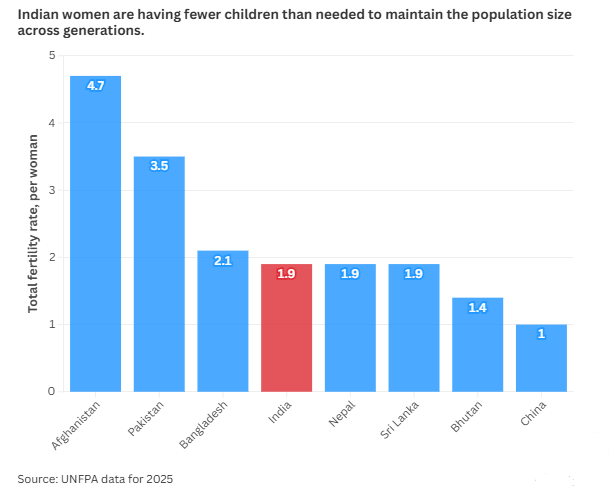
- Demographic Composition:
- Working-age population (15–64 years): 68%
- Children (0–14 years): 24%
- Youth (10–24 years): 26%
- Elderly (65+ years): 7% (expected to rise)
What is the Real Fertility Crisis?
- The real fertility crisis lies not in overpopulation or underpopulation, but in the inability of individuals to achieve their reproductive goals.
- It calls for reproductive agency—the freedom to make informed choices regarding sex, contraception, and family planning.
| Total Fertility Rate (TFR) – The average number of children born to a woman during her childbearing years. – A TFR of 2.1 is considered the replacement level needed to maintain a stable population. |
Reasons for Population Decline
- Access to Reproductive Healthcare: Contraceptive use and maternal health services have expanded.
- Female Education & Empowerment: Increased female literacy and workforce participation delay childbirth.
- Urbanization: Urban lifestyles reduce family size due to cost and space constraints.
- Economic Uncertainty: Rising cost of living and job instability discourage large families.
Significance of the Population decline
- Population Stabilization: A TFR of 2.0 indicates India is approaching population stabilization, which can ease pressure on natural resources, public services, and the environment.
- Improved Maternal health: Fewer childbirths per woman, coupled with delayed age of marriage, lead to reduced maternal mortality, better child care, and healthier families.
- Women Empowerment: Lower fertility rates reflect higher education levels, workforce participation, and greater autonomy among women, leading to better social and economic outcomes.
What are the concerns?
- Ageing Population: A rise in the elderly population will increase the dependency on the working population, demanding increased focus on pension, healthcare, and social welfare systems.
- Potential for Skewed Sex Ratios: In certain areas, fertility reduction without tackling gender bias can exacerbate sex-selective practices, leading to imbalanced sex ratios.
- Demographic Imbalance: States with vast fertility differences, potentially leading to interstate migration, cultural shifts, and resource strain in low-TFR states.
| Global scenario – In Japan the median age is over 48 years. This has led to prolonged economic stagnation, shrinking workforce, and increased public spending on pensions and healthcare. – China’s one-child policy, enforced from 1979 to 2015, significantly lowered the birth rate, leading to a rapidly aging population. – South Korea has one of the world’s lowest fertility rates, at 0.78 as of 2022. |
Concluding remarks
- India stands at a demographic crossroads. The decline in fertility is a testament to social progress in education, healthcare, and gender empowerment.
- However, as the focus shifts from population control to reproductive rights and demographic balance, India must prepare for a future that balances economic productivity, social support systems, and individual reproductive choices.
Source: TH
Previous article
News In Short-10-06-2025
