


Syllabus: GS3/Economy
Context
- Recently, VV Giri National Labour Institute (VVGNLI) forecasted that the Gig workforce in India, making up 15% of the country’s total non-agricultural workforce.
- It builds on estimates from NITI Aayog’s 2022 gig workforce report.
Key Findings & Projections of Study
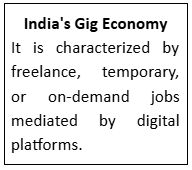
- Approximately 3 million workers were engaged in platform jobs across 11 major companies in 2020.
- It is expected to reach 23 million, making up 7% of the non-agricultural workforce by 2030, and is projected to more than double, reaching 62 million workers by 2047.
- It could generate up to 90.8 million jobs under aspirational growth scenarios, but economic and regulatory uncertainties could limit growth to 32.5 million.
- Sectoral Expansion: Initially concentrated in ride-sharing and food delivery, gig jobs have diversified into healthcare, education, creative services, and professional consulting with the rapid rise of app-based services and shifting work preferences.
Challenges and Regulatory Gaps
- Lack of Social Security: Gig workers often operate without health benefits, insurance, or retirement provisions.
- Long Working Hours and Stress: Unregulated working hours, erratic schedules, and heavy workloads lead to stress and health safety issues.
- Absence of Grievance Redressal Mechanisms: Workers who raise concerns or speak out against unfair practices often face retaliation, including instances like ID blocking.
Regulatory Considerations Highlighted in Study
- Worker Rights & Unionisation: The study calls for legal recognition of gig workers, including the right to unionize and collectively bargain.
- Transparency in task allocation algorithms is crucial for fair pay distribution and improved working conditions.
- Classification & Legal Protections: Countries like the UK, Canada, Spain, and France legally differentiate workers from independent contractors, ensuring access to labor protections and social security.
- India needs clear classification criteria to address worker vulnerabilities.
- Fair Wages & Algorithmic Accountability: The study recommends policies to:
- Ensure minimum income guarantees
- Regulate working hours
- Increase transparency in gig work assignments
- Enhance grievance redressal mechanisms
- National Registry for Gig Workers: A statutory registry (i.e. National Platform Worker Registry), managed by central and state governments, could help streamline social security access for gig employees.
- Integration of occupational health and safety standards in platform-based work.
Other Policies & Initiatives
- Code on Social Security, 2020: It aims to extend social security benefits to gig and platform workers.
- It proposes the creation of a social security fund, financed through contributions from aggregators, to provide health insurance, pension schemes, and accident coverage.
- Skill Development & Training: Programs focused on upskilling gig workers in areas like digital literacy, entrepreneurship, and specialized trades are being encouraged to enhance employability.
Previous article
India’s IBC Framework: Balancing Resolution with Recovery
Next article
Blue NDC Challenge
