


Syllabus: GS3/ Environment
Context
- A recent study has revealed that ocean acidification has breached its planetary boundary, posing grave threats to marine ecosystems and global climate stability.
What is Ocean Acidification?
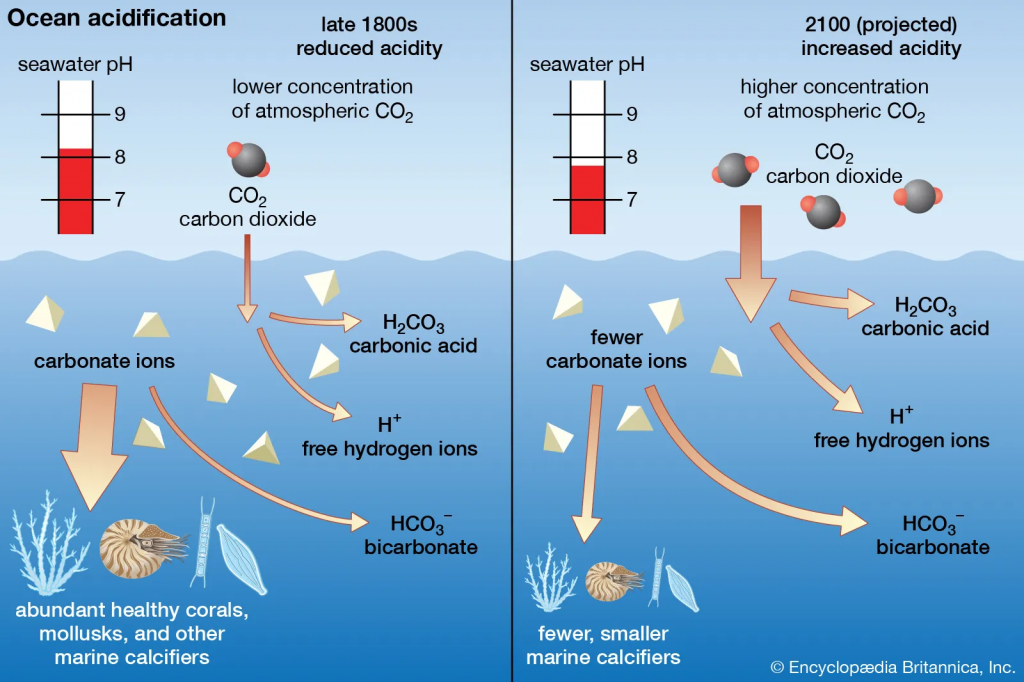
- Ocean acidification refers to the ongoing decrease in the pH of Earth’s oceans, caused by the uptake of carbon dioxide (CO₂) from the atmosphere.
- When CO₂ dissolves in seawater, it forms carbonic acid, which lowers ocean pH and reduces calcium carbonate levels – essential for many marine organisms.
Planetary Boundary Breach
- Planetary boundaries are thresholds beyond which the Earth’s vital systems may no longer maintain a stable environment.
- The study finds that by 2020, the average global ocean conditions had already fallen 20% below pre-industrial calcium carbonate saturation, crossing the safe threshold for acidification.
- At 200 metres below the surface, 60% of global waters had breached the “safe” limit for acidification.
Impacts of Ocean acidification
- Calcifying Species Affected: Corals, oysters, mussels, and pteropods (sea butterflies) are most vulnerable.
- Acidification weakens shells and skeletons, reduces reproduction, slows growth, and increases mortality.
- Fisheries and Livelihoods: Decline in fish nursery grounds affects food security and economic stability of coastal communities.
- Tourism Sector: Coral reef degradation affects tourism and recreational diving industries.
- Climate Feedbacks: Damage to ocean ecosystems like plankton may affect carbon sequestration capacity of oceans. This could amplify global warming over time.
- Social impacts: Climate-linked migration and livelihood loss may increase geopolitical tensions. Rising unemployment in coastal sectors may trigger social unrest.
Initiatives to Tackle Ocean Acidification
- Global Ocean Acidification Observing Network (GOA-ON): GOA-ON is a collaborative international network of 367 members from 66 countries, aimed at enhancing the monitoring and understanding of ocean acidification across estuarine, coastal, and open ocean systems.
- UN Decade of Ocean Science for Sustainable Development (2021–2030): Proclaimed in 2017 by the United Nations General Assembly, it aims to reverse the decline the ocean health through;
- Stimulating scientific research, technological innovation, and policy-relevant knowledge.
- Supporting countries to achieve SDG-14 (“Life Below Water) and broader climate resilience.
- Intergovernmental Oceanographic Commission (IOC) of UNESCO: Under its Global Ocean Observing System (GOOS), it supports real-time ocean monitoring including pH and CO₂ measurements.
- Blue Carbon Initiatives provides research, policy advice, and financing mechanisms to promote blue carbon strategies globally.
- Blue Carbon refers to the carbon stored in coastal and marine ecosystems such as mangroves, salt marshes, and seagrasses.
Way Ahead
- Policy and Governance: Mainstream ocean acidification into national climate and ocean policies.
- Prioritise Marine Spatial Planning and Integrated Coastal Zone Management.
- Local Adaptation and Conservation: Protect and restore resilient ecosystems, such as mangroves and seagrasses.
- Implement Marine Protected Areas (MPAs) in regions of high vulnerability.
Concluding remarks
- Ocean acidification is not just a marine problem, it is a multi-dimensional crisis affecting biodiversity, economies, food systems, and climate resilience.
- Its silent but accelerating pace demands urgent and coordinated policy responses globally and nationally.
Source: Guardian
| Read this in Hindi: महासागर अम्लीकरण |
Previous article
Blue NDC Challenge
