

Hurricane Melissa
Syllabus: GS1/Geography
In News
- Hurricane Melissa made a catastrophic landfall in Jamaica, bringing extreme rainfall, storm surge, and potential structural collapse.
| Melissa is the strongest storm to hit Jamaica since 1988’s Hurricane Gilbert and is expected to impact southeastern Cuba and the Bahamas. |
Hurricanes
- It is also known as typhoons or cyclones depending on their location and are the most intense storms on Earth.
- Scientifically termed tropical cyclones, they all form through the same process, but only those originating in the Atlantic or eastern Pacific are called hurricanes.
- A six-year rotating list of names, updated and maintained by the World Meteorological Organization, is used to identify these storms.
- Names can be retired if storms cause significant damage or casualties, based on member consensus.
Formation
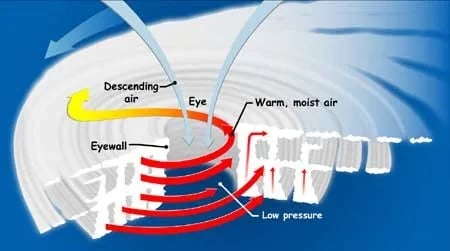
- Tropical cyclones are powerful storms that form over warm ocean waters near the equator, fueled by rising warm, moist air that creates low-pressure zones.
- As surrounding air rushes in, it also warms, rises, and forms clouds, causing the system to spin due to Earth’s rotation—counterclockwise in the Northern Hemisphere and clockwise in the Southern.
- As the storm intensifies, an eye forms at the center, marked by calm and low pressure.
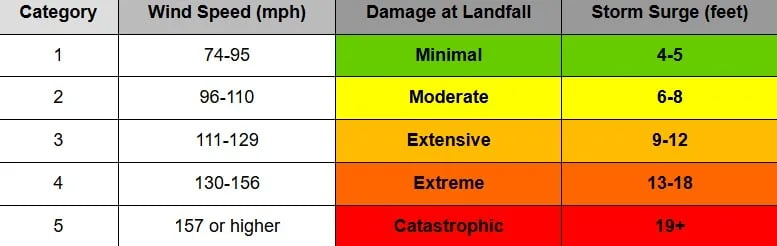
- When wind speeds reach 39 mph, it becomes a tropical storm, and at 74 mph, a tropical cyclone or hurricane.
- These storms weaken over land but can still cause heavy rain and wind damage inland.
Source : TH
Model Youth Gram Sabha Initiative
Syllabus: GS2/ Polity and Governance
Context
- The Union government launched the Model Youth Gram Sabha (MYGS) initiative along with a Training Module and the MYGS Portal in New Delhi.
The Model Youth Gram Sabha (MYGS)
- The Model Youth Gram Sabha (MYGS) is a pioneering initiative to strengthen Janbhagidari and promote participatory local governance by engaging students in simulated Gram Sabha sessions.
- Aligned with National Education Policy 2020, it aims to inculcate democratic values, civic responsibility and leadership among youth, nurturing future citizens committed to transparency, accountability and the vision of Viksit Bharat.
- The initiative is a joint effort of the Ministry of Panchayati Raj, the Ministry of Education, and the Ministry of Tribal Affairs.
- The initiative will be rolled out across more than 1,000 schools nationwide, including Jawahar Navodaya Vidyalayas (JNVs), Eklavya Model Residential Schools (EMRSs), and State Government Schools.
Source: AIR
AmazonFACE Experiment
Syllabus: GS3/Environment
Context
- In Brazil’s Amazon rainforest, scientists have built a unique experiment called AmazonFACE to simulate future atmospheric conditions by pumping carbon dioxide (CO₂) into the forest canopy.
- The goal is to understand how the Amazon — often called the “lungs of the Earth” — will adapt to rising CO₂ levels in the coming decades.
About the Project:
- AmazonFACE (Free-Air CO₂ Enrichment) is located near Manaus, Brazil.
- The setup includes six steel tower rings, each surrounding 50–70 mature trees.
- Three rings will be fumigated with elevated CO₂ to mirror future climate projections (2050–2060), while others serve as controls.
- Sensors monitor forest responses every 10 minutes — tracking CO₂ absorption, oxygen release, and changes in humidity.
- The project is led by INPA (National Institute for Amazon Research) and Universidade Estadual de Campinas, with support from Brazil and the United Kingdom.
Source: DDNews
Superfluid Helium to Study Nonlinear Wave Dynamics Such as Tsunamis and Solitons
Syllabus: GS3/Science and Technology
In News
- Researchers at the University of Queensland have developed a chip-scale wave flume using a 6.7-nanometre film of superfluid helium to study nonlinear wave dynamics such as tsunamis and solitons.
| Do you know? – Tsunamis and solitons are examples of nonlinear waves, whose behaviour changes unpredictably with conditions. 1. Tsunamis are large and destructive, while solitons are stable, solitary waves that maintain their shape and speed over long distances. |
Latest Developments
- Researchers used laser light to generate and measure waves and observed long-predicted phenomena such as backward wave steepening, shock fronts, and soliton fission—solitary waves travelling as troughs instead of crests.
- Although the microscopic system operates under different forces, it follows the same Korteweg–De Vries equation that governs large-scale waves, making it mathematically equivalent.
- The platform offers a fast, precise way to explore nonlinear fluid dynamics and advances research in optomechanics.
Significance
- The recent innovation enables ultra-fast, tunable experiments and opens new frontiers in optomechanics and nonlinear physics at microscopic scales, with implications for disaster prediction and communication technologies.
Source :TH
Previous article
China’s Complaint Against India at WTO
Next article
Sardar Patel’s Vision & Meaning of National Unity
