


Syllabus: GS2/Governance
In News
- The Union Tribal Affairs Ministry has issued a policy mandating that relocation of forest-dwelling communities from tiger reserves must be “exceptional, voluntary, and evidence-based.
Background
- India’s tiger conservation strategy is moving from exclusionary “fortress conservation” to a rights-based, community-centred model.
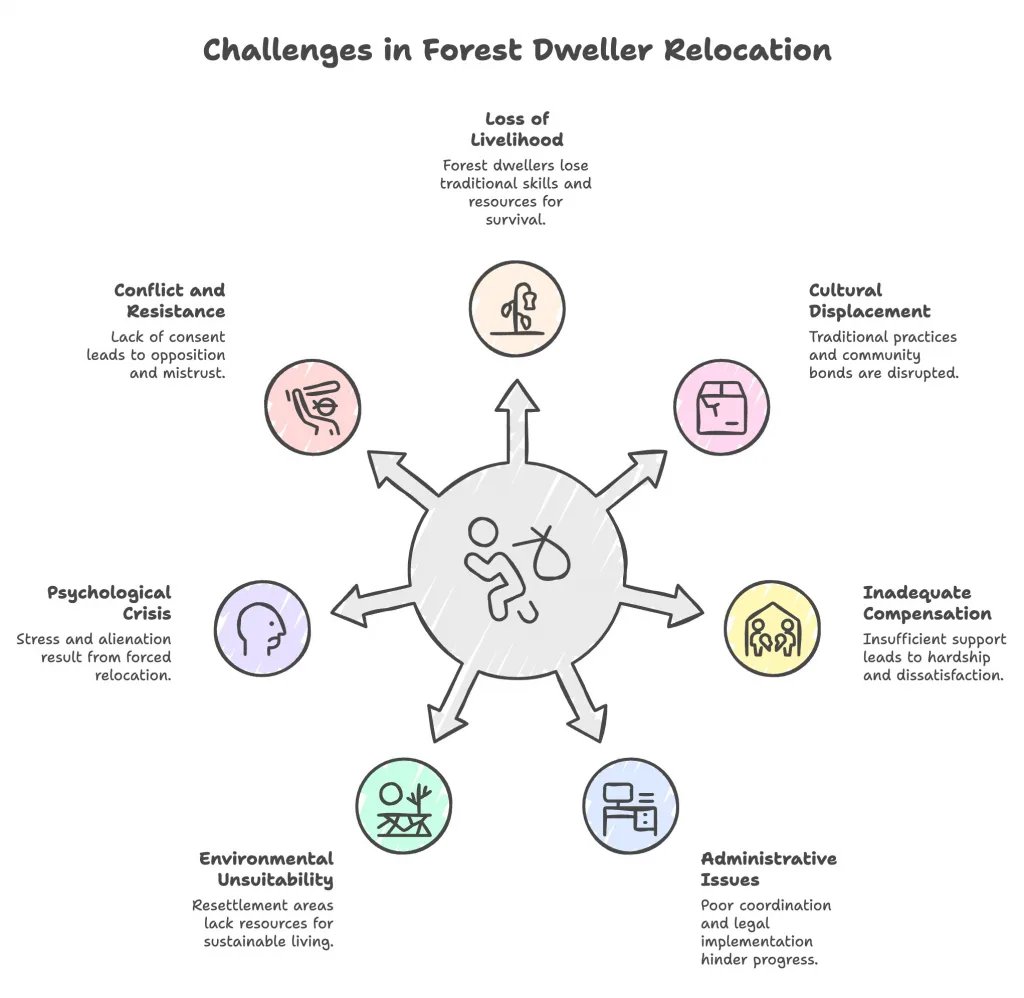
- Historically, the creation of tiger reserves often displaced forest-dwelling communities, but the Union Ministry of Tribal Affairs (MoTA) now mandates that relocation must be a last resort, voluntary, scientifically justified, rights-compliant, and equitable.
| Do you know? – Forest Rights Act (FRA), 2006: The Act mandates Free, Prior and Informed Consent (FPIC) from the Gram Sabha, scientific evidence that coexistence with wildlife is infeasible, voluntary consent of affected families, and comprehensive rehabilitation. 1. The Forest Rights Act (FRA) is intrinsically tied to constitutional guarantees of equality (Article 14), life and livelihood (Article 21), and self-governance in Scheduled Areas (Article 244). – Wildlife (Protection) Act (WLPA), 1972: Tiger conservation cannot harm tribal or forest-dweller rights unless irreversible ecological damage is proven and all alternatives fail. 1. Together, these laws establish a “rights-first, science-based, consent-driven” framework, placing the burden of proof on the state rather than the community. |
Key Recommendations
- It advocates a rights-based, ethical approach to the relocation of forest-dwelling communities from tiger reserves.
- It mandates that relocation must be voluntary, scientifically justified, and compliant with the Forest Rights Act (FRA) and Wildlife Protection Act (WLPA).
- It emphasizes Free, Prior, and Informed Consent (FPIC), robust rehabilitation, and the Gram Sabha’s authority in decision-making.
- Officials have a fiduciary duty to act with integrity, and mechanisms such as public dashboards and independent audits are essential to uphold accountability and prevent misuse of conservation as a pretext for dispossession.
- It outlines two pathways: coexistence, where communities remain in their traditional habitats with access to infrastructure, conservation roles, and livelihood support; and voluntary relocation, which must include land-for-land compensation, livelihood restoration, cultural access, and rigorous monitoring. Five core principles guide this approach—rights protection, community self-determination, equity, scientific transparency, and accountability.
- Establish a National Framework for Community-Centred Conservation and Relocation (NFCCR) to set procedural standards, timelines, and accountability.
- It aims to Create a National Database on Conservation-Community Interface (NDCCI) to track relocations, compensation, and post-relocation outcomes.
Way Ahead
- The new policy framework by the Union Tribal Affairs Ministry marks a transformative shift in India’s conservation strategy by prioritizing tribal rights and ethical relocation practices.
- Protecting India’s wildlife and upholding the rights and dignity of forest communities are inseparable goals, requiring collaboration, transparency, and respect for constitutional and ecological imperatives.
Source: TH
Previous article
Cyclone Montha
