


Syllabus: GS1/Geophysical Phenomena
Context
- Severe cyclonic storm Montha created destruction in Andhra Pradesh.
- The name ‘Montha’, meaning beautiful or fragrant flower, was contributed by Thailand.
- The next cyclone will be named Senyar, as suggested by UAE, after that it will be Ditwah (Yemen), Arnab (Bangladesh), and Murasu (India).
What are Cyclones?
- The word Cyclone is derived from the Greek word Cyclos meaning the coils of a snake.
- It was coined by Henry Peddington because the tropical storms in the Bay of Bengal and the Arabian Sea appear like coiled serpents of the sea.
- Cyclones are powerful, rotating storms that form over warm ocean waters, characterized by low pressure at the center and high winds.
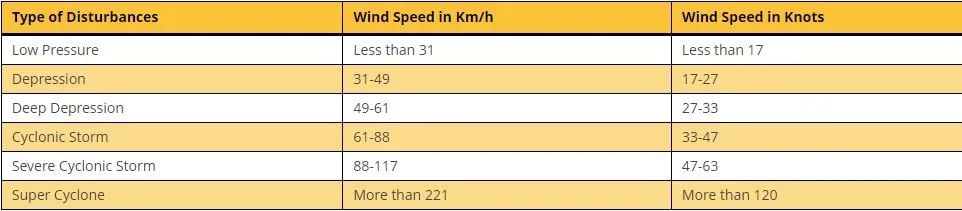
- Worldwide terminology: Cyclones are given many names in different regions of the world:
- They are known as typhoons in the China Sea and Pacific Ocean; hurricanes in the West Indian islands in the Caribbean Sea and Atlantic Ocean; tornados in the Guinea lands of West Africa and southern USA.; willy-willies in north-western Australia and tropical cyclones in the Indian Ocean.
How a Cyclone is formed?
- Conditions: Cyclones typically form over warm ocean waters, the warmth provides the necessary heat and moisture to fuel the cyclone.
- Formation of a Low-Pressure System: When the air rises up and away from the ocean surface, it creates an area of lower air pressure below.
- It causes the air from surrounding areas with higher pressure to move towards the low-pressure area which further leads to warming up of the air and causes it to rise above.
- Cyclonic Circulation: The rotation of the Earth (Coriolis effect) causes the rising air to start spinning around the low-pressure center. This spinning motion leads to the development of cyclonic circulation.
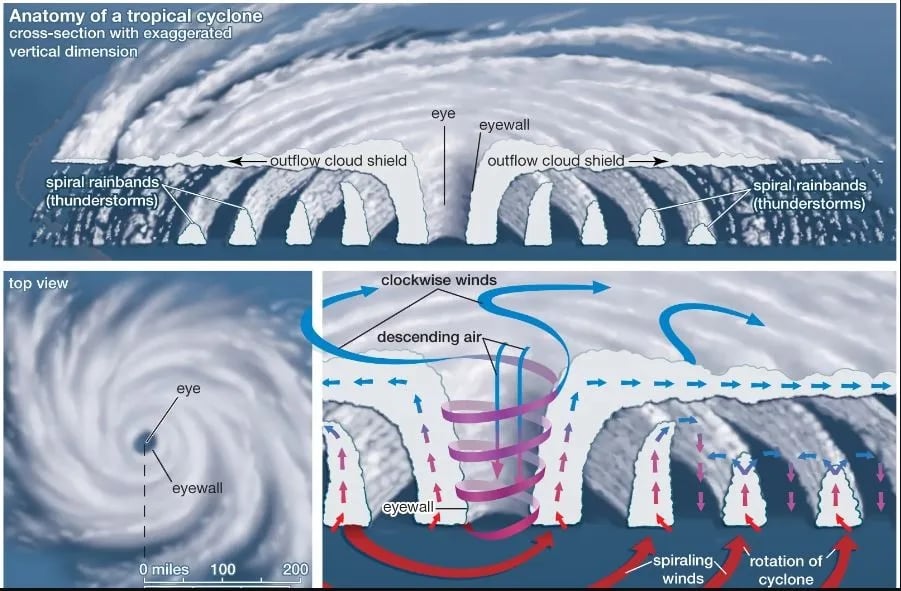
- As the wind system rotates with increasing speed, an eye gets formed in the middle.
- The centre of a cyclone is very calm and clear with very low air pressure. The difference of temperature between the warm, rising and the cooler environment causes the air to rise and become buoyant.
- Dissipation: A cyclone will eventually weaken and dissipate when it moves over cooler waters, encounters dry air, or interacts with land, which disrupts the system’s supply of warm, moist air.
Nomenclature
- The names are maintained and updated by an international committee of the World Meteorological Organization.
- Cyclones in the North Indian Ocean region are named by the regional specialized meteorological centers (RSMCs) in India, Bangladesh, Myanmar, Oman, Pakistan, and Sri Lanka.
- Each country contributes names to a list used on a rotating basis.
- The primary reason for naming cyclones is to make communication easier and more efficient.
| India Meteorological Department (IMD) – It was established in 1875. – It is the principal government agency in all matters relating to meteorology and allied subjects. – It is under the Ministry of Earth Sciences (MoES). |
Source: TH
Previous article
News in Short – 29 October, 2025
Next article
Relocation of Forest-dwelling Communities
