


Syllabus: GS3/Economy
Context
- India’s manufacturing sector is regaining momentum amid geopolitical shifts that are reshaping global production networks and offers a solid foundation for the next phase of industrial growth.
- As the Economic Survey notes, sustaining this revival will require stronger competitiveness and deeper integration into global value chains.
About India’s Manufacturing Sector
- India’s manufacturing industry is a critical pillar of the economy, contributing significantly to employment, exports, and overall growth.
- In recent years, the sector has regained momentum as global supply chains diversify and countries seek alternatives to concentrated production hubs.
- It has created an opportunity for India to position itself as a reliable and competitive manufacturing destination.
Sectoral Progress and Value Chain Upgrading
- Electronics and Semiconductors: Electronics manufacturing has expanded rapidly, with production increasing nearly six-fold and exports almost eight-fold over the past decade.
- Pharmaceuticals and Medical Devices: It has established India as one of the world’s largest suppliers of generic medicines and vaccines, combining scale with technology intensity, with India supplying over half of global vaccine demand and a large share of generic medicines.
- Automobiles and Auto Components: India is a major producer of two-wheelers, passenger vehicles, and commercial vehicles, supported by a strong auto-component ecosystem.
- The sector is undergoing a transition towards electric mobility, advanced electronics, and cleaner technologies.
- Steel, Metals, and Heavy Industry: Steel and metals form the backbone of India’s industrial base, supporting infrastructure, construction, and capital goods manufacturing.
- India ranks among the world’s largest steel producers, benefiting from domestic demand and resource availability.
- Textiles and Apparel: Textiles and apparel remain labour-intensive and export-oriented, providing employment to millions.
- India has strengths across the value chain, from fibre and yarn to finished garments.
- Recent policy support aims to improve scale, modernise production, and enhance competitiveness against low-cost global producers.
- Renewable Energy and Emerging Technologies: Manufacturing linked to renewable energy, such as solar modules, wind components, and energy storage systems is gaining momentum as India expands its clean energy capacity.
- It aligns industrial growth with climate goals and offers opportunities for technology learning, scale, and export potential.
- Emerging areas such as green hydrogen equipment and advanced materials are beginning to attract investment.
- MSMEs Across Sectors: Micro, Small and Medium Enterprises (MSMEs) contribute substantially to employment and exports but face challenges related to finance, technology adoption, and skill development.
- Deeper integration of MSMEs into strategic value chains, as suppliers of components and specialised services will be essential for inclusive and sustainable industrial growth.
Concerns & Issues Around India’s Manufacturing Sector
- Limited Share in GDP and Employment: Manufacturing’s share in India’s GDP has remained around 15–17% for years, lower than that of many industrialised and emerging economies.
- It has not generated employment at the scale needed to absorb India’s growing workforce, raising concerns about jobless or low-quality job growth.
- Incomplete Integration into Global Value Chains: India remains underrepresented in global manufacturing value chains, especially in high-technology and complex products.
- India still relies heavily on imported intermediates, limiting domestic value addition and reducing resilience to global supply disruptions while exports have grown in sectors such as pharmaceuticals and electronics.
- Infrastructure and Logistics Bottlenecks: Although logistics efficiency has improved, costs remain high relative to some competitors.
- Road transport continues to dominate freight movement, while railways and coastal shipping, more efficient for long-distance and bulk transport, are underutilised.
- Congestion at ports, last-mile connectivity gaps, and uneven infrastructure quality across states add to operational inefficiencies.
- High Cost of Doing Business at the Firm Level: Formal ease-of-doing-business (EODB) reforms have improved regulations on paper, but firms often face delays in land acquisition, utility connections, environmental clearances, and local approvals.
- Unpredictability in implementation and slow dispute resolution increase project timelines and discourage large-scale investments, particularly in capital-intensive manufacturing.
- Weak R&D and Technology Absorption: India’s manufacturing sector suffers from relatively low investment in research and development.
- Industry–academia linkages remain limited, and many firms struggle to absorb advanced technologies.
- It constrains productivity growth and makes it difficult to compete in technology-intensive and precision manufacturing segments.
- Skill Mismatches and Labour Constraints: While India has a large labour pool, skill mismatches persist.
- Many manufacturing firms face shortages of trained technicians, engineers, and shop-floor supervisors
- Existing skilling systems often lag behind industry needs, especially in advanced manufacturing, automation, and digital production technologies.
- Challenges Faced by Micro, Small and Medium Enterprises (MSMEs): Limited access to affordable credit, low technology adoption, inadequate quality infrastructure, and weak integration into large supply chains restrict their ability to scale and compete globally.
- Fragmented Industrial Clusters: Industrial clusters in India are often small and fragmented, limiting agglomeration benefits such as shared infrastructure, supplier networks, and knowledge spillovers.
- Without scale and deeper integration, clusters struggle to deliver sustained productivity and capability gains.
- Regulatory Uncertainty and State-Level Variations: Manufacturing outcomes are increasingly shaped by state and local governments.
- Differences in land policies, labour regulations, power tariffs, and compliance processes across states create uncertainty for investors.
- Frequent policy changes or inconsistent enforcement further raise risk perceptions.
- Quality and Standards Compliance: While Quality Control Orders (QCO) and standards enforcement can strengthen competitiveness, poorly calibrated implementation risks increasing compliance costs, especially for MSMEs.
- Inadequate testing and certification infrastructure can delay production and disrupt supply chains.
Policy Push & Efforts in India’s Manufacturing Sector
- Make in India: It sought to position India as a global manufacturing hub by encouraging domestic and foreign investment, improving ease of doing business, and identifying priority sectors.
- It helped raise manufacturing’s visibility in policymaking and laid the groundwork for subsequent reforms and incentive-based schemes.
- Production Linked Incentive (PLI) Schemes: These schemes provide incentives linked directly to incremental production and sales, encouraging firms to scale up manufacturing in India.
- PLI programmes cover sectors such as electronics, pharmaceuticals, automobiles, solar modules, textiles, and advanced chemistry cell batteries.
- PLIs aim to embed Indian firms more deeply into global value chains by rewarding scale, efficiency, and exports.
- Infrastructure-Led Industrial Growth: Programmes such as PM Gati Shakti and National Logistics Policy focus on integrated planning across railways, roads, ports, airports, and logistics parks.
- Dedicated freight corridors, industrial corridors, and industrial parks are being developed to reduce logistics costs and improve connectivity between production centres and markets.
- India has made steady progress, with logistics costs declining to around 7.97% of GDP in FY 2023–24, comparable with global benchmarks.
- Ease of Doing Business and Regulatory Reforms: These include simplification of company laws, rationalisation of labour codes, faster insolvency resolution, and digitisation of approvals and filings.
- Policy efforts are increasingly focused on implementation quality—speed, predictability, and consistency at the state and local levels while formal regulations have improved.
Way Forward: Towards a Long-Term Manufacturing Strategy
- The proposed National Manufacturing Mission reflects an effort to align incentives, infrastructure, skilling, and innovation under a coherent long-term industrial strategy.
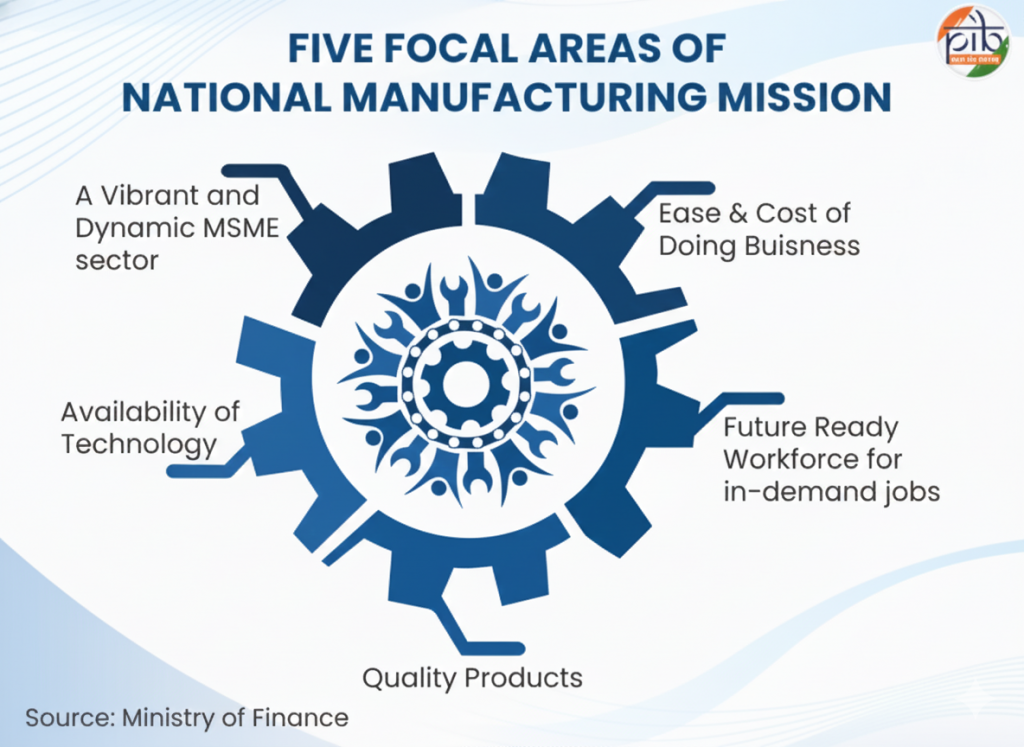
- The objective is not only to increase output, but to build deep technological capabilities, strengthen R&D ecosystems, and develop globally competitive firms in strategically important sectors.
| Daily Mains Practice Question [Q] Discuss the role of industrial policy, technology adoption, infrastructure and logistics, and MSMEs in enabling India to move towards higher value-added and strategically important manufacturing sectors. |
