


Syllabus: GS2/Issues Related To Health
Context
- Recently, the Finance Minister presented the Union Budget for 2026-27 signals recognition of India’s growing health and care needs.
- The allocations and priorities reveal a troubling gap between intent and investment.
Health Allocation in Union Budget (2026–27)
- Combined Allocation: ₹1,10,939 crore for the Ministry of Health and Family Welfare and AYUSH, up from ₹1,03,851 crore in the 2025–26 Budget Estimates.
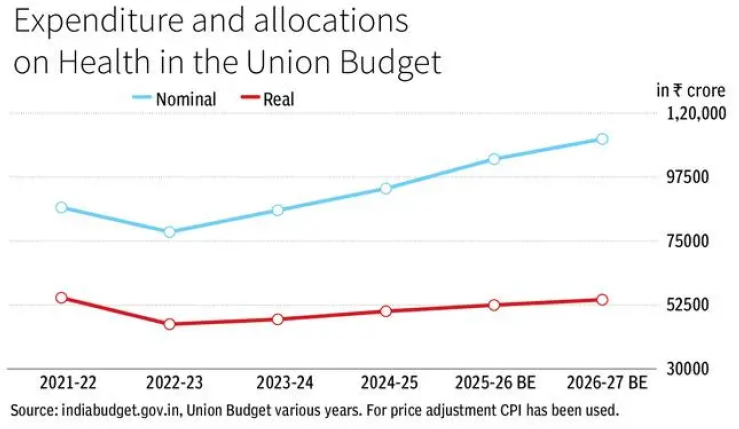
- It is only about 3.5% in real terms after adjusting for inflation.
- However, real health spending in 2026–27 remains lower than the actual expenditure in 2020–21.
Key Announcements in Union Budget (2026–27) For the Health Sector
- Biopharma Strategy for Healthcare Advancement through Knowledge, Technology and Innovation (SHAKTI) Initiative: It aims to boost India’s capacity in biologics and biosimilars, advanced pharmaceutical research, and domestic production of critical medicines.
- It has an outlay of ₹ 10,000 crores over the next 5 years to develop India as a global Biopharma manufacturing hub.
- A Biopharma-focused network to be created with 3 new National Institutes of Pharmaceutical Education and Research (NIPER) and upgrading 7 existing ones.
- A network of over 1000 accredited India Clinical Trials sites to be created.
- Expansion of Health and Care Workforce: It has the proposal to create a cadre of 1.5 lakh Allied Health Professionals (AHPs) and caregivers.
- It aims to cater the growing demand for elderly care, long-term care, and rehabilitative services, driven by India’s ageing population.
- Allied health professionals play a crucial role in diagnostics, therapy, and support services, complementing doctors and nurses.
- AYUSH: Three new All India Institutes of Ayurveda, upgrading AYUSH pharmacies and Drug Testing Labs for higher standards of certification ecosystem, & upgrading the WHO Global Traditional Medicine Centre.
- Medical Tourism and Public–Private Partnerships: The Budget proposes a Scheme to support States in establishing five Regional Medical Hubs, in partnership with the private sector.
- These hubs are intended to attract foreign patients and promote India as a global healthcare destination, and serve as integrated healthcare complexes that combine medical, educational and research facilities.
- They will have AYUSH Centres, Medical Value Tourism Facilitation Centres and infrastructure for diagnostics, post-care and rehabilitation.
- Preventive and Wellness-Oriented Approach (Rhetorical Emphasis): The Union Budget reiterates the importance of preventive healthcare, wellness and lifestyle-based interventions, and integration of traditional systems of medicine under AYUSH.
- Mental Health and Trauma Care: The Union Budget has the provision to setup a NIMHANS-2 and also upgrade National Mental Health Institutes in Ranchi and Tezpur as Regional Apex Institutions.
- Focus on Medical Education and Infrastructure: The Budget reiterates support for expansion of medical and allied health education capacity, and infrastructure development in select tertiary care institutions.
- These measures aim to address long-term shortages of trained health professionals, though details on scale and funding remain limited.
- Digital Health and Technology Push: Allocations continue for digital health initiatives, including platforms for health records and service delivery.
- The stated objective is to improve efficiency, data integration, and access to services.
- However, concerns remain about digital exclusion, data privacy, and uneven benefits across regions and social groups.
Related Concerns & Issues
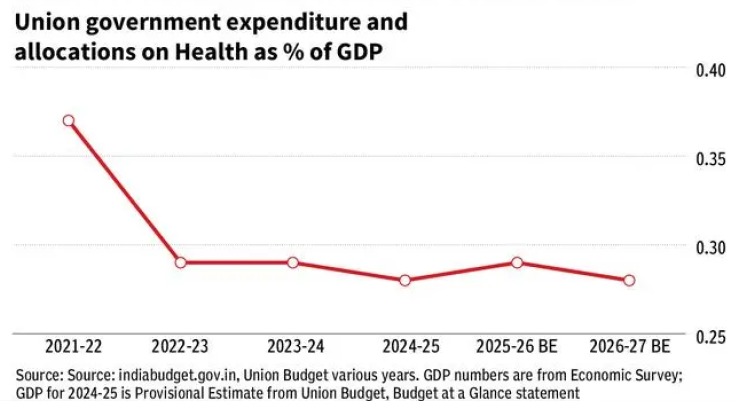
- Declining Priority for Health: Health spending as a share of GDP has fallen from 0.37% (2020–21 Actuals) to 0.28% (2026–27 BE).
- Health’s share in the total Union Budget has declined from 2.26 per cent to 2.07% over the same period.
- Cuts To Public Health & Promotion For Commercial Schemes: Programmes that strengthen the public health system and protect vulnerable populations, such as the National Health Mission (NHM), PM Swasthya Suraksha Yojana (PMSSY), nutrition schemes, and health research have faced significant cuts.
- However, the schemes promoting commercial and private-sector interests, notably Pradhan Mantri Jan Arogya Yojana (PMJAY) and the Digital Health Mission, have seen increased allocations, despite persistent implementation failures.
- Uncertain Future of Health and Wellness Centre: The expansion of Health and Wellness Centres (HWCs) is vital for delivering comprehensive primary healthcare.
- Since HWCs are funded under NHM, sustained cuts to NHM cast serious doubt on whether this network can expand or even function effectively.
Case of National Health Mission (NHM)
- NHM is the backbone of India’s public health response, covering maternal and child health, disease control programmes, non-communicable diseases, primary and secondary healthcare services.
- It has seen a real-term decline of around 8% in the 2026–27 Budget since 2021–22.
- The actual NHM expenditure has consistently exceeded allocations, indicating high demand and unmet needs.
- NHM funds frontline health workers, especially ASHAs, who are predominantly women and were globally recognised for their role during the pandemic.
- Reduced funding means essential services like safe deliveries, childhood immunisation, TB treatment cannot be delivered at earlier levels.
- Critical programmes on non-communicable diseases and climate change and health, largely implemented through NHM, now face serious uncertainty due to paltry allocations.
Case of Pradhan Mantri Jan Arogya Yojana (PMJAY)
- PMJAY appears to be the ‘blue-eyed’ programme of the government.
- In 2024–25, ₹7,500 crore was allocated, but only about ₹6,983 crore was actually spent.
- In 2026–27 BE, PMJAY allocation has increased by 36% compared to 2024–25.
- This is concerning given that PMJAY is widely known to:
- Largely benefit the private sector;
- Exclude many Dalits, Scheduled Tribes, and marginalised groups;
- Provide only partial financial relief, leaving households with high out-of-pocket expenses;
- Medical Tourism vs Public Healthcare: Using public resources to support private healthcarefor wealthy foreign patients risks deepening inequities.
- It comes at the cost of strengthening the public healthcare system, which remains the primary source of care for the poor and marginalised.
Way Forward: Focus on Public Healthcare
- India’s health challenges demand a strong, well-funded public system. Persisting with a blind obsession to promote commercial interests requires serious introspection.
- Instead of expanding insurance-based and tourism-oriented models, the Union government needs to:
- Restore and expand funding for NHM and public health infrastructure;
- Ensure fair wages for frontline health workers;
- Prioritise universal, free, and quality healthcare for the most vulnerable;
| Daily Mains Practice Question [Q] The Union Budget 2026–27 makes several announcements aimed at strengthening India’s health sector. However, concerns have been raised regarding the adequacy and prioritisation of health allocations. Comment. |
