


Syllabus: GS3/Infrastructure
Context
- Recently, the Prime Minister of India, addressing the Maritime Leaders’ Conclave during India Maritime Week 2025, declared that India’s maritime sector has undergone ‘historic progress’, positioning the nation as a rising force in global maritime trade.
About the India’s Maritime Sector
- Nearly 95% of India’s trade by volume and about 70% by value moves through maritime routes.
- In FY 2024–25, major ports handled about 855 million tonnes of cargo, signaling robust growth in maritime trade and port efficiency.
- The Maritime India Vision 2030 charts 150+ initiatives with projected investments of ₹3–3.5 lakh crore, supported by a recent ₹69,725 crore package for shipbuilding.
India’s Ports: New Benchmarks
- Expanding Capacity and Efficiency: India’s port capacity has nearly doubled, rising from 1,400 million metric tonnes per annum (MMTPA) in 2014 to 2,762 MMTPA in 2025.
- Cargo handling volumes also surged from 972 million metric tonnes (MMT) to 1,594 MMT, with major ports handling 855 MMT in FY 2024–25, up from 819 MMT the previous year.
- The average vessel turnaround time dropped from 93 hours to 48 hours, enhancing global competitiveness and throughput.
- Financial Strength and Productivity: India’s maritime sector’s net annual surplus increased from ₹1,026 crore to ₹9,352 crore, while the operating ratio improved from 73% to 43%, reflecting robust financial discipline and operational sustainability.
Indian Shipping: Expanding Fleet & Capacity
- Fleet and Tonnage Growth: India’s shipping fleet expanded from 1,205 to 1,549 Indian-flagged vessels, with gross tonnage rising from 10 MGT to 13.52 MGT, underscoring growing national capacity in maritime trade.
- Rise of Coastal Shipping: Coastal cargo movement nearly doubled from 87 MMT to 165 MMT, highlighting a strategic shift toward low-cost and eco-friendly transport.
- Empowering the Seafaring Workforce: India’s seafarer community has grown from 1.25 lakh to over 3 lakh, now comprising 12% of the global workforce.
- India ranks among the top three suppliers of trained seafarers, creating global opportunities across ship operations and logistics.
India’s Inland Waterways
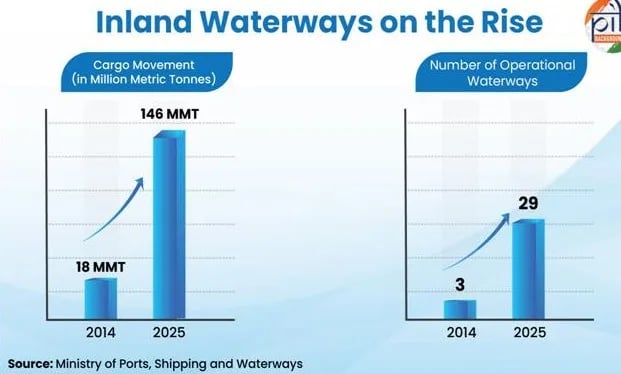
- The Inland Waterways Authority of India (IWAI) reported a record 146 MMT cargo movement in 2025, up from 18 MMT in 2014 — an astounding 710% increase.
- The number of operational waterways grew from 3 to 29, strengthening India’s riverine logistics network.
- The Haldia Multi-Modal Terminal (MMT) in West Bengal — developed with World Bank support and handed to IRC Natural Resources under PPP mode — has a 3.08 MMTPA capacity, marking a milestone in multimodal transport integration.
- Ferry and Ro-Pax Revolution: Over 7.5 crore passengers travelled via ferry and Ro-Pax services in 2024–25, reflecting public confidence in water-based mobility.
Issues & Challenges Facing India’s Maritime Sector
- Fragmented Governance and Outdated Legislation: The maritime sector is governed by multiple laws, some dating back to the 19th century, such as the Indian Ports Act, 1908.
- Recent reforms like the Indian Ports Bill, 2025 aim to modernize governance, but concerns remain over centralization of power and erosion of federal balance.
- Underperformance of Non-Major Ports: A NITI Aayog study highlights that non-major ports lack adequate infrastructure, skilled manpower, and connectivity, limiting their contribution to national trade.
- Many of these ports operate below capacity and struggle with regulatory bottlenecks.
- Infrastructure and Logistics Bottlenecks: Several port projects face delays in land acquisition, environmental clearances, and inter-agency coordination, despite several initiatives.
- Inland waterway development is progressing slowly, affecting multimodal logistics efficiency.
- Environmental and Sustainability Concerns: Ports are under pressure to adopt green technologies, but implementation of shore power, waste management, and emission controls remains uneven.
- The push for green hydrogen hubs at Paradip, Tuticorin, and Kandla is promising but still in early stages.
- Limited Domestic Shipping Capacity: India’s shipping fleet is relatively small compared to global standards, leading to heavy reliance on foreign vessels for cargo movement.
- Tax disparities and lack of incentives have discouraged domestic shipbuilding and fleet expansion.
- Skill Gaps and Maritime Education: Maritime training institutions need modernization to meet international standards.
- There’s a shortage of skilled professionals in areas like port operations, marine engineering, and logistics management.
- Security and Strategic Vulnerabilities: Maritime security challenges include piracy, illegal fishing, and geopolitical tensions in the Indian Ocean Region.
- Coordination among coastal states and agencies remains a work in progress.
Related Efforts & Initiatives
- Strategic Investments and Schemes: Under Maritime India Vision (MIV) 2030, India plans investments worth ₹3–3.5 lakh crore across ports, shipping, and inland waterways. Key financial pillars include:
- Maritime Development Fund (MDF): ₹25,000 crore corpus for long-term shipping finance.
- Shipbuilding Financial Assistance Scheme (SBFAS): ₹24,736 crore to offset domestic cost disadvantages.
- Shipbuilding Development Scheme (SbDS): ₹19,989 crore for greenfield clusters and yard expansions.
- Indian Ship Technology Centre (ISTC): ₹305 crore facility in Visakhapatnam for R&D, design, and skills.
- Sagarmala Programme: It is a flagship component of MIV 2030 and the Maritime Amrit Kaal Vision 2047, aims to cut logistics costs, enhance port-led development, and create jobs.
- Out of 840 projects worth ₹5.8 lakh crore, 272 projects (₹1.41 lakh crore) have been completed, while 217 projects (₹1.65 lakh crore) are underway — transforming India’s coastal and logistics infrastructure.
- Boosting the Northeast and Tourism: Over ₹1,000 crore has been invested in inland waterway infrastructure in the Northeast, with luxury cruise ships worth ₹250 crore being built for Assam’s Brahmaputra River under the Cruise Bharat Mission.
- Maritime Amrit Kaal Vision 2047: It charts a long-term roadmap with ₹80 lakh crore investments targeting green ports, sustainable shipping, digital logistics, and shipbuilding innovation. Key initiatives include:
- Green corridors and methanol-fueled vessels;
- Green hydrogen bunkering at major ports;
- Over 300 actionable initiatives to make India a global maritime leader by 2047.
- Other Notable Projects:
- Greenfield Port at Bahuda (Odisha): 150 MTPA capacity, ₹21,500 crore investment.
- Water Metro Project (Patna): Electric ferry system worth ₹908 crore.
- SCI–Oil PSU JV: Strengthening India’s vessel ownership.
- Lighthouse Museum (Lothal, Gujarat): ₹266 crore cultural project.
- NMPA Initiatives: 8 major projects including a 150-bed hospital (₹107 crore) and a dedicated cruise gate for international tourists.
Next article
China’s Complaint Against India at WTO
