


Syllabus: GS3/Indian Economy
Context
- Recently, the Report of the 16th Finance Commission, Chaired by Dr Arvind Panagariya, was tabled in Parliament for the five-year period between 2026-27 and 2030-31.
Constitutional Provisions For Finance Commission (FC)
- Article 280: It mandates the President of India to constitute a Finance Commissionevery five years or earlier if necessary.
- It specifies that the Commission shall consist of a Chairperson and four other members.
- Parliament of India is empowered to prescribe qualifications of members, and mode of selection.
- Article 280(3): Distribution of net proceeds of taxes between the Union and States;
- Allocation of shares among States;
- Principles governing grants-in-aid to States from the Consolidated Fund of India;
- Measures to augment State resources to supplement Panchayats and Municipalities;
- Any other matter referred by the President in the interest of sound public finance;
- Article 281: Requires the President to lay the Finance Commission’s report before each House of Parliament.
- Includes an Explanatory Memorandum on actions taken.
- Article 270: Provides the constitutional basis for sharing of Union taxes with States.
- The Finance Commission recommends how this divisible pool is distributed.
- Article 275 (Grants-in-Aid to States): Authorizes Parliament to provide grants-in-aid from the Consolidated Fund of India.
- The Finance Commission recommends principles and amounts for such grants.
- Articles 243H & 243X (Local Bodies Finance): Enable States to authorize Panchayats and Municipalities to levy taxes and receive grants.
- The Finance Commission recommends measures to augment State funds for local bodies.
- Article 266 (Consolidated Fund of India): All grants recommended by the Finance Commission are charged to the Consolidated Fund of India.
Legal Provision
- Finance Commission (Miscellaneous Provisions) Act, 1951: It was enacted under Article 280(1).
- It lays down qualifications, terms of office, and conditions of service of FC members.
- President’s Power of Reference: The President may refer additional fiscal matters to the Finance Commission beyond those explicitly listed in Article 280.
Report of the 16th Finance Commission (2026–31
- Share of States in Central Taxes: The Commission has recommended that 41% of the divisible pool of central taxes be devolved to the states, maintaining the same share as recommended by the 15th FC.
- The divisible pool is calculated after excluding cesses, surcharges, and the cost of tax collection from the Centre’s gross tax revenue.
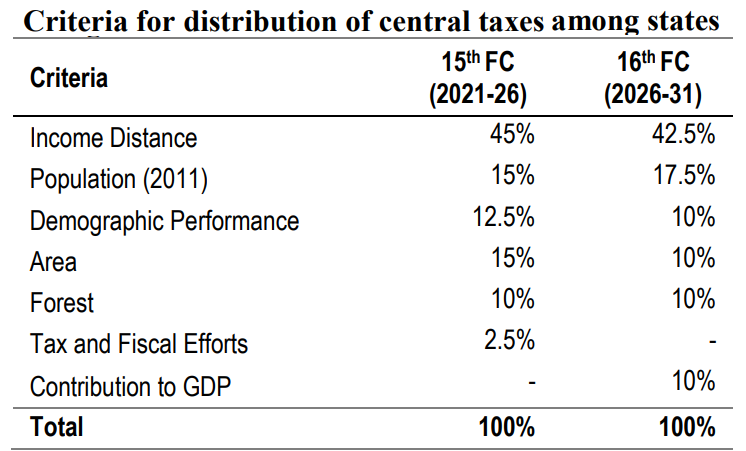
- Income Distance (Per Capita GSDP Distance): States with lower income levels receive a higher share to promote equity.
- Income distance is defined as the gap between a state’s per capita GSDP and the average per capita GSDP of the top three large states.
- The calculation uses averaged data from 2018–19 to 2023–24, excluding the pandemic year.
- Population (2011 Census): Devolution is linked to population shares based on the Census 2011, continuing the approach followed by recent commissions.
- Demographic Performance: Redefined by the 16th FC to reflect population growth between 1971 and 2011, rather than Total Fertility Rate (TFR).
- States that have successfully controlled population growth are rewarded with a higher share.
- Forest Cover: The Commission has expanded the scope of this criterion by including dense, moderately dense, and open forests, and by considering both the share in total forest area and the increase in forest area between 2015 and 2023.
- Contribution to GDP: A new parameter introduced by the 16th FC, it measures a state’s contribution to national GDP using the square root of its GSDP relative to all states.
- It replaces the earlier tax and fiscal effort criterion and acknowledges the role of economically stronger states in national growth.
Grants-in-Aid
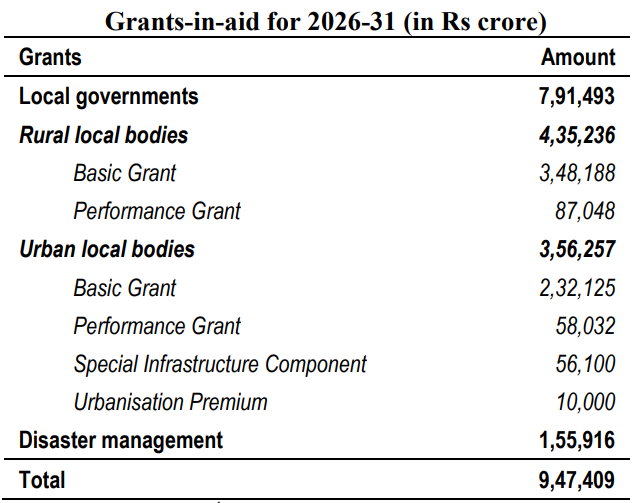
- The Commission has recommended grants worth ₹9.47 lakh crore over the five-year period. These are primarily directed towards local bodies and disaster management.
- The 16th FC has discontinued revenue deficit grants, sector-specific grants, and state-specific grants, signalling a shift towards simplified and outcome-oriented transfers.
Grants for Local Bodies
- A total of ₹8 lakh crore has been recommended for local bodies, including ₹4.4 lakh crore for rural local bodies and ₹3.6 lakh crore for urban local bodies.
- These grants are divided into:
- Basic Grants (80%), of which half are untied, while the remaining are tied to sanitation, solid waste management, and water management.
- Performance-Based Grants (20%), linked to states’ transfers to local bodies and growth in own-source revenues.
- All grants are subject to entry-level conditions, including constitutional functioning of local bodies, publication of audited accounts, and timely constitution of State Finance Commissions.
- Special Components:
- Special Infrastructure Grants of ₹56,100 crore for wastewater management in cities with populations between 10–40 lakh.
- Urbanisation Premium Grants of ₹10,000 crore as one-time assistance for integrating peri-urban areas and formulating rural-to-urban transition policies.
Disaster Management Grants
- The Commission has recommended ₹2,04,401 crore for State Disaster Relief and Management Funds.
- The Centre’s Share: 90% for North-eastern and Himalayan states, and 75% for other states.
Fiscal Roadmap and Debt Sustainability
- The 16th FC has laid out a medium-term fiscal consolidation path, recommending that:
- The Centre reduced its fiscal deficit to 3.5% of GDP by 2030–31.
- States adhere to a 3% of GSDP fiscal deficit limit.
- A key recommendation is the strict discontinuation of off-budget borrowings, with an expanded definition of fiscal deficit and debt to include all such liabilities.
- The 16th FC projects that combined Centre-State debt will decline from 77.3% of GDP in 2026–27 to 73.1% by 2030–31.
Key Concerns & Issues in the 16th FC
- Vertical Devolution Imbalance: Persistent mismatch between Union revenue powers and State expenditure responsibilities.
- Cesses and surcharges (outside the divisible pool) have reduced effective transfers to states;
- Shrinking fiscal space for states despite expanding mandates (health, education, urban services).
- Horizontal Imbalances Among States: Widening gap between high-income and low-income states
- Debate over rewarding demographic performance vs. addressing development deficits.
- Current income-distance formula may inadequately capture multidimensional deprivation.
- Rising Subnational Debt & Fiscal Stress: Post-COVID debt levels of states have increased sharply;
- Growing reliance on off-budget borrowings and public sector undertakings;
- Long-term fiscal sustainability and hidden liabilities;
- Quality of Public Expenditure: Transfers often focus on quantum, not outcomes;
- Weak monitoring of conditional and sector-specific grants;
- Inefficiency in service delivery despite higher allocations;
- Climate Change & Disaster Vulnerability: Existing Finance Commission frameworks treat disaster relief as episodic, not structural;
- Climate-vulnerable states face recurring fiscal shocks;
- Absence of a formal climate fiscal risk index;
- Urban Local Bodies (ULBs) & Panchayati Raj Institutions (PRIs): Chronic underfunding and weak own-revenue capacity;
- Dependence on tied grants reduces autonomy;
- Local governments remain fiscally weak despite constitutional backing;
- Data Reliability & Transparency: Dependence on delayed or inconsistent state-level fiscal data;
- Difficulty in assessing true fiscal health due to accounting practices;
Structural Reform Recommendations
- Power Sector Reforms: States are encouraged to pursue privatisation of electricity distribution companies (DISCOMs).
- The 16th FC suggests creating a special purpose vehicle to warehouse legacy debt, with repayment linked to capital assistance schemes after privatisation.
- Subsidy Rationalisation: The Commission has called for a review of subsidy expenditure, especially unconditional cash transfers with weak targeting.
- It recommends clear exclusion criteria, standardised accounting, and an end to financing subsidies through off-budget borrowings.
- Public Sector Enterprise Reforms: The Commission has identified 308 inactive State Public Sector Enterprises (SPSEs) for review and closure.
- It recommends state-level disinvestment policies and mandatory Cabinet review for enterprises incurring losses in three out of four consecutive years.
Other Recommendations
- Reform Vertical Devolution: Re-examine the share of states in the divisible pool;
- Bring more cesses and surcharges into the divisible pool;
- Refine Horizontal Devolution Criteria: Introduce multidimensional deprivation indicators;
- Balance equity with efficiency and demographic responsibility;
- Debt & Fiscal Responsibility Reforms: Incentive-based grants for debt reduction and fiscal transparency;
- Clearer treatment of off-budget borrowings;
- Outcome-Linked Transfers: Shift from input-based to performance-based grants;
- Strengthen monitoring and evaluation mechanisms;
- Mainstream Climate Fiscal Federalism: Climate vulnerability–linked grants;
- Dedicated resilience and adaptation funding windows;
- Strengthen Local Government Finance: Predictable, untied grants for ULBs and PRIs;
- Incentives for property tax and user-charge reforms
Conclusion
- The 16th FC’s report reflects a strong emphasis on fiscal discipline, transparency, environmental sustainability, and structural reforms, while maintaining equity in resource distribution.
- It seeks to strengthen India’s cooperative federal framework and ensure long-term fiscal sustainability by streamlining grants, discouraging off-budget liabilities, and incentivising governance and economic performance.
| Daily Mains Practice Question [Q] The Sixteenth Finance Commission’s recalibration of the inter-State tax devolution formula seeks to balance growth incentives with equity concerns. Discuss it for cooperative federalism and inclusive growth in India. |
Next article
A Budget For The Deep Tech Ecosystem
