


Syllabus: GS2/Education; Social Issues
Context
- The UDISE+ 2025–26 report highlights substantial expansion in India’s school education system while revealing persistent regional, social, infrastructure and teacher-related disparities.
About India’s School Education System
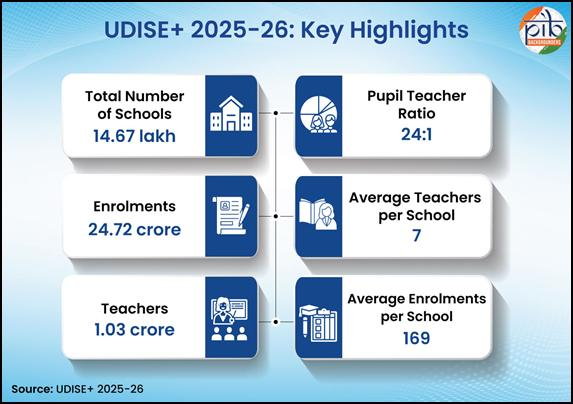
- According to UDISE+ 2025–26, India has one of the world’s largest school education systems, encompassing nearly 1.47 million schools, 24 crore students and 1.02 crore teachers.
- The system spans foundational, preparatory, middle and secondary stages and involves government, aided and private institutions.
- The Right to Education Act, 2009 guarantees free and compulsory education for children aged 6–14 years.
- However, the contemporary challenge has shifted from merely expanding access to ensuring retention, learning outcomes, equity and quality.
Constitutional & Policy Perspectives
- Education is in the Concurrent List (Entry 25), enabling both the Union and States to legislate and implement policies.
- Key constitutional provisions include:
- Article 21A: Right to free and compulsory education for 6–14-year-olds.
- Article 45: Early childhood care and education.
- Article 46: Promotion of educational and economic interests of SCs, STs and weaker sections.
- Article 15(4) & 15(5): Special provisions for disadvantaged social groups in education.
- The National Education Policy (NEP) 2020 seeks universal foundational literacy and numeracy, multidisciplinary learning, vocational exposure, technology integration and equitable access.
Key Findings of UDISE+ 2025–26
- Expansion With Uneven Access: School participation and retention have improved, but geographical disparities remain pronounced.
- Aadhaar seeding reaches 99.6% in Andhra Pradesh and 99% in Chandigarh, compared with only 35% in Meghalaya, against a national average of 90.2%.
- Meghalaya records a Foundational Gross Enrolment Ratio (GER) of 131, while Bihar records only 24. At the secondary stage, Chandigarh recorded 109, compared with Bihar’s 48.
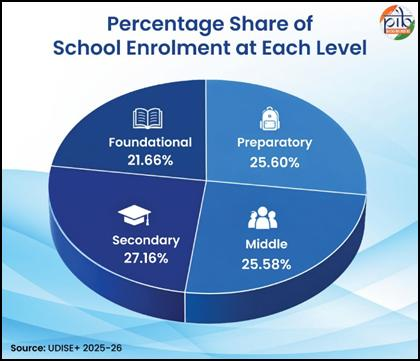
- Social Disparities Persist: Nationally, GER is highest among OBC students (49%), followed by General (27%), SC (17%) and ST (10%).
- The composition of enrolment differs substantially across States and Union Territories: ST enrolment is particularly prominent in regions such as Mizoram, Meghalaya, Ladakh and Lakshadweep, while SC representation is high in Punjab.
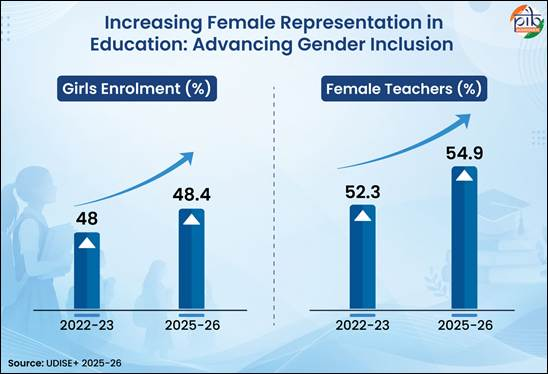
- The Gender Parity Index indicates that girls’ participation is higher than boys’ across most States/UTs, marking an important achievement in gender inclusion.
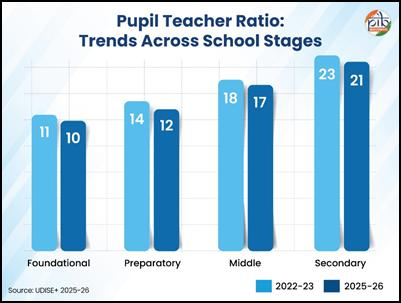
- Teacher Availability Remains Uneven: The Pupil-Teacher Ratio (PTR) varies considerably.
- Secondary PTR reaches 43 in Jharkhand, indicating significant pressure on teachers, whereas it is only 6 in Sikkim.
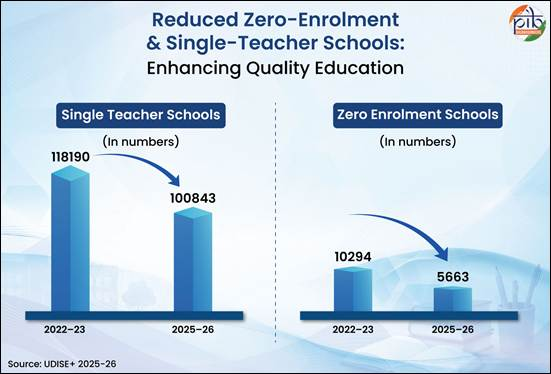
- Rural and remote schools continue to experience teacher shortages and the burden of multi-grade teaching and non-teaching duties.
- Dropout Remains a Concern: Bihar records the highest preparatory-stage dropout rate (7.9%) and middle-stage dropout rate (9%).
- At the secondary level, Ladakh records the highest rate at 14.8%, followed by Karnataka.
- Such patterns underline the difficulty of ensuring a smooth transition to and completion of secondary education.
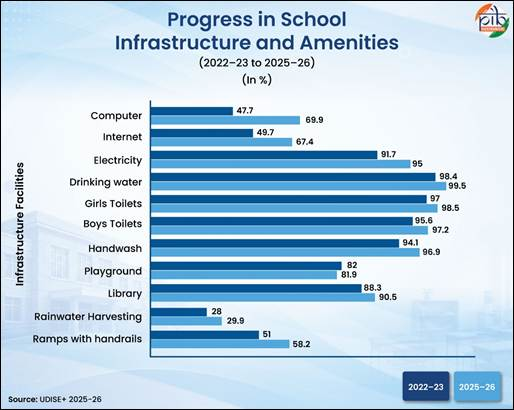
- Infrastructure and Inclusion Gaps: Access to electricity and drinking water has improved, but infrastructure remains uneven.
- Remote, tribal, hilly and border regions face greater difficulties in transport and school access.
- Children from SC/ST communities, minorities, poorer households and children with disabilities continue to face additional barriers.
Key Issues and Concerns
- Regional disparities: enrolment, dropout rates, availability of schools, infrastructure, and teacher-student ratio vary widely from one state to another and from one union territory to another.
- In hilly, tribal, border, and geographically distant locations, there are no schools and limited transitability.
- Social Inequalities: SC, ST, minority and economically disadvantaged students face greater challenges
- The GER reveals unequal access to education with large differences between social groups and levels of education.
- Bihar, Uttar Pradesh and Ladakh are among the states which have comparatively high dropout rates at different levels.
- Shortage of teachers and workload: There is still a shortage of trained teachers in rural, distant and poor places.
- The teachers have a larger workload, specifically at the secondary level, and in populous States, the children get less individual attention.
- Infrastructure deficits. Drinking water and electricity are better, but many rural and poorly educated populations still lack basic utilities.
- Many schools do not have accessible classrooms, inclusive infrastructure, and teaching approaches to support children with impairments.
- Digital divide: Differences in access to digital resources create barriers to learning opportunities between areas and communities.
- Gender & inclusion problems: Engagement of girls has improved, yet concerns are evident in terms of lowering dropouts and a smooth transition to secondary education.
- Poor transition to higher grades: Access to education has not always translated into better transition or retention from elementary to secondary education.
Related Reforms & Initiatives
- Government interventions include NEP 2020, Samagra Shiksha, PM SHRI Schools, NIPUN Bharat, PM POSHAN, DIKSHA, UDISE+ and the National Means-cum-Merit Scholarship Scheme.
- These seek to strengthen foundational learning, infrastructure, nutrition, teacher capacity, digital access and educational inclusion.
Way Forward: Strengthening India’s School Education System
- India needs to move from an access-centric to an equity-and-learning-centric approach.
- Target educationally deprived districts through need-based infrastructure and transport investment.
- Rationalise teacher deployment and incentivise teachers in rural, tribal and difficult areas.
- Strengthen foundational literacy and numeracy while improving secondary-school transition.
- Expand affordable digital infrastructure and device access without replacing classroom learning.
- Make schools genuinely disability-inclusive, with accessible buildings, assistive technologies and trained teachers.
- Use UDISE+ data for district-level targeting, monitoring and outcome-based policy.
- Integrate educational interventions with poverty reduction, nutrition, social protection and gender-sensitive policies.
Conclusion
- UDISE+ 2025–26 demonstrates that India has made considerable progress in expanding schooling, improving participation and strengthening infrastructure.
- But the persistence of regional and social inequalities shows that universal access is not synonymous with equal educational opportunity.
- Achieving the NEP 2020 vision and SDG 4—quality education for all requires targeted public investment, equitable teacher deployment and stronger support for disadvantaged communities.
- India’s next educational transition must therefore be from expansion to equity, quality and learning outcomes.
| Daily Mains Practice Question [Q] India’s school education system has made significant progress in expanding access and enrolment, but regional, social and infrastructural disparities continue to constrain equitable learning outcomes. Discuss. |
Previous article
The Centre’s Fiscal Outlook
Next article
Reassessing Manufacturing Growth in India
