


Syllabus: GS3/Economy
Context
- As China’s export competitiveness intensifies and India seeks to benefit from the China-plus-one strategy while countering the ‘China Squeeze’ on developing-country manufacturing, questions over the reliability of India’s manufacturing data have gained renewed importance.
About Manufacturing Sector and Measuring Growth in India
- Manufacturing is central to India’s structural transformation because it can generate large-scale employment, deepen technological capabilities and strengthen exports.
- India measures manufacturing performance primarily through two indicators:
- Gross Value Added (GVA): Measures the value added by manufacturing activities and contributes directly to GDP estimation.
- Index of Industrial Production (IIP): Measures changes in the volume of industrial output, with manufacturing constituting its largest component.
- GVA captures value added and includes estimates for the informal sector, whereas IIP is primarily an index of output volumes in the organised industrial sector.
- It makes the recent divergence between the two series an important issue for policymakers and UPSC aspirants studying national income accounting, industrial policy and data governance.
Gross Value Added (GVA)
- It measures the value of goods and services produced by an economic sector after deducting the cost of intermediate inputs used in production.
- GVA = Value of Output – Intermediate Consumption
- It is an important measure of economic activity and forms the basis for estimating Gross Domestic Product (GDP).
- GVA can be measured for different sectors such as agriculture, industry and services.
- At the aggregate level, GDP at market prices = GVA at basic prices + product taxes – product subsidies.
- GVA is particularly useful for understanding the contribution and underlying performance of individual sectors, including manufacturing.
Index of Industrial Production (IIP)
- It is a short-term indicator that measures changes in the volume of industrial production over time.
- In India, the IIP covers three broad sectors, ie Mining, Manufacturing and Electricity.
- It is compiled and released periodically by the National Statistical Office (NSO), Ministry of Statistics and Programme Implementation (MoSPI).
Why Do Manufacturing Numbers Matter?
- Reliable data is essential to assess whether government interventions are producing the intended results.
- The Make in India Programme (2014) aimed to strengthen domestic manufacturing and investment, while the PLI scheme sought to encourage production in strategically important sectors.
- The stakes are particularly high amid intensifying global competition. China’s export capacity can put pressure on lower-cost producers in developing economies, even as multinational firms diversify supply chains under the China+1 strategy.
- India’s ability to capture this opportunity depends not merely on headline growth rates but on whether manufacturing is actually expanding in output, productivity and employment.
Related Issues and Concerns
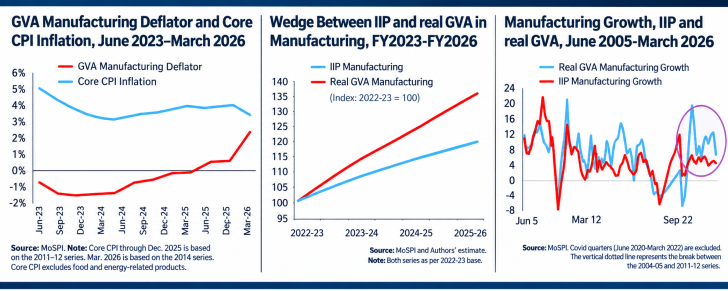
- Manufacturing GVA Deflator: The new GDP estimates reportedly show a fall in the manufacturing GVA deflator for nine consecutive quarters between 2023 and 2025.
- It is difficult to reconcile with broader price trends, particularly when consumer inflation did not indicate sustained economy-wide deflation.
- Wholesale Price Index (WPI) is influenced by input and commodity prices, whereas a GVA deflator should reflect the prices relevant to value added.
- Divergence Between Real GVA and IIP: There is a substantial gap between real manufacturing GVA and IIP.
- By 2025-26 real manufacturing GVA was about 15 percentage points above the IIP level, implying average annual growth of roughly 11% for GVA compared with 6% for IIP between 2022-23 and 2025-26.
- The informal sector is included in GVA but excluded from IIP; however, recent informal-sector estimates have been proxied using formal-sector information.
- A persistent gap would instead raise questions about productivity gains, measurement methods or data sources.
- Weakening Relationship Between GVA and IIP: Historically, manufacturing GVA and IIP growth moved broadly together.
- Since methodological changes associated with the 2011-12 base framework, however, the relationship appears to have weakened, with recent GVA growth displaying greater volatility than the comparatively stable IIP series.
Related Efforts and Initiatives
- India has undertaken several measures to strengthen manufacturing:
- Make in India: Promotes investment, innovation and domestic production.
- PLI Scheme: Provides incentives linked to incremental production in selected sectors.
- Atmanirbhar Bharat: Encourages resilient domestic supply chains and strategic self-reliance.
- National Logistics Policy and PM Gati Shakti: Seek to reduce logistics costs and improve infrastructure integration.
- Ease of Doing Business and infrastructure reforms: Aim to improve the competitiveness of Indian firms.
Way Forward: Reassessing Manufacturing Growth
- India should avoid treating a single indicator as the final verdict on manufacturing performance.
- Instead, policymakers should triangulate GVA, IIP, exports, employment, capacity utilisation and corporate investment data.
- MoSPI should publish a detailed methodological note explaining the new GDP calculations, including the construction of manufacturing deflators and estimates for the informal sector.
- Greater transparency would enable independent scrutiny and improve public trust.
- Regular reconciliation between IIP and national accounts data would help identify whether divergences reflect genuine productivity improvements or statistical issues.
- Ultimately, India’s manufacturing challenge is strategic as well as statistical. As global supply chains adjust to Chinese competition and China+1 diversification, credible data is indispensable for judging whether India is genuinely gaining manufacturing strength, or merely measuring it differently.
| Daily Mains Practice Question [Q] Critically examine the importance of reliable manufacturing data in assessing the success of India’s industrial policies. Discuss the concerns arising from the divergence between Manufacturing Gross Value Added (GVA) and the Index of Industrial Production (IIP). |
Previous article
Progress in India’s School Education System
