


Syllabus: GS3/Instracture Development
In News
Adivasi people in Madhya Pradesh are protesting against the Ken-Betwa river-linking project for fear of mass displacement, degradation of their ancestral woods, and loss of their traditional identity.
Ken–Betwa Link Project (KBLP)
- It is a major water-resources development project for the Bundelkhand region of Madhya Pradesh and Uttar Pradesh, aimed at mitigating long-standing problems of water scarcity and irrigation.
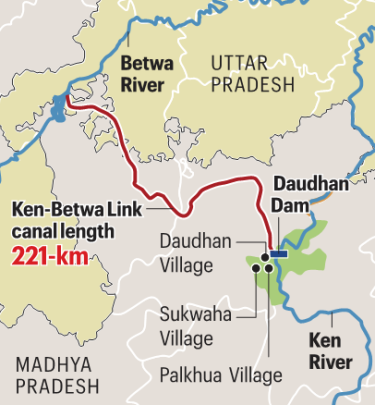
- It envisages transferring water from the Ken basin to the Betwa basin through a system of the Daudhan Dam, a connecting canal, and accompanying works.
- It is the priority project under the National Perspective Plan for Interlinking of Rivers to move into the execution stage.
- Phases: It has two phases.
- Phase I will involve building the Daudhan Dam complex and its subsidiary units such as the Low-Level Tunnel, High-Level Tunnel, Ken-Betwa Link Canal, and powerhouses.
- Phase II will involve three components — Lower Orr Dam, Bina Complex Project, and Kotha Barrage.
Benefits of The Ken-Betwa Link Project (KBLP)
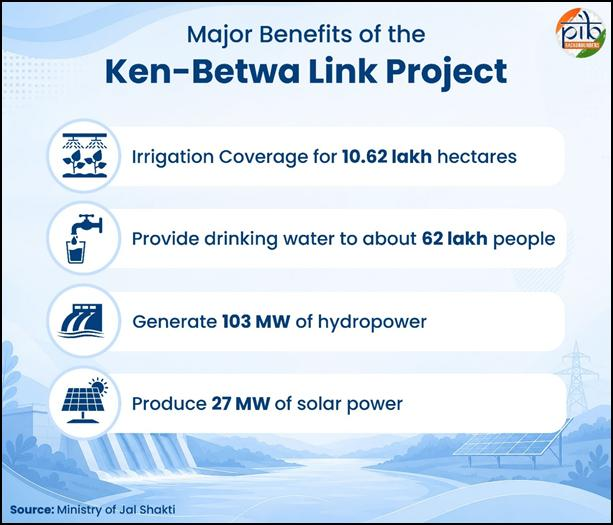
- It will increase irrigation, drinking water supply, jobs and infrastructure in the water-stressed Bundelkhand area of Madhya Pradesh and Uttar Pradesh.
- It will improve drought resilience, agricultural production and incomes, reduce distress migration and improve access to markets, schools and health services.
- Roads, bridges and connectivity linked with the project might bring additional benefits to adjacent villages.
- It tries to achieve a balance between water security and socio-economic advantages, and responsible management of land, environmental and social consequences.
Assessment and Clearance
- The environmental impacts of the Ken–Betwa Link Project (KBLP) were assessed through detailed environmental studies as part of the statutory clearance process.
- The project has received all the statutory clearances needed under law, including Environmental Clearance (2017), Wildlife Clearance (2016), Clearance from the Ministry of Tribal Affairs (2017), and Forest Clearance (2023), subject to prescribed conditions and mitigation measures.
- The project is also implementing various environmental management, compensatory afforestation, wildlife conservation, and biodiversity protection measures to address and minimize the identified environmental impacts.
Concerns and Criticism
- Water diversion: Ken water could be diverted from portions of Bundelkhand that depend on the river.
- Downstream impact: Reduction in natural flow may affect drinking water, irrigation, agriculture and ground recharge in downstream areas, especially around Banda, Mahoba and Chhatarpur.
- Environmental impact: The construction of Daudhan dam may result in large-scale submergence, deforestation and changes in the natural river system of Ken.
- The Daudhan Dam would inundate a major portion of Panna National Park and Tiger Reserve, possibly covering some 98 sq km of protected land and forcing the removal of some estimated 2–3 million trees.
- Impact assessment concerns: Critics say the available environmental studies do not properly examine the repercussions for downstream villages, water supply, agriculture and ecosystems.
- Research has warned that big-scale water transfers could impact land-atmosphere interactions and regional rainfall.
- Regional equity: The main issue is whether the water of Bundelkhand should be used for the purposes of Bundelkhand itself before it is taken out of the region.
- Displacement and compensation: The project is also projected to displace roughly 5228 families in Chhatarpur and 1400 in Panna socially.
- There have been protests over compensation and perceived inadequate benefits to communities affected.
Conclusion
- Ken-Betwa Link Project is a major step to solve the age-old socio-economic and water problems of Bundelkhand.
- However, its success depends a lot on stringent mitigation protocols like landscape-level wildlife conservation, compensatory afforestation and transparent rehabilitation to ensure that environmental damage does not outweigh human gain and the infrastructure provides long-term agricultural stability and power.
Source: TH
Previous article
News In Short 21-08-2026
Next article
India’s Revised FDI Framework
