


Rani Lakshmibai
Syllabus: GS1/ Culture
In News
- PM Modi paid tribute to Rani Lakshmibai on her 198th birth anniversary (19 November).
Early life
- Born in 1828 in Varanasi as Manikarnika Tambe, to Moropant Tambe and Bhagirathi Sapre.
- She grew up at Bithoor in the circle of Peshwa Baji Rao II, alongside Nana Sahib and Tatya Tope. She trained in horse riding, swordsmanship and archery, which was unusual for girls at the time.
- She married Raja Gangadhar Rao of Jhansi in 1842 and took the name Lakshmibai.
Why the British took Jhansi
- Their infant son died in 1851. Shortly before his death in November 1853, the Raja adopted Damodar Rao.
- Lord Dalhousie refused to recognise the adopted heir. Jhansi was annexed in 1854 under the Doctrine of Lapse.
- She reportedly responded, “Main apni Jhansi nahin doongi” (I will not give up my Jhansi).
Role in Revolt of 1857
- Taking charge: When the revolt spread to Bundelkhand, she took control of Jhansi, raised an army and strengthened its defences.
- Women’s unit: She organised the Durga Dal, a women’s military unit linked with figures such as Jhalkari Bai. It is often seen as an inspiration for the INA’s Rani of Jhansi Regiment.
- Siege of Jhansi (March-April 1858): She resisted forces led by Sir Hugh Rose, then escaped with Damodar Rao.
- Gwalior: She joined Tatya Tope at Kalpi, and together they captured Gwalior in June 1858.
- She was killed fighting British forces at Kotah-ki-Serai near Gwalior, on 17 or 18 June 1858. Even Hugh Rose reportedly praised her courage and leadership.
Source: TH
Pichwai Painting
Syllabus: GS1/Culture
Context
- Prime Minister Narendra Modi gifted US President Donald Trump a Golden Pichwai painting, showcasing India’s rich artistic heritage during his visit to the Philippines.
About Pichwai Painting
- Originating in Nathdwara, Rajasthan, this traditional cloth-painting art is known for its intricate detailing, vibrant colours and exquisite gold work.
- Featuring motifs such as lotuses, cows and trees, the artwork reflects centuries-old craftsmanship and the skill of traditional artisans.
- Its golden finish adds a regal appeal, making it a symbol of India’s cultural legacy and artistic excellence.
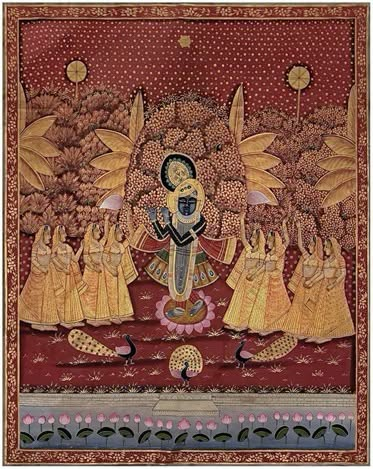
Source: BT
Juvenile Justice (Care and Protection of Children) Act
Syllabus: GS2/Governance
In News
- Kerala Home Minister has urged the Centre to amend the Juvenile Justice Act, citing a rise in violent crimes involving minors.
Juvenile Justice (Care and Protection of Children) Act
- The Juvenile Justice (Care and Protection of Children) Act, 2015, replaced, 2000 Act , and came into force on January 15, 2016.
- It is the primary legislation for ensuring safety, security, dignity and well-being of children.
- It is administered by the Ministry of Women and Child Development.
- It strengthened the legal protection available to children accused of crimes by treating them primarily as children requiring correction, rehabilitation and reintegration into society, rather than as adult criminals.
Features
- It provided that adolescents in the age group of 16 – 18 years, who were suspected of committing heinous acts could be tried as adults, after examination by the Juvenile Justice Board.
- It further said that juveniles can be tried as adults for only egregious acts where the punishment for the offence is a minimum of seven years in jail, ensuring that children accused of lesser infractions are safeguarded from the adult criminal justice system.
- It also simplified the adoption procedures for the orphans, abandoned and surrendered children and gave a legislative status to the Central Adoption Resource Authority (CARA).
Source :IE
India’s Television Broadcasting Shift
Syllabus: GS2/Governance
In News
- World Television Day is observed to recognise the medium’s global role.
World Television Day
- It is observed globally on 21 November each year, following the proclamation of the United Nations General Assembly through a Resolution adopted in 1996.
- It recognizes television as a vital medium in informing, educating, and influencing public opinion, and in fostering communication and global understanding.
Broadcasting
- Broadcasting is the systematic transmission of audio and video content to a large audience through electronic communication networks.
- Television broadcasting combines sound and moving images to deliver news, information, education and entertainment.
- Over the decades, technological advancements have expanded its reach through terrestrial, satellite, cable and internet-based platforms. This has made television an important medium of mass communication.
Achievements
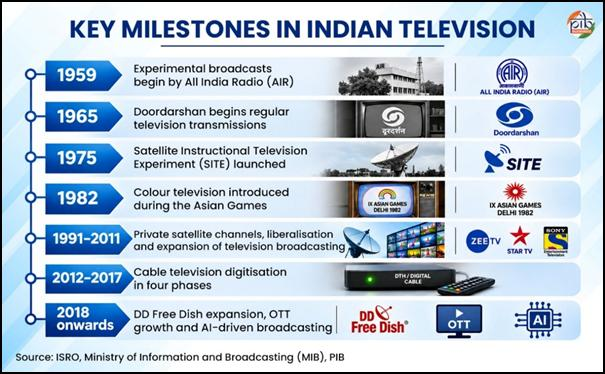
- The mid 1970s was a turning moment in the history of Indian Television. Satellite Instructional Television Experiment (SITE), 1975-76, employed satellite technology to transmit instructional programs to villages in six States, encouraging education and socio-economic development.
- The countrywide broadcasting was further extended with the advent of the INSAT system.
- INSAT-1A was launched in April 1982 and INSAT-1B became fully operational in October 1983.
- Doordarshan meanwhile began colour broadcasting on 15 August, 1982, which became famous with the live telecast of Asian Games in November 1982.
- Direct-to-Mobile (D2M) broadcasting uses terrestrial infrastructure to transmit video, audio and data directly to compatible mobile devices. Reception does not require a SIM card or mobile data connection.
Do you know?
- Satellite-based television services use specific portions of the radio frequency spectrum to transmit signals between satellites and Earth.
- The Ku-band is one such frequency band, commonly used for Direct-to-Home (DTH) broadcasting.
- It generally operates in the frequency range of 12–18 GHz.
- DTH services commonly use frequencies around 10.7–12.75 GHz for downlink transmission, depending on the system and regional allocation.
- Its relatively high frequencies allow the use of smaller dish antennas at subscriber premises. However, Ku-band signals can be affected by heavy rainfall, which may temporarily interrupt reception.
Source :PIB
National Gopal Ratna Awards (NGRA) 2026
Syllabus: Miscellaneous
Context
- The Department of Animal Husbandry and Dairying has announced the winners of the National Gopal Ratna Awards (NGRA) 2026.
- The Fisheries, Animal Husbandry and Dairying Minister will present the awards on November 26, on the occasion of National Milk Day 2026, in Patna, Bihar.
About
- The NGRA is one of the highest national honours in the livestock and dairy sector.
- Under the Rashtriya Gokul Mission (RGM), the Department has been conferring the National Gopal Ratna Awards (NGRA) annually since 2021 on the occasion of National Milk Day.
- Launched in 2014, the RGM focuses on the scientific conservation and development of indigenous bovine breeds.
- The awards are given in three categories:
- Best Dairy farmer rearing indigenous cattle/buffalo breeds.
- Best Dairy Cooperative Society (DCS)/Milk Producer Company (MPC)/Dairy Farmer Producer Organisation (FPO).
- Best Artificial Insemination Technician (AIT).
- A Special Award for the North Eastern Region (NER) and Himalayan States is also provided in each category.
- For the Best Dairy Farmer and Best DCS/MPC/FPO categories, the prize money is ₹5 lakh, ₹3 lakh and ₹2 lakh for the 1st, 2nd and 3rd ranks, respectively. The Special Award carries ₹2 lakh.
- In the AIT category, awardees receive a certificate of merit and a memento, with no cash prize.
Source: PIB
Previous article
Delhi’s Solid Waste Management Bye-Laws, 2026
Next article
News In Brief 21-11-2026
