


Syllabus: GS2/ Polity and Governance
Context
- The Ministry of Home Affairs (MHA) has notified the Foreign Contribution (Regulations) Amendments Rules 2026, issued under the Foreign Contribution (Regulation) Act, 2010.
Foreign Contribution Regulation Act (FCRA), 2010
- FCRA aims to regulate the acceptance and utilization of foreign contributions to prohibit activities detrimental to the national interest.
- It was first enacted in 1976 but repealed and later replaced with new legislation in 2010. It was further amended in 2020.
- FCRA registration is valid for 5 years and must be renewed before expiry.
- The Union Ministry of Home Affairs (MHA) monitors the implementation of the FCRA to ensure that such funds do not adversely affect the country’s internal security.
Key Amendments to FCRA Rules
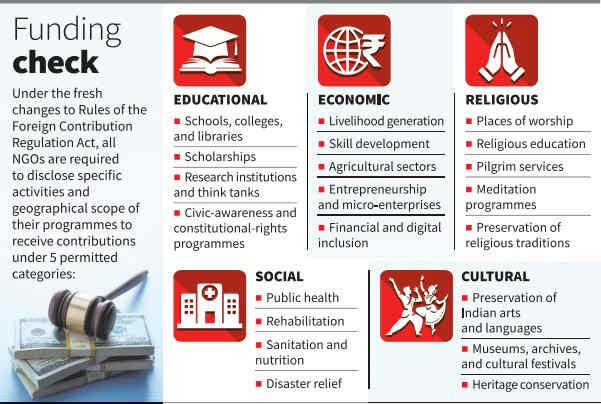
- Categorisation of NGO Activities: NGOs seeking foreign funds must register under one of five permitted categories — social, economic, educational, cultural, and religious.
- This is the first time separate activity lists have been laid out for NGOs in each category.
- Mandatory Disclosure: NGOs must now disclose their activities, the geographical scope of their programmes, their websites, social media accounts, and publications.
- They must also pay separate fees for each category, State and Union Territory they operate in, as opposed to the previous single fee for FCRA registrants.
- Key functionaries: The amended Rules also broaden the definition of an NGOs “key functionary” beyond office-bearers and directors to include trustees, partners, the head of a Hindu Undivided Family, governing body members, and anyone else controlling or managing the organisation.
- Associations having foreign nationals (other than persons of Indian origin) as key functionaries will ordinarily not be considered eligible for registration or prior permission, unless specifically permitted by the Central government.
- State-wise and Category-wise Registration: The amended Rules state that the certificate of registration or the application form (for fresh registrations) shall specify the purpose or purposes for which registration is granted, chosen only from such list of purposes as specified in the Schedule appended to the Rules; and the States or Union territories in which the NGO proposes to undertake the activities.
- The Rules also imposes a fee on NGOs to operate for each specified purpose, and within each State or Union Territory.
Significance of Amended Rules
- The amendments enhance transparency through greater disclosure of NGO activities and foreign funding.
- The purpose-specific and State-specific approval system strengthens monitoring and accountability.
- The expanded definition of key functionaries improve governance and responsibility within NGOs.
- The changes improve the traceability of foreign funds and strengthen regulatory oversight.
What are the Concerns?
- Multiple registrations and fees increase compliance costs for NGOs.
- Enhanced reporting requirements burden smaller organizations with limited resources.
- Restrictions on approved activities and locations will reduce operational flexibility.
- Stringent regulations affect the functioning of civil society organizations and foreign-funded development projects.
Concluding remarks
- The amended FCRA Rules seek to strengthen transparency, accountability, and oversight of foreign contributions received by NGOs.
- While the measures can improve regulatory compliance and prevent misuse of funds, their effective implementation should ensure that genuine civil society organizations are able to continue their developmental and humanitarian work without undue administrative burdens.
Previous article
News In Short 23-06-2026
Next article
CRED-Meta Deal of Fintech Sector
