


Syllabus: GS2/International Relation
Context
- Recently, the Saudi Arabia–Türkiye–Pakistan mutual defence agreement signed in Mecca (Mecca Joint Defence Agreement) signals growing regional security cooperation and a possible shift from US-dominated arrangements towards strategic hedging.
About the Saudi–Türkiye–Pakistan Defence Pact
- The pact provides that an armed attack against any one of the three members will be treated as an attack against all.
- Its language resembles the collective-defence principle underlying NATO’s Article 5.
- The agreement builds upon the long-standing Saudi–Pakistan military relationship and adds Türkiye’s considerable conventional military capabilities.
- It does not amount to a formal anti-US or anti-Israel military bloc.
- All three retain significant relationships with Western powers: Saudi Arabia relies heavily on US defence technology, Türkiye remains a NATO member, and Pakistan maintains an important relationship with Washington.
- Thus, the pact is better understood as strategic hedging i.e. an attempt by regional powers to supplement, rather than immediately replace, external security guarantees.
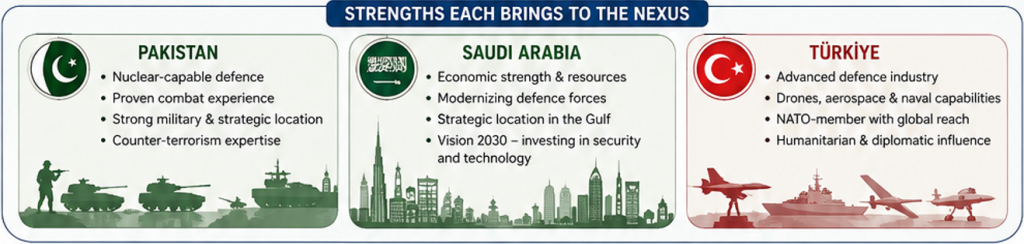
Complementary Strengths of the Three Partners
- Saudi Arabia: financial resources, energy power, strategic geography and influence across the Arab and Islamic worlds.
- Türkiye: one of the region’s strongest conventional militaries and a rapidly expanding indigenous defence industry, particularly in drones and unmanned systems.
- Pakistan: a large professional military, extensive experience of military cooperation with Saudi Arabia and, most importantly, nuclear weapons capability.
- Although the pact does not constitute a formal Pakistani nuclear umbrella, its existence inevitably introduces Pakistan’s strategic capabilities into the calculations of a potential adversary.
Why Did the Three Countries Join?
- Saudi Arabia seeks strategic insurance after attacks on its oil infrastructure and repeated regional crises demonstrated the risks of excessive dependence on a single security guarantor.
- Saudi’s broader foreign policy increasingly emphasises strategic autonomy and diversification of partnerships.
- Türkiye, under President Recep Tayyip Erdoğan, has pursued greater strategic autonomy while remaining within NATO.
- The agreement expands Ankara’s influence towards the Gulf and South Asia and can create opportunities for its defence industry.
- Pakistan gains an institutional framework for its traditionally close military relationship with Saudi Arabia while broadening its diplomatic influence beyond its India-centric security concerns.
Implications of Mecca Joint Defence Agreement
- For the United States and West Asia: The agreement reflects the relative erosion of exclusive US security primacy, rather than the disappearance of American influence.
- They are developing multiple partnerships with Türkiye, Pakistan, China and other powers.
- The pact could therefore accelerate the transition from a predominantly US-centred security architecture towards a more multipolar West Asian order.
- Implications for Iran and Israel: The agreement could be interpreted as an emerging counterweight to Iranian regional influence, particularly given Saudi–Iranian rivalry.
- Türkiye and Pakistan share borders with Iran and have strong interests in preventing instability along their frontiers.
- The combination of Saudi financial power, Turkish conventional capabilities and Pakistani military and nuclear capabilities could alter regional deterrence calculations.
What Does It Mean for India?
- India should avoid viewing the pact exclusively through the Pakistan prism.
- Saudi Arabia has developed substantial economic, energy, investment and diaspora linkages with India.
- Riyadh therefore has strong incentives to preserve its relationship with New Delhi and is unlikely to automatically support Pakistan in every India–Pakistan dispute.
- Türkiye remains a concern because of its positions on Kashmir and its political and defence ties with Pakistan.
- India should therefore seek greater clarity from Saudi Arabia that the mutual-defence clause will not be invoked in an India–Pakistan conflict.
- The evolving West Asian security architecture has implications for India’s energy security, trade, diaspora welfare, connectivity and maritime interests.
- Any deterioration in relations with Arab partners could impose significant economic costs.
Way Forward for India: Multi-Alignment
- Deepen India–Saudi strategic ties through energy, investment, defence and critical infrastructure cooperation.
- Maintain functional engagement with Türkiye despite political differences, while clearly communicating India’s concerns over Kashmir and Pakistan.
- Strengthen India’s strategic presence in the Gulf and Indian Ocean, including maritime security and connectivity initiatives.
- Preserve balanced relations with Iran, Israel and Arab states instead of being drawn into regional rivalries.
- Enhance counter-terrorism and intelligence cooperation with Gulf partners to address cross-border terrorism and radicalisation.
- Use platforms such as I2U2, India–Middle East–Europe connectivity initiatives and bilateral strategic partnerships to remain an active participant in the evolving regional order.
Conclusion
- The Mecca pact should neither be dismissed as symbolic nor exaggerated as a new ‘West Asian NATO’.
- Its deeper significance lies in the emergence of regional strategic autonomy.
- For India, the appropriate response is not alarm but active, flexible and interest-based engagement with all major poles of West Asian power.
| Daily Mains Practice Question [Q] Discuss the implications of Saudi–Türkiye–Pakistan Defence Pact for India, the United States, Iran and Israel. What should be India’s strategic response to this evolving geopolitical landscape? |
Previous article
Indian Handloom Sector: Key Part of India’s Economy
Next article
Challenges Facing India’s Higher Education
