


Syllabus: GS3/ Science and Technology
Context
- The British Empire’s “All-Red Line” demonstrated the strategic importance of communication networks, a role now performed by undersea fibre-optic cables connecting the digital world.
What Were Undersea Telegraph Cables?
- Undersea telegraph cables were insulated communication wires laid on the seabed to transmit telegraphic messages across oceans.
- They revolutionized long-distance communication by reducing message transmission time from weeks or months to a matter of minutes.
- They were the predecessors of today’s fibre-optic submarine cables that carry most global internet traffic.
- In 1851, the world’s first successful undersea telegraph cable was laid across the English Channel by the Submarine Telegraph Company.
Emergence of the “All-Red Line”
- In the late 19th century, Britain built a large network of undersea telegraph cables across its colonies.
- This network was called the “All-Red Line” because British colonies were shown in red colour on maps.
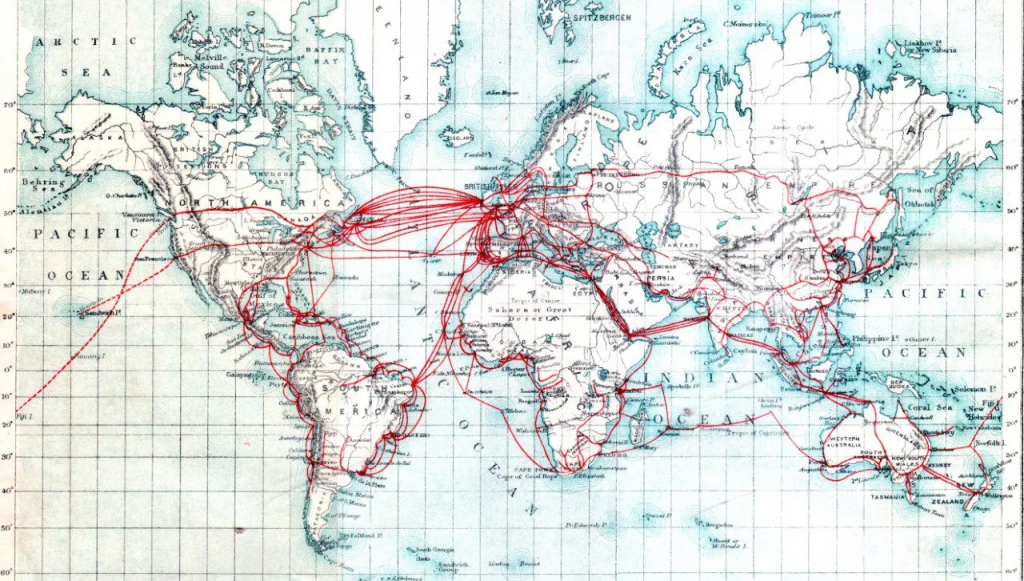
- The network connected different parts of the British Empire and helped Britain communicate quickly with its colonies.
- The network passed through British-controlled territories to avoid dependence on rival powers.
- Cables were drawn from the Strait of Gibraltar into the Mediterranean, routed through Malta and the Suez Canal, into the Red Sea, across the Indian Ocean to Bombay, and stretched as far as Hong Kong.
Major Vulnerabilities Associated with Undersea Cables
- Concentration of Infrastructure: Many submarine cables are concentrated along the same seabed routes, creating dangerous single points of failure.
- Difficulty in Repair Operations: Repairing damaged submarine cables requires specialised ships, technical expertise, and international coordination. Repair operations become difficult during military tensions or maritime conflicts.
- Legal and Regulatory Ambiguity: International legal frameworks regarding intentional cable disruption remain weak and ambiguous, especially in situations involving hybrid warfare or grey-zone conflicts.
India’s Undersea Cable Network
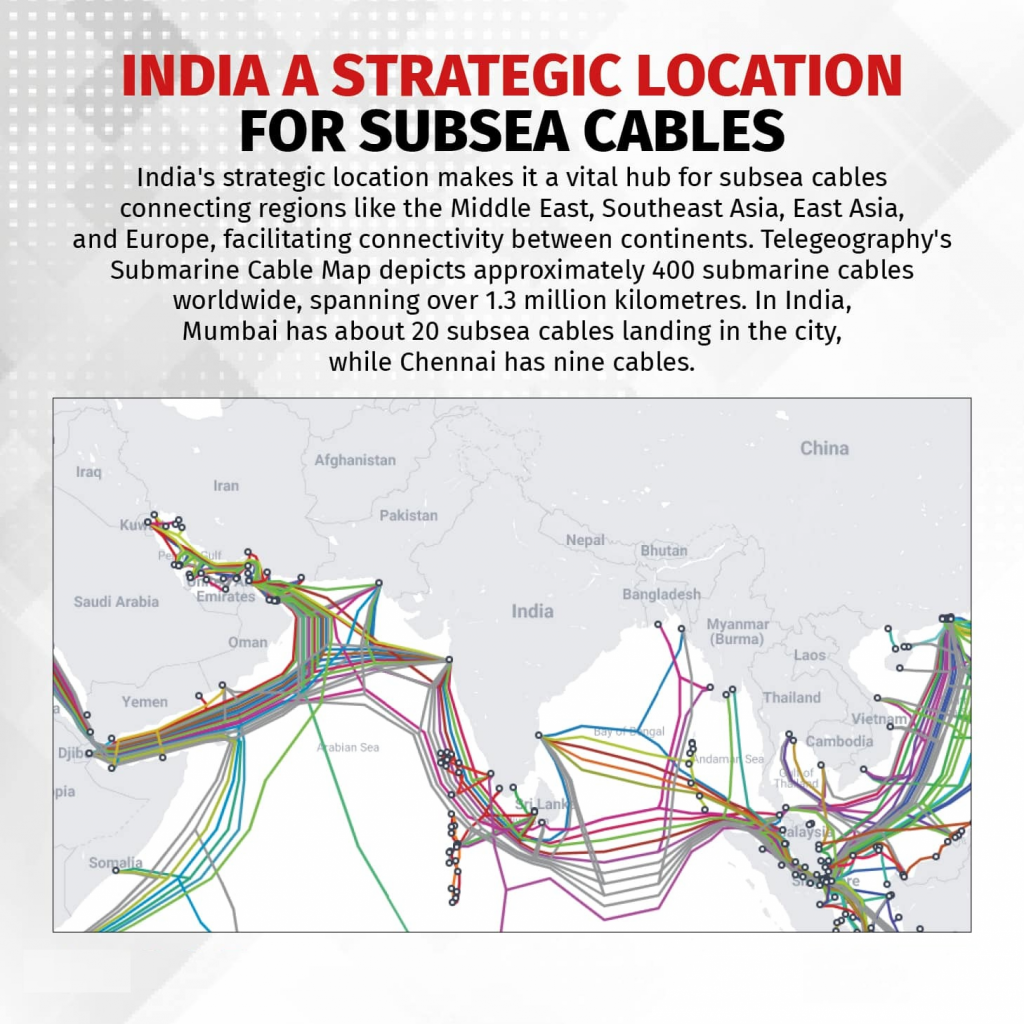
- India is a significant player in the global submarine cable network, with 17 international cables and 14 landing stations in cities like Mumbai and Chennai.
- As of the end of 2022, the total lit capacity and activated capacity of these cables stood at 138.606 Tbps and 111.111 Tbps, respectively.
- India is linked to global networks through several submarine cables, including SMW4 (South East Asia–Middle East–Western Europe 4) and IMEWE (India–Middle East–Western Europe).
India’s Undersea Cable Technological Deficiencies
- India lacks defined legal mechanisms to safeguard undersea cables within its territorial waters and Exclusive Economic Zone (EEZ).
- Unlike countries like Australia, which has “Cable Protection Zones” regulated under UNCLOS, India has yet to designate similar zones, leaving its cables vulnerable to both accidental and malicious damage.
- Operational Readiness: India lacks indigenous cable repair ships and relies on foreign vessels for maintenance. This absence significantly delays restoration following cable damage.
- Monitoring Shortfall: There is minimal undersea infrastructure for real-time surveillance of subsea cable networks, which further risks timely detection and response to disruptions.
International Advisory Body for Submarine Cable Resilience
- It was established by the International Telecommunication Union (ITU) in partnership with the International Cable Protection Committee (ICPC) in 2024.
- This initiative aims to strengthen the resilience of submarine cables.
- The Advisory Body will also provide strategic guidance to address challenges related to increasing traffic, aging infrastructure, and growing environmental threats to submarine cables.
International Cable Protection Committee (ICPC)
- ICPC, founded in 1958, is a global forum for governments and commercial entities involved in the submarine cable industry.
- Its primary mission is to enhance the security of undersea cables by providing a platform for exchanging technical, legal, and environmental information.
Previous article
CRED-Meta Deal of Fintech Sector
Next article
NEET-linked Suicides: A Case Study
