


Preah Vihear Temple
Syllabus: GS1/ Art & Culture
In News
- India has expressed concern over reports of damage to conservation facilities at the Preah Vihear temple complex.
About Preah Vihear Temple
- It is an ancient Hindu temple dedicated to Shiva located in Cambodia, near the border with Thailand.
- It was built mainly during the reigns of Khmer kings Suryavarman I and Suryavarman II (9th–12th centuries CE).
- It was declared a UNESCO World Heritage Site in 2008.
Source: TH
Pradhan Mantri Garib Kalyan Package
Syllabus: GS2/ Welfare Scheme
In News
- The Supreme court extends ₹50 Lakh Pradhan Mantri Garib Kalyan Package (PMGKY) insurance to all doctors who died on COVID.
About PMGKP Insurance Scheme
- Overview: The PMGKP Insurance Scheme is a specific component under the larger Pradhan Mantri Garib Kalyan Package, launched in March 2020.
- Coverage: Personal accident insurance cover of ₹50 lakh per eligible health worker.
- Risks Covered: Death due to COVID-19 infection.
- Accidental death while performing COVID-related duty.
Source: TH
National Makhana Board Holds First Meeting
Syllabus: GS3/Economy
In News
- A ₹476.03 crore Central Sector Scheme for holistic makhana development was rolled out during the National Makhana Board’s first meeting.
About
- The Union Government has established the National Makhana Board, fulfilling the announcement made in the Union Budget 2025—26.
- The establishment of the Board marked a major step toward strengthening and modernizing India’s Makhana sector.
- It is headquartered in Purnea, Bihar.
| Do you know? – Makhana, commonly known in English as fox nut, is the dried edible seed of the prickly water lily or gorgon plant (Euryale ferox). – This plant is found in freshwater ponds throughout South and East Asia. – It is recognized for its violet and white flowers, as well as its large, round, and prickly leaves, which can often exceed a meter in diameter. – The edible part of the Makhana plant consists of small, round seeds that have an outer layer ranging from black to brown. a. This has led to it being referred to as the ‘Black Diamond.’ – In 2022, ‘Mithila Makhana’ was conferred a Geographical Indication (GI) tag. – Makhana (Gorgon Nut or Foxnut) is an aquatic crop and is mainly grown in tropical and subtropical regions. |
Source :PIB
CoalSETU Policy
Syllabus: GS3/ Economy
In News
- The Union Cabinet has approved the CoalSETU Policy, which introduces a new system for coal linkage auctions aimed at improving transparency, efficiency, and flexibility in coal allocation for industrial use.
About CoalSETU Policy
- Overview: CoalSETU creates a new auction window under the existing Non-Regulated Sector (NRS) Linkage Auction Policy of 2016.
- Eligibility and Scope: Open to any domestic coal buyer (excluding traders); coking coal excluded; removes prior end-use restrictions for flexibility.
- Usage Restrictions: Coal for own consumption, export (up to 50% of quantity), coal washing, or other permitted purposes; domestic resale prohibited.
- Significance: Enhances transparency, ease of doing business, accelerates domestic coal utilization, reduces import dependence, and aligns with commercial mining reforms.
Source: PIB
International Fund for Agricultural Development (IFAD)
Syllabus: GS3/ Agriculture
In News
- India showcased its achievements in rural development, women’s empowerment and climate-resilient agriculture at the IFAD–India Day event held in Rome.
About International Fund for Agricultural Development
- Headquartered in Rome, Italy, IFAD functions as a UN specialized agency established in 1977 to combat rural poverty in developing nations through targeted financing.
- IFAD provides concessional loans, grants, and technical assistance primarily to smallholder farmers, pastoralists, and rural entrepreneurs, emphasizing agriculture, climate resilience, value-chain development, and livelihood diversification.
Source: PIB
Project Suncatcher
Syllabus: GS3/Science and Technology
Context
- Google CEO Sundar Pichai has announced Project Suncatcher, a long-term research initiative to deploy solar-powered data centres in space by 2027.
About
- Under this project, Google is exploring constellations of satellites hosting high-performance AI hardware, similar to Starlink’s satellite network but focused on space-based computing, not internet delivery.
- These satellites would run on solar energy, using free-space optical links to connect nodes and transfer data at terabit speeds. In space, solar panels can generate up to 8 times more energy than on Earth and almost continuously.
Why space?
- AI-driven data centres on Earth are consuming massive electricity and water. Their power demand could rise by 165% by 2030, worsening climate stress and remaining vulnerable to disasters and cable disruptions.
Source: IE
Supernova
Syllabus: GS3/ Science & Technology (Space)
Context
- Astronomers using the James Webb Space Telescope (JWST) have identified a rare supernova linked to a long gamma-ray burst, dating to about 730 million years after the Big Bang.
What is Supernova?
- Hydrostatic Equilibrium in a Star: A star survives because of a balance between;
- Gravity which is pulling matter inward and
- Nuclear Fusion, releasing energy outward by fusing hydrogen into helium, and later heavier elements.
- A supernova is a powerful and luminous stellar explosion, occurring when a star reaches the end of its life. This happens when a massive star’s core collapses under gravity after it runs out of nuclear fuel.
- This collapse triggers a shockwave that blasts the star’s outer layers into space, creating a supernova.
Types of Supernovae
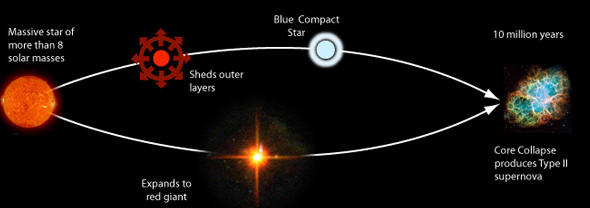
- Core-Collapse Supernova (Type II, Ib, Ic): These supernovae occur in massive stars that are at least eight times the mass of the Sun. When nuclear fusion stops, the core collapses and outer layers blast outward. It leaves behind;
- A neutron star (if mass is at least eight times as massive as the sun), or
- A black hole (if mass is at least 20 times that of the sun).
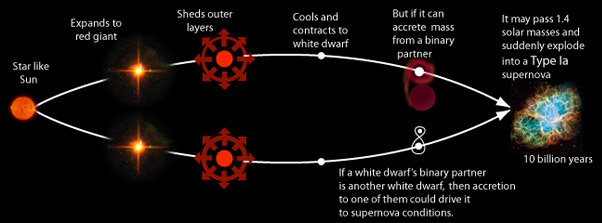
- Thermonuclear Supernova (Type Ia): It occurs in binary star systems where a white dwarf star accumulates matter from its companion.
- When the white dwarf exceeds the Chandrasekhar Limit of approximately 1.4 solar masses it leads to core compression and runaway nuclear fusion, resulting in a Type Ia supernova with no core remnant.
Source: MoneyControl
India’s Wildfire Management Resolution Adopted At UNEA-7
Syllabus: GS3/ Environment
Context
- India’s resolution titled “Strengthening the Global Management of Wildfires” was adopted at the 7th Session of the United Nations Environment Assembly (UNEA-7) held in Nairobi, Kenya.
About
- India drew attention to UNEP’s global report ‘Spreading Like Wildfire’, which warns that wildfires may rise by 14% by 2030, 30% by 2050 and 50% by 2100, if current trends continue.
- India emphasized a call for a shift from a reactive response to proactive prevention, through better planning, early-warning and timely risk reduction measures.
- The Global Fire Management Hub, established in 2023 by FAO and UNEP, was acknowledged as a key mechanism for supporting international efforts.
Key Provisions of India’s Resolution
- Strengthened International Cooperation
- Enhanced Regional and Global Collaboration
- Knowledge Sharing and Capacity Building
- Support for National and Regional Action Plans
- Facilitating Access to International Finance
Source: PIB
Previous article
India out of Pax Silica Initiative
Next article
Amendment of Insurance Laws Bill, 2025
