


Syllabus: GS2/ Governance, GS3/ Science and Technology
Context
- The rapid expansion of satellite megaconstellations, driven by soaring demand for high-speed connectivity, has intensified the global race for limited spectrum and orbital slots.
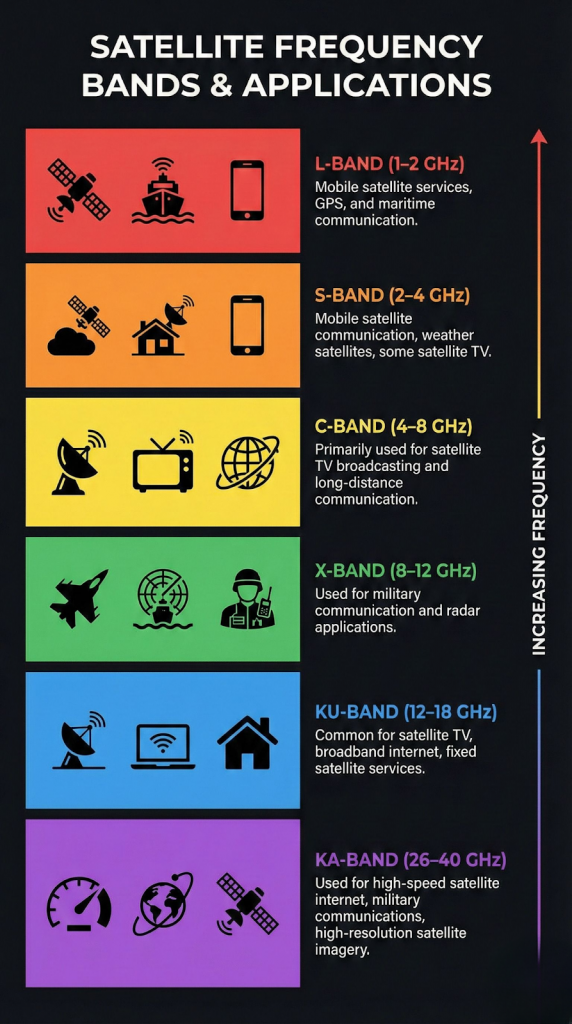
What is Satellite Spectrum?
- Satellite spectrum refers to the radio frequencies used for satellite communications.
- These frequencies enable satellite-based systems to transmit data and signals between satellites in orbit and ground stations.
- Unlike terrestrial spectrum, satellite spectrum operates without national territorial limits and is managed globally by the International Telecommunications Union (ITU).
- Satellite spectrum is divided into different frequency bands, each suited for specific types of communication
Spectrum allocation in India
- Spectrum for satcom is part of the first schedule of The Telecommunications Act, 2023 (“Assignment of spectrum through administrative process”).
- Under Section 4(4) of the Act, telecom spectrum shall be assigned through auction “except for entries listed in the First Schedule for which assignment shall be done by administrative process”.
- Administrative process under the Act means assignment of spectrum without holding an auction (a bid process for assignment of spectrum).
Fight for Spectrum in Space
- Spectrum Congestion: Ku, Ka, and L bands are in extremely high demand. Overlapping frequencies risk interference, reducing service quality and threatening critical functions such as GPS.
- Orbital Crowding and Debris: Over 40,000 tracked objects already orbit Earth, including 27,000+ pieces of debris larger than 10 cm.
- Projections show 50,000+ satellites may orbit by 2030, increasing collision risks and complicating scientific observations.
- The ITU’s first-come, first-served system favours well-resourced spacefaring nations and companies that can file early and manage complex coordination, leaving late entrants with fewer and less valuable spectrum–orbit options.
- Digital Divide and Affordability: LEO satellites offer low latency (20–40 ms), enabling telemedicine and online education.
- But affordability remains a challenge as Starlink terminal costs $600, unaffordable for most rural populations.
- The ITU estimates that bridging global digital gaps will require $2.6–2.8 trillion by 2030.
Consequences of the Unregulated Spectrum Race
- Technological Consequences: Increased interference reduces reliability of services such as remote sensing, GPS, and climate observation.
- Scientific astronomy faces disruptions due to bright satellite trails and radio noise.
- Economic Consequences: Early movers may establish monopolies in satellite broadband markets. Spectrum scarcity raises the cost of deployment for late entrants.
- Geopolitical Consequences: Unequal access to spectrum deepens the strategic divide between advanced and developing nations.
- Social Consequences: Without affordability reforms, satellite Internet may become premium infrastructure serving wealthy users, not underserved communities. This undermines its potential to reduce the global digital gap.
Reforms under World Radiocommunication Conference
- The World Radiocommunication Conference 2023 introduced key reforms through Resolution 8, requiring operators to report any deviation between planned and actual orbital deployments to prevent misuse of filings.
- It also set phased deployment benchmarks for megaconstellations, 10% within two years, 50% within five years, and full deployment within seven years, to ensure timely and accountable use of spectrum and orbital resources.
Way Ahead
- The spectrum–orbit race demands updated global governance to balance innovation with sustainability, ensuring transparent coordination, stronger debris mitigation, and equitable access.
- For emerging spacefaring nations like India, active participation in shaping these norms is crucial to keep outer space sustainable and inclusive.
| International Telecommunications Union (ITU) – The ITU is a specialised agency of the United Nations with 194 member states. – Founded in 1865 to facilitate international connectivity in communications networks, it serves as the sole global coordinator for satellite spectrum and orbital slots. a. India has been a member of ITU since 1869. – Functions: It allocates global radio spectrum and satellite orbits. a. It develops the technical standards that ensure networks and technologies seamlessly interconnect, and strive to improve access to ICTs to underserved communities worldwide. |
Source: TH
Previous article
Cabinet Approves India-Oman Free Trade Pact
