


Syllabus: GS3/Environment; Disaster Management
Context
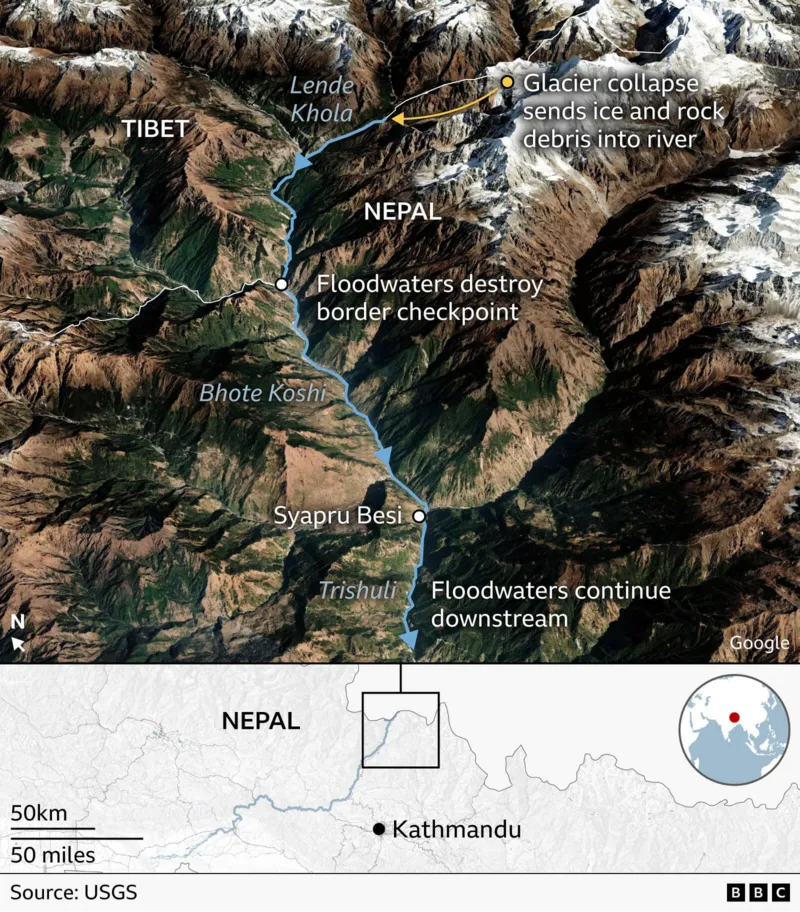
- Recently, a devastating flash flood in Nepal’s Bhotekoshi River system caused widespread destruction across Rasuwa, Nuwakot and Dhading.
- The affected Rasuwagadhi–Bhotekoshi–Trishuli corridor is strategically important because it connects Nepal with Tibet and carries substantial cross-border trade and pilgrimage traffic.
About Bhotekoshi Flash Flood and the Himalayan Flood Phenomenon
- Satellite observations indicate a complex interaction involving an ice avalanche, permafrost movement and rockslide.
- Scientists have described the triggering mass movement as a sturzstrom (a catastrophic rock avalanche capable of travelling rapidly over long distances).
- When rock mixes with ice, snow, frozen soil and water, friction and resistance may decline, allowing the mass to accelerate and transform downstream into a debris flow and flood.
- It is distinct from a conventional monsoon flood and illustrates why Himalayan disasters can have multiple interacting triggers.
Link with the Wider Himalayan Crisis
- The Himalayas are increasingly experiencing compound hazards: glacial lake outburst floods (GLOFs), landslides, avalanches, cloudbursts, debris flows and extreme rainfall.
- The Chamoli disaster in Uttarakhand (2021) similarly involved a massive rock-and-ice avalanche that transformed into a destructive debris flow.
- The Bhotekoshi event also follows earlier flood episodes in the same river system, demonstrating the vulnerability of Himalayan valleys to sudden high-altitude disturbances.
Key Reasons for Floods in Himalayan Regions
- Glacier & Permafrost Instability: Rising temperatures accelerate glacier retreat and thaw permafrost, weakening mountain slopes.
- Glacial Lake Outburst Floods (GLOFs): Rapidly expanding glacial lakes can breach their natural dams and release enormous volumes of water.
- Extreme precipitation: Climate change can intensify short-duration, high-intensity rainfall and cloudbursts.
- Steep topography: Large elevation gradients convert slope failures into high-velocity debris flows.
- Seismic and geological fragility: Young, tectonically active mountains are naturally prone to landslides and rockfalls.
- Unplanned infrastructure: Roads, hydropower projects and settlements can disturb unstable slopes and river channels.
- Transboundary river systems: Hazards originating in one country can rapidly affect downstream communities in another.
Impacts of Himalayan Floods
- Human and Economic Costs: Floods cause deaths, displacement, destruction of homes, agricultural losses and disruption of livelihoods.
- Remote mountain communities are particularly vulnerable because damaged roads and bridges can isolate them from relief.
- Infrastructure and Connectivity: Hydropower installations, roads, bridges and border trade infrastructure face severe risks.
- Damage to the Rasuwagadhi crossing can affect Nepal-China commerce and regional connectivity.
- Ecological Impacts: Floods and landslides accelerate soil erosion, destroy habitats and destabilise river ecosystems.
- Repeated disturbances can reduce the resilience of fragile mountain ecosystems.
- Strategic and Regional Implications: Because Himalayan rivers cross national boundaries, disaster management requires India-Nepal-China cooperation, particularly for information sharing, satellite monitoring and downstream warnings.
Efforts and Initiatives: Global and Indian
- India has progressively strengthened its disaster-management architecture through the Disaster Management Act, 2005, NDMA, National Disaster Response Force (NDRF) and Central Water Commission (CWC) flood forecasting mechanisms.
- Important measures include:
- Early Warning Systems (EWS) and real-time hydrometeorological monitoring.
- GLOF risk assessment and glacial-lake monitoring.
- InSAR and satellite-based landslide surveillance.
- Hazard zonation and climate-resilient infrastructure.
- Community-based disaster preparedness and evacuation drills.
- Improved coordination between IMD, CWC, ISRO, NDMA and state authorities.
- At the international level, the Sendai Framework for Disaster Risk Reduction (2015–2030) promotes understanding disaster risk, strengthening governance, investing in resilience and improving preparedness.
- The UN Early Warnings for All initiative seeks universal access to effective early-warning systems, while the World Bank supports disaster-risk financing, resilient infrastructure and climate adaptation in vulnerable countries.
- The World Bank and International Finance Corporation (IFC) reports show that investing in climate resilience delivers high returns, typically yielding $4 to up to $8.60 in protected value or net benefits for every $1 invested.
Flood-Resilient, Sustainable Himalayas
- Climate change should not automatically be treated as the sole cause of every Himalayan disaster.
- In the Bhotekoshi case, scientists have identified several interacting geological and climatic factors.
- The Bhotekoshi tragedy highlights a crucial limitation: an early warning is useful only when there is sufficient time to act.
- Extremely rapid events such as sturzstroms can overwhelm conventional warning systems.
Way Forward
- A sustainable Himalayan strategy should therefore focus on:
- Multi-hazard early-warning systems, rather than flood-only systems.
- Continuous monitoring of glaciers, glacial lakes, permafrost and unstable slopes.
- Risk-sensitive land-use planning and prohibition of construction in high-risk zones.
- Climate-resilient roads, bridges and hydropower infrastructure.
- Restoration of mountain wetlands, forests and natural drainage systems.
- Stronger transboundary data sharing among Himalayan countries.
- Local communities as the first responders through training and evacuation planning.
- Greater emphasis on disaster prevention and risk reduction, rather than post-disaster relief alone.
Conclusion
- The Bhotekoshi flash flood is a reminder that the Himalayan disaster landscape is evolving from predictable seasonal flooding towards complex, compound and potentially extremely rapid hazards.
- The goal should not merely be to rebuild what has been destroyed, but to determine where rebuilding is safe and sustainable.
- A flood-resilient Himalayas will require the integration of geology, glaciology, climate science, technology, ecological conservation and regional cooperation.
| Daily Mains Practice Question [Q] Discuss the geological, climatic and anthropogenic factors behind Himalayan floods. Examine their implications for India and other Himalayan countries, and suggest measures for building a flood-resilient and sustainable Himalayas. |
Previous article
A History of Learning in R&D: Beyond Expenditure
