


Syllabus: GS3/Economy
Context
- NITI Aayog has released the report titled “Deepening the Corporate Bond Market in India”.
About
- The report examines the current state, challenges, and future roadmap for strengthening India’s corporate bond market—a key financing avenue for corporations, infrastructure, MSMEs, and emerging sectors.
- A deep and liquid corporate bond market helps mobilise long-term capital, reducing over-reliance on bank credit and supporting economic growth.
- It is critical for financing infrastructure, climate actions, MSMEs, and emerging sectors aligned with Viksit Bharat 2047 goals.
What is a Corporate Bond?
- Corporate bonds are debt securities issued by private and public corporations.
- Companies issue corporate bonds to raise money for a variety of purposes, such as building a new plant, purchasing equipment, or growing the business.
- When one buys a corporate bond, one lends money to the “issuer,” the company that issued the bond.
- In exchange, the company promises to return the money, also known as “principal,” on a specified maturity date. Until that date, the company usually pays you a stated rate of interest, generally semiannually.
- While a corporate bond gives an IOU (I owe you) from the company, it does not have an ownership interest in the issuing company, unlike when one purchases the company’s equity stock.
Major Highlights of the Report
- Growth and Current Status: Outstanding corporate bonds rose from ₹17.5 trillion (FY2015) to ₹53.6 trillion (FY2025), growing at ~12% annually.
- Market size is 15–16% of GDP, improved but still below peers like South Korea, Malaysia and China.
- Corporate bond fundraising is now approaching bank credit levels, signalling a gradual shift to market-based financing.
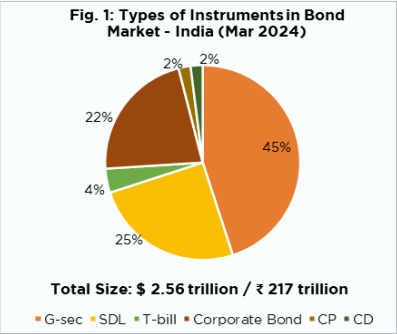
- Strategic Importance: A deep corporate bond market is indispensable for a $30 trillion economy by 2047, enabling mobilisation of long-term, low-cost capital for infrastructure, industry, climate action and emerging sectors.
- It complements banks, reduces systemic concentration risks, strengthens monetary transmission, and supports a resilient financial architecture.
- The report forecasts that India’s corporate bond market has the potential to exceed ₹100–120 trillion by 2030 (approximately $1.3–1.4 trillion), provided deeper structural reforms and institutional capacity-building are undertaken.
- Equity vs. Bond Market Imbalance: India’ s equity market is valued at USD 4.8 trillion while the bond market is valued at USD 642 billion.
- Equity markets are nearly 7 times larger than bond markets, indicating significant imbalance
- Structural Limitations:
- Issuer concentration: Dominated by top-rated corporates; limited MSME participation.
- Investor concentration: Heavy reliance on institutional investors; low retail and FPI participation.
- Market structure: Private placements dominate; secondary market liquidity is shallow.
- Regulatory frictions: Overlapping regulators, high compliance costs, procedural delays.
- Investment constraints: Insurance and pension funds face limits on lower-rated securities.
- Weak enablers: Inefficient debt recovery, tax asymmetries, high transaction costs.
- Economic Benefits of a Deep Bond Market:
- Channels institutional and household savings into productive investment.
- Supports development of risk management tools.
- Provides stable financing for infrastructure, green transition, MSMEs and innovation-led sectors.
- Global Experience & Lessons: Countries like US, South Korea, Singapore and Thailand show success through:
- coherent and unified regulation;
- strong market infrastructure;
- active market-making and deep secondary markets;
- streamlined disclosures and credit enhancement mechanisms.
- These features enhance liquidity, investor diversity and financing depth.
Reforms Undertaken in India
- SEBI: SEBI has introduced electronic trading through the Request for Quote (RFQ) platform, facilitated retail access through online bond platforms, strengthened governance standards for credit rating agencies and debenture trustees, and simplified issuance norms.
- RBI: The RBI has enhanced settlement architecture, introduced tri-party repos and credit default swaps, and supported the development of repo and clearing mechanisms.
- Government: Additionally, the Government has promoted Infrastructure Investment Trusts (InvITs), Real Estate Investment Trusts (REITs), and green finance initiatives to encourage long-term investment and deepen capital markets.
- Collectively, these reforms have laid a strong foundation for a more transparent, accessible, and technology-driven bond market ecosystem.
Reform Roadmap (Phased Approach)
- Short-term priorities: Streamline regulations and improve inter-regulatory coordination.
- Strengthen market infrastructure and digital access.
- Simplify issuance for wider issuer participation.
- Build confidence via quick wins and early liquidity improvements.
- Medium to Long-term priorities: Unified regulatory architecture and stronger resolution mechanisms.
- Deeper secondary markets with active market-making and repo facilities.
- Broader issuer base (mid-sized firms, new asset classes).
- Product innovation: long-tenor bonds, credit-enhanced instruments, sustainability-linked bonds.
- Expand investor base (insurance, pension, retail, FPIs).
- Leverage digital innovations (tokenised bonds, integrated data platforms).
Source: PIB
Previous article
New Fight for Spectrum in Space
Next article
India out of Pax Silica Initiative
