


Syllabus: GS3/ Energy
Context
- The Union Cabinet has approved the Atomic Energy Bill, 2025, titled SHANTI (Sustainable Harnessing of Advancement of Nuclear Technology for India).
- The Bill seeks to create a unified and modern legal framework for India’s nuclear sector.
About
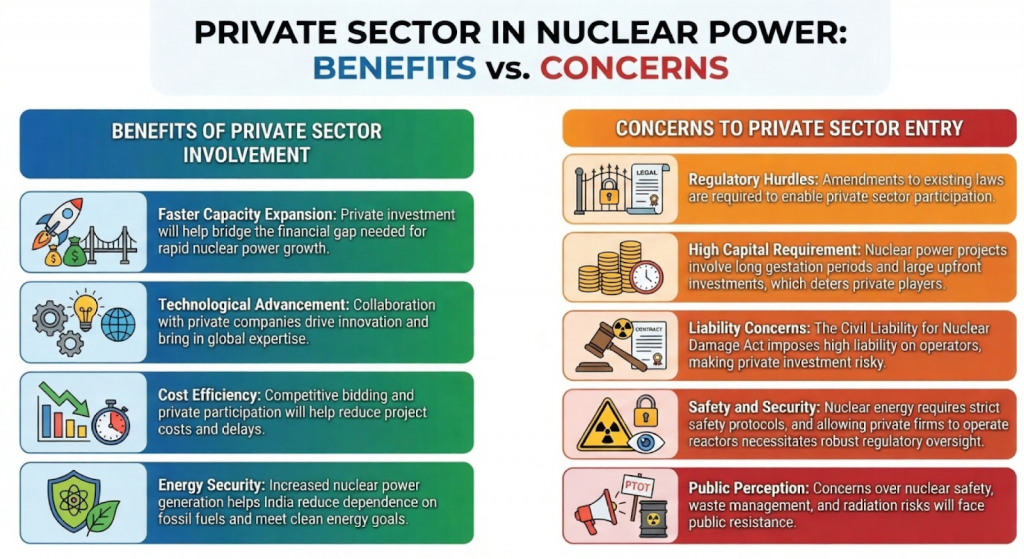
- Traditionally, nuclear power plants in India have been owned and operated only by state-owned Nuclear Power Corporation of India Ltd (NPCIL) and its fully-owned subsidiary Bharatiya Nabhikiya Vidyut Nigam (BHAVINI).
- To allow private sector participation government has to amend key legislations;
- Atomic Energy Act, 1962, a framework for nuclear energy development and regulation.
- Civil Liability for Nuclear Damage Act, 2010, ensuring compensation mechanisms for nuclear incidents.
Key Provisions of the Bill
- Partial Opening of the Nuclear Value Chain: The Bill allows private and global companies to participate in atomic mineral exploration, nuclear fuel fabrication and manufacturing of nuclear equipment and components.
- Core and strategic areas such as reactor operation and weapons-related activities will continue to remain under government control.
- Revamp of the Nuclear Liability Regime: The Bill proposes a redesigned liability framework to address long-standing investor concerns by;
- Clearly defining liability responsibilities among operators, suppliers, and the government.
- Introducing insurance-backed liability caps to limit financial uncertainty.
- Providing government support beyond a fixed liability threshold.
- Nuclear Safety Authority: The legislation proposes the establishment of an independent nuclear safety authority.
- This body will strengthen regulatory oversight, separate safety regulation from promotional roles, and enhance credibility and transparency.
- Dedicated Nuclear Tribunal: It calls for a dedicated tribunal to handle nuclear-related disputes, intended to streamline resolution and enhance transparency in the sector.
Strategic Rationale Behind the Reform
- India has set an ambitious target of 100 GW of nuclear power capacity by 2047. Achieving this goal requires large-scale capital infusion, advanced reactor technologies and Faster project execution.
- Energy Transition: Nuclear power provides clean, reliable baseload energy, complementing intermittent renewables.
- It supports India’s commitments under climate agreements by reducing dependence on fossil fuels.
- Enhancing Energy Security: Diversifying energy sources through nuclear power reduces vulnerability to fuel imports and geopolitical shocks.
Way Ahead
- Clear Regulatory Framework: Establish a robust regulatory environment to ensure safety, compliance, and transparency, addressing concerns about accountability and national security.
- Public-Private Partnerships (PPPs): Promote partnerships where the government maintains oversight, while private players handle operations, innovation, and investment, ensuring a balance of interests.
- Gradual Implementation: Start with pilot projects and small-scale initiatives to test private sector involvement, ensuring risk management before large-scale implementation.
Source: TH
Previous article
News In Short 12-12-2025
Next article
Cabinet Approves India-Oman Free Trade Pact
