


Syllabus: GS2/ Health/ Governance
Context
- Union Minister of Health and Family Welfare, launched the SUMAN Roadmap 2030 to strengthen maternal and newborn healthcare.
About SUMAN Roadmap 2030
- The SUMAN Roadmap 2030 has been designed as a comprehensive national strategy to accelerate progress toward the Sustainable Development Goals (SDGs) by 2030 related to maternal and newborn health.
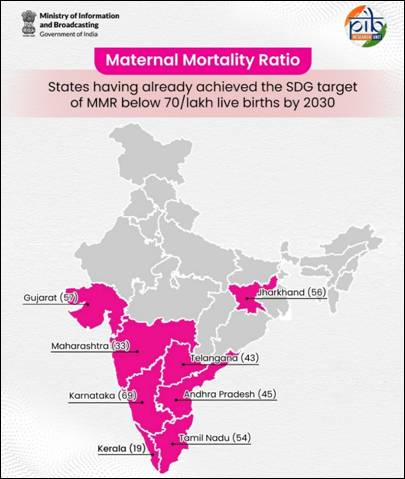
- The framework seeks to reduce the Maternal Mortality Ratio (MMR) to below 70 per 100,000 live births by 2030, while also lowering neonatal and infant mortality rates and advancing the goal of zero preventable maternal and newborn deaths.
- It focuses on 130 districts across 13 high-focus states, including Uttar Pradesh, Bihar, Madhya Pradesh, Rajasthan, Odisha, Assam and West Bengal.
What is Maternal Mortality?
- Maternal death is the death of a woman while pregnant or within 42 days of termination of pregnancy, irrespective of the duration and site of the pregnancy, from any cause related to or aggravated by the pregnancy or its management but not from accidental or incidental causes.
- Maternal Mortality Ratio (MMR) is the number of maternal deaths per 1,00,000 live births.
- Maternal Mortality Rate: This is calculated as maternal deaths to women in the ages 15-49 per lakh of women in that age group, reported under SRS.
- The Sustainable Development Goal (SDG) 3.1 targets reducing the global maternal mortality ratio to less than 70 per 1,00,000 live births by 2030.
Governmesnt Initiatives to Reduce MMR
- Janani Suraksha Yojana (JSY): Launched in 2005 with the objective of reducing maternal and neonatal mortality, JSY promotes institutional delivery among pregnant women especially with weak socio-economic status.
- Pradhan Mantri Matru Vandana Yojana (PMMVY), is a maternity benefit program run by the Ministry of Women and Child Development, Government of India.
- The maternity benefit, of Rs. 5000/-, is available to a woman for the first living child of the family subject to fulfilment of conditionalities.
- Further under ‘Mission Shakti’, the scheme (PMMVY 2.0) provides additional cash incentive for the second child, if that is a girl child.
- Pradhan Mantri Surakshit Matritva Abhiyan (PMSMA): Launched in 2016, PMSMA provides pregnant women a fixed day, free of cost assured and quality Antenatal Care on the 9th day of every month.
- LaQshya: Launched in 2017, LaQshya aims to improve the quality of care in labour room and maternity operation theatres to ensure the quality care during delivery and immediate post-partum.
- Capacity building is taken-up for MBBS doctors in Anesthesia (LSAS) and Obstetric Care including C-section (EmOC) skills to overcome the shortage of specialists in these disciplines, particularly in rural areas.
- Maternal Death Surveillance Review (MDSR) is implemented both at facilities and at the community level. The purpose is to take corrective action at appropriate levels and improve the quality of obstetric care.
- Monthly Village Health, Sanitation and Nutrition Day (VHSND) is an outreach activity for provision of maternal and child care including nutrition.
- Reproductive and child health (RCH) portal is a name-based web-enabled tracking of pregnant women and new-born to ensure provision of regular and complete services to them including antenatal care, institutional delivery and post-natal care.
Innovations in Maternal Healthcare
- Madhya Pradesh’s ‘Dastak Abhiyan’: A community-driven campaign that focuses on early detection of maternal health risks and ensures timely medical intervention.
- Tamil Nadu’s Emergency Obstetric Care Model: A robust referral system that ensures pregnant women receive timely emergency care, reducing maternal complications.
Challenges Still Faced in India
- High Out-of-Pocket Expenses (OOPE): Despite policy efforts, families often bear the cost of diagnostics, medicines, and private services during emergencies.
- Sociocultural Barriers: Gender dynamics, low education levels, restricted decision-making power among women, and stigma around maternal care all delay early care-seeking.
- Rise in High-Risk Pregnancies: Trends such as delayed childbirth, obesity, hypertension, diabetes, and short inter-pregnancy intervals contribute to riskier pregnancies.
- Weak Infrastructure in Remote Areas: Rural, tribal, and hilly regions lack emergency obstetric care, reliable transport, and blood storage facilities.
About Child Mortality
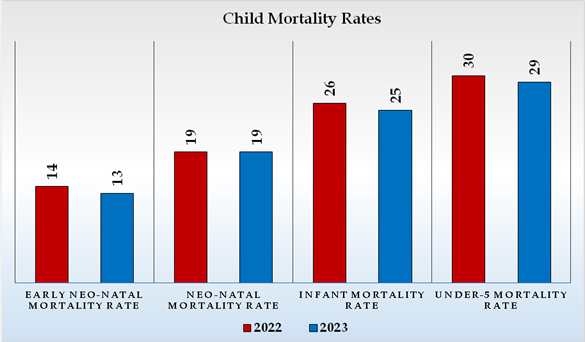
- Early Neonatal Mortality Rate (ENMR): It is the number of deaths of live-born infants during the first seven days of life per 1,000 live births in a given year.
- Neonatal Mortality Rate (NMR): It is the number of deaths of live-born infants during the first 28 completed days of life per 1,000 live births in a given year.
- Infant Mortality Rate: The Infant Mortality Rate (IMR) is the number of deaths of children under one year of age per 1,000 live births in a given year.
- Under-Five Mortality Rate (U5MR): It is the number of deaths of children before reaching five years of age per 1,000 live births in a given year.
Way Ahead
- India has made significant progress in reducing maternal mortality, successfully achieving the National Health Policy (NHP) target of an MMR below 100 by 2020.
- However, continued efforts are required to reach the SDG target of MMR by 2030.
- Strengthening healthcare infrastructure, expanding maternal health programs, and addressing socioeconomic barriers will be critical in further reducing maternal mortality in the country.
Source: PIB
Previous article
Flamingo Revolution
